
Mega-corporations Occupying Communities, Tourist Enclaves — Community Art Distance Learning (Part 3)
"Every historical period has a dominant culture." So said the German philosopher Hegel.
Community art once flourished for a period due to a huge influx of funding. Now, with government funding for artists withdrawing, an era dominated by large corporations has arrived. In just a few years, memories are once again updated before they can even be fully recorded.
Macau's old districts have been designated to become leisure destinations for tourists. In 2024, the government demarcated six areas across different parts of the city, naming them "zones." These included old streets, historical landmarks, and idle spaces. The six major gaming corporations, known for operating entertainment resorts, were tasked with this hot potato, using revitalization as a pretext for repurposing. They are replacing original community uses with entertainment and tourism elements, making this a prerequisite for continuing to operate casinos in Macau. While ostensibly government-led, it essentially requires gaming corporations to invest and strategize to boost foot traffic in these six areas.

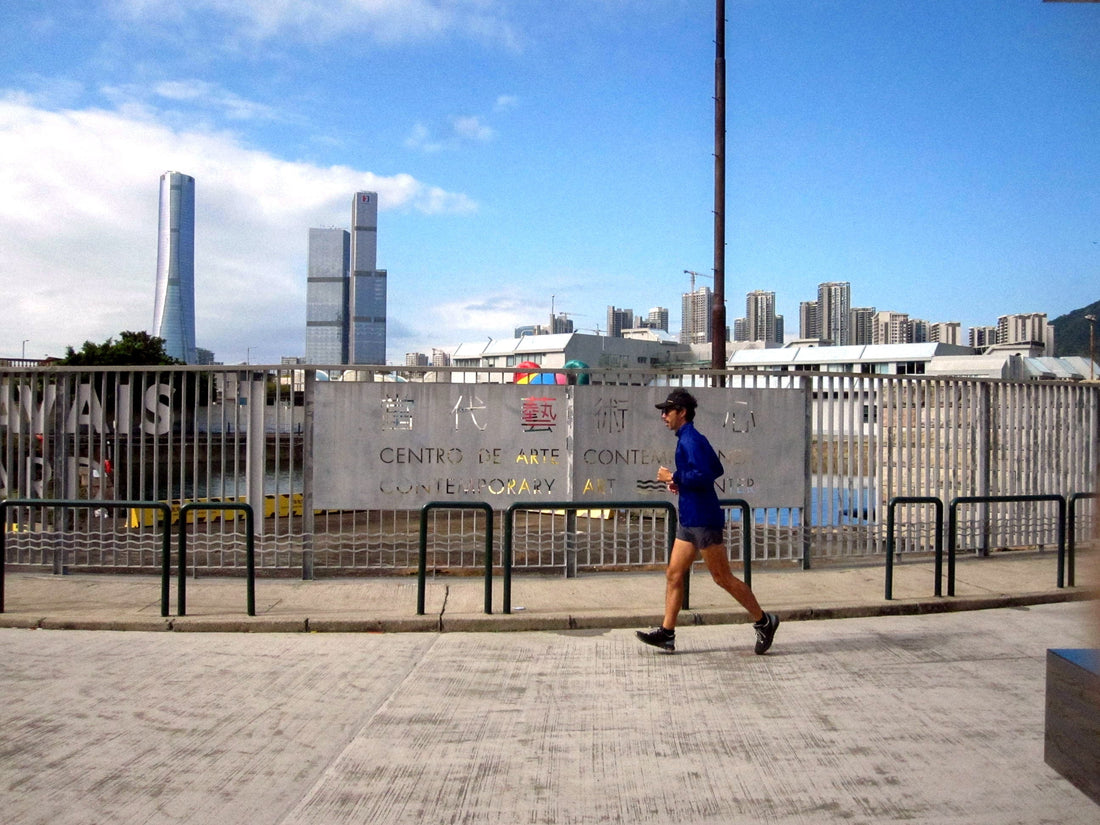
The entire waterfront space around Barra do Lago remains unused.

The Marine Workshop before it was covered by display boards.
It's not to say the government hasn't tried, but it has long been criticized for its handling of regional cultural affairs, always having the will but not the means. This time, by directly providing space and having corporations fund it, they break free from the heavy burden of "government-business" collaboration. Unlike a typical outsourcing system, it aims to directly apply the successful experience of operating entertainment businesses to the very places where we live. While gaming corporations excel at operating businesses in enclosed, risk-free new towns, it remains to be seen whether this experience can translate to organic, open spaces. What is certain, however, is that if a place has the potential to be seen, its elements must be leveraged to the fullest.
MGM was the first to write a chapter unrelated to the shipyards in Barra do Lago, attracting festive visitors with pop culture installations, dai pai dongs, and exquisite exhibitions. On the same street, none of these refer to Barra Village, the shipyard's engine room, or the office named after Carlos I. Rua da Felicidade was once a famous red-light district, but prostitutes and opium dens have long vanished like smoke, leaving only a street of blue-brick buildings. Wynn has drilled into the walls of historical buildings, hanging decorations that pass through red doors and windows. After becoming a pedestrian zone, it did not improve business for the merchants as expected, causing even those who initially trusted the system to openly express dissatisfaction, collectively posting notices hoping the street would return to its former appearance. A street away, SJM occupies the bustling Avenida de Almeida Ribeiro. The cultural and opera center has been converted into a food center, offering hand-shaken beverages and rich shark fin noodle soup. The government has also cleverly cooperated with land concessions, and the "Macau Palace," once dubbed the "pirate ship" floating casino, will also re-establish itself in the Inner Harbor. If leisure and entertainment transformation is already irreversible, then Walter Benjamin's important study, "The Arcades Project," serves as a reference. It maximizes viewing based on everyday life, by adding roofs to 19th-century Parisian streets and transforming them into pleasant shopping spaces, the precursor to modern shopping malls. It turns consumption into an entertainment experience while providing visually pleasing scenes, using glass, steel, and other structures as walls to separate from nature, exuding a strange allure.

Rua da Felicidade has long been illuminated by decorative lights, and the original shops on the street have almost disappeared.

The place where neighbors used to gather and play chess has been converted into a snack shop.
Streets, lanes, and alleys, scattered in the winding corners of the old city, cluttered and decaying, require more careful handling than other idle urban elements. One misstep and shared memories could slip away like mercury. Sands has performed "facelifts" in areas like Rua da Palha and Fong Wa Lei, borrowing elements and rebuilding identical houses after dismantling the original streets. Many scholars apply Foucault's "heterotopia" to describe these illusory real spaces, where the eradication of original characteristic communities and the urban reconstruction of "heterogeneous places" are already common controversies. While old shops are closing down, millions are being invested to support young people starting businesses in Rua da Palha, an ambiguous approach. The contradiction between these two identities makes one wish that the Iec Long Firecracker Factory could remain idle. We can no longer see authenticity. Melco Resorts is doing similar things simultaneously, arranging similar "homework" within the Monte Fort Garden area. Post-processed territorial expansion replaces genuinely desired places to visit, involving appropriation, juxtaposition, and suspension, with no interaction in the environment. We are entering a transient "structure of feeling." After the荔枝碗船廠 (Lai Chi Vun Shipyards) were cleared, Galaxy Entertainment seemed unrestrained by this vast space. After multiple renovations, it has become a laboratory for a postmodern theme park, making Macau's coexistence with the ocean seem insignificant. Shipyards no longer host vessels, and craftsmanship is experienced through a small corner of text and images on display boards. Fiction and reality become complex and indistinguishable, and visitors submissively claim to have seen an imagined city.

Kam Pek used to be a cultural and opera center, now converted into a food center.

The empty space of the shipyard warehouse next to Barra do Lago has been occupied by eateries.
It's hard not to feel a false impression: is Macao's only choice to become a mere showcase? So-called revitalization, it turns out, means trying to ignore "me." Once the desires of the observer are known, there is no room for negotiation. Visitors are fooled with propaganda and illusory techniques, living a style of life on ruins and debris that bears no resemblance to reality. The aforementioned places, after flourishing, did decline due to population and industry migration for various reasons. In Japan, Ryo Yamazaki's "community design" emerged as an intervention point, not relying on corporate integration but rather rebuilding regional relationship networks, not rigidly transforming spaces into other functions, but allowing urban life to naturally unfold within the community. Meanwhile, "gentrification" is a warning sign, referring to specific communities developed to serve new middle-class residents. Simon Parker's "Meet the City" cites scholars who refer to this group as "cosmocrats" (or "global citizens/new class citizens"), who use resources and special consumption patterns to marginalize local areas, turning them into their urban sky castles. In Macao, where everyone is middle class, tourists act as this entire group, merging into "cosmocrat tourists." All urban culture under festivalization is catering to these buyers, who do not need our usual community services, but rather seek to satisfy their curiosity and desire for entertainment.
The "zones" will eventually become six "enclaves" established without being influenced by the supply and demand relationship of the community. Just a street away, they are colonized by tourism, old buildings are restored but not understood, becoming popular landscapes, space is commodified, and residents in Macau's mixed commercial and residential model are filled with hostility.
Yet, they all claim this is for Macau.
-