A Delicate Child's Perspective: Eva Lindström's Picture Books, Winner of the Astrid Lindgren Memorial Award
Eva Lindström is a picture book author I really admire. I had been meaning to write a recommendation for her but hadn't gotten around to it until my child requested to read "My Tear Jam" (Text and Illustrations: Eva Lindström, Publisher: Little Wheat Field) for over a month. It was then that I slowly began to understand the author's brilliance — which is, in essence, her utmost sincerity.

The story reads quite plainly, without the clear narrative arc of traditional stories (could this be why Eva's books haven't sold particularly well in Macau?). It's just about a lonely child, Frank, watching three other children play, going home to make tear jam, and finally hosting a tea party and inviting the three children. Because my five-year-old daughter never tired of listening to it, I repeatedly reread it. Through conversations with my child, I slowly began to understand more.
That's right, this is a book about emotions. Lonely Frank watches other children play together every day and cries because he's sad. Yet, Eva's text never uses words like "sad" or "lonely"; at most, it describes a state of "aloneness." Frank's feelings are expressed with phrases like "They're over there again. What's so fun about it?" — language that children can easily understand. No wonder after a few days, my younger daughter wanted to narrate these pages herself, because every sentence was something she could comprehend.

After Frank returns home, he starts making "tear jam." As an adult, when I first read this part, I vaguely felt that the author didn't want to interpret "crying" negatively; it was probably about "the beauty of crying." However, my younger daughter's reaction to this part was only concern for the recipe: would the tears make the jam too salty? It suddenly dawned on me that this is actually the "turning point" of the story. From previously using "sour grapes" ways to alleviate emotions, like "What's so fun about it?", he admits his sadness and transforms it into positive action – making jam.

This leads to the seemingly wonderful outcome in the book, where everyone accepts the invitation to the tea party. The last page shows a scene of messy cups and plates, an empty house. Every time we get here, I ask my younger daughter, "Where did they go?" Sometimes she replies, "They went out to play." Other times, she points to a toaster in the picture, "They went into the toaster"—and indeed, there seem to be two human legs there! Although it gives me, her mom, a slight chill, I don't negate any of her answers. After all, I also feel that the author doesn't intend for Frank to suddenly gain friends, as in typical stories. Instead, the ending is left relatively open, because in our lives, change is not always that easy.
Later, my younger daughter told me, "I also like playing by myself." I was proud of her for expressing her true feelings and not viewing playing alone negatively. The magic of tear jam lies in writing with utmost sincerity for children.
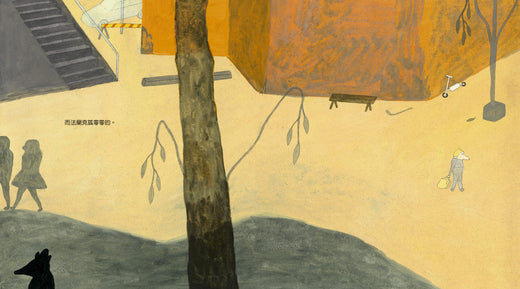
Besides this latest work translated into Chinese, readers of Jingjing should already be familiar with Eva Lindström's works in the picture book series from Hong Kong's Cotton Tree Publishing, such as "The Missing Hat" and "The Runaway Lamb." "The Runaway Lamb" tells the story of a lamb tired of its ordinary life, who escapes the pasture and hides in a marten's house, only to discover that whether it runs away or stays, the problems remain the same. It reminds me of a time when I ran away from home as a child, climbed over a mountain, and, anxious about wild beasts and bad people, arrived at my grandmother's house far away. Looking back, it remains a precious adventure in my growth. "The Missing Hat," on the other hand, is about a hat that disappears during a magic show performed by Little G's dad at a gathering. Several children search for it in the apartment building, and eventually, the hat humorously reappears, alleviating the anxiety of something lost. Each story is so "ordinary" yet "extraordinary," meticulously portraying children's inner emotions, making them worth reading again and again.


Let's conclude this piece by borrowing words from the Astrid Lindgren Memorial Award website introducing the 2022 laureate, Eva Lindström: "The moods and emotions she depicts in words and images can be as relevant to big life questions as to events in children's everyday lives. Her uncompromising, boundary-crossing style enables her to reach far beyond the picture book target group."
-