"Where did you all go, suddenly departing from this world?"
I want to mourn you in the city, but the city changes too quickly. All traces of your visit have been erased without a trace: the park we went to is now fenced off, the building we once stayed in has been rebuilt, and the mall and shops where I bought you ice cream at that small store have closed. I can't understand why it's so incredibly difficult to miss you in this place we once called "home."
To ascend to heaven... I don't even know where you went.
"Where are you?" "How are you?" But memories remain silent. Recently, my mother told me that in that year, she was Fongzi, and she also lost a good friend, Jiuer. She knew that Jiuer was later in a place called "ignorance." It is a place, it is not a place, it is ubiquitous. Fongzi said it was a kind of "confinement," but I didn't believe it.
Chihiro Iwasaki has a picture book titled "Jiuer's Star."
Jiuer in that book was a kind girl, often getting herself hurt to help other children. One day, the village river overflowed, and little Aji, soaking wet, stood on the bank, crying out, "Jiuer! Jiuer!" Aji's parents were so angry that they went to Jiuer's house to confront her. Unexpectedly, as night fell, Jiuer still hadn't returned. After the adults questioned them, everyone suddenly realized that Jiuer had fallen into the river and drowned while saving Aji, who had fallen in. That night, a green star rose from the river, and the villagers all called it "Jiuer's Star."

"Jiuer's Star" (Author: Ryusuke Saito. Illustrator: Chihiro Iwasaki. Chinese edition: Hsin-Yi Publications)
Fongzi said that when she "saw" Jiuer again, Jiuer was surrounded by endless stars. She asked Jiuer, "Do you live in the stars?" Jiuer said, "I live in your heart. Thank you for always remembering me. When you remember, I exist." I know you are there too. My sister said she couldn't accept the religious说法 that you would be punished for ending your own life, saying that you hurt your parents and that you should go to hell. She couldn't accept that you would continue to suffer the unfinished pains of the human world in "confinement." Hearing Fongzi's explanation, we suddenly realized, "'Ignorance' is the soul's 'VIP room'."
As Fongzi recounted everything she saw, I couldn't help but think of Kenji Miyazawa's "Night on the Galactic Railroad," where a group of children take a train bound for the stars of the Milky Way, but when they return, their friend Campanella (カムパネルラ) is left behind. In reality, Campanella had died. I feel that Kenji Miyazawa and Fongzi both experienced a deep sorrow, as witnesses to death, carrying that pain forward in their lives. "Night on the Galactic Railroad" was published very late, just like Fongzi, who only slowly recounted Jiuer's "ignorance" and "stars" after she became an adult and her children had grown white hair. We can even consider it an unfinished work by Kenji Miyazawa. At this moment, I am reading Kenji Miyazawa's question: "Where exactly are you?"

The cover of IHATOVO・01. "Ihatovo" is a fictional utopia created by Junaida for Kenji Miyazawa, with selections from Miyazawa's poetry and fairy tales.
Or perhaps I will live on as a survivor of suicide. But there are many ways to move forward.
In a bookstore, there's a graphic novel called "Paysage après la bataille." The first scene shows a woman with a suitcase. If not for the text on the dust jacket, following the visual clues, we would gradually uncover the whole story. Staring blankly at the artwork: amidst the chaos of war, dismembered limbs and armor are scattered everywhere. There's a rabbit in this painting; will it manage to escape?
The entire book tells of the pain of those left behind by death: the protagonist's eight-year-old daughter is hit by a car while cycling on an ordinary day and dies. Losing her takes only a minute.
Body, pillow, cobblestones. Hairdryer, gun barrel, hose, teardrops. The fallen horse symbolizes the shattered iron horse. The memory of the body and the rabbit's corpse. We follow the mother's path, escaping with immense solitude to an unnamed distant place. It's a good book, thick pages, light brushstrokes, extremely satisfying to read. Not only were you shattered and dismembered, but the departure of a loved one also shattered us (me and the mother).
Carrying a profound sense of emptiness, there are times when there's a feeling of not being present. Yet, the black bird in the painting becomes an anchor: it is death, a listener, and finally, the power that can lead us to the magnificent scenery of life.

"Paysage après la bataille" (A Belgian work by Éric LAMBE + Philippe DE PIERPONT) Winner of the 2017 Angoulême International Comics Festival Best Work Award. The title "Paysage après la bataille" (Landscape after the battle) implies chaos and exhaustion; after the battle, no one is a winner.
The last words Jiuer said to Fongzi in the water were, "Please promise me one thing: when you grow up, you must help me go to a beautiful wedding." Your world is dark and unknown. In this "VIP room," stardust and lightning forge your soul, making you the mother of light.

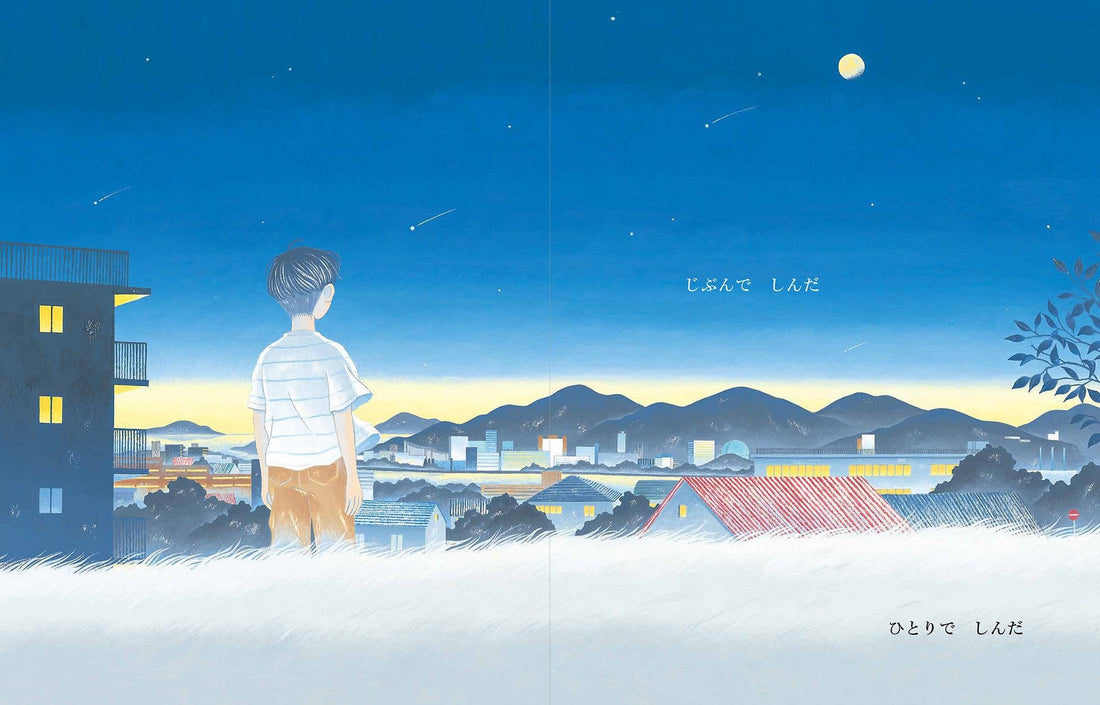
"Boku" (Me. Text: Shuntaro Tanikawa. Illustrations: Satomi Goda. Iwasaki Shoten published a series curated around Shuntaro Tanikawa's poem "Darkness is the Mother of Light.")
-