The joy of going up to the attic
"One cannot step into the same river twice."
In July this year, Jingjing 31 officially concluded its nearly three-year residency in the attic, much like completing an artist-in-residence contract. At that time, the two snack shops downstairs were still open, people couldn't move around, vegetable stalls were everywhere, "Xiaohongshu" wasn't popular, the government kept issuing consumption vouchers to boost spending, and everyone was confined to local time and space.
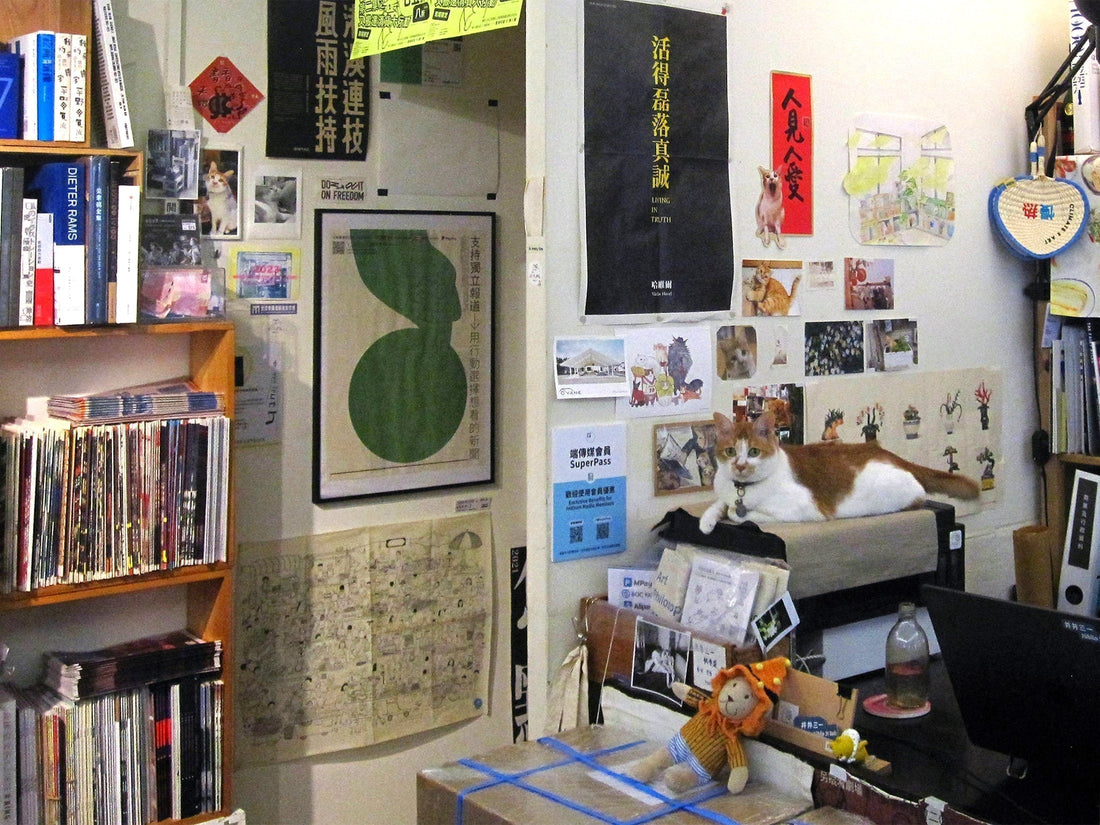
The attic unexpectedly became a safe haven, simply because in this secluded place, the bookstore suddenly became an observer of the world. This strange sense of belonging and wandering transformed into a complete independence and freedom. Unfamiliar places shimmered with new scents, living in this city that couldn't be remembered quickly enough. Taking a sip of water from the river was enough to excite one, sketching out streets that people could no longer distinguish. We had no idea of "Afonso de Albuquerque's" illustrious background in Portugal, yet we stepped onto the lane named after him, not just for a day, but for three whole years.
 Due to space limitations, most books are sold out once they're gone.
 We are interested in books related to visual arts.
Independent bookstores are endearing because they reflect the owner's personality and preferences. Over the past few years, Jingjing has consciously been trying different things. "Taste Period" was its debut, a small photography exhibition held in the stairwell, inviting friends to use toy cameras for children, instantly printing photos through thermal printing technology. "Ten seconds after pressing the shutter, the life of the photo begins its countdown." Those streets that would disappear under the lens, the silent everyday self, the city finally belonged to us, even if the images printed on thermal receipts would fade over time. The virtual world was originally meant to supplement the limitations of paper, but in this era of digitalization, even records can "die" at any moment. We constantly encourage people to create Zines, precisely because we want to preserve different facets of life. In collaboration with the Macau Theatre Culture Association, we launched the "from Scene to Zine" workshop and exhibition project, focusing on cities, theater, and zines. This initiative aims to help individuals organize their own Zines through daily life and theater experiences. Everyone is their own curator; taking snapshots, deleting, and organizing on a phone are all purposeful acts of curation. After the passage of time and changes, the Zine will become increasingly clear.

Photography exhibition "Taste Period" (2022), workshop and exhibition "from Scene to Zine" (2022).
People of every era feel they live in some kind of crazy time, bidding farewell to the old days every morning, yet feeling so close and so far. "Great names are only achieved after one's death, seemingly from an unclassifiable destiny." Book curation is a classification, and also a captivating but distant realm. Besides wanting to stir resonant emotions, it's also secretly a portrait of life, offering appropriate responses. "Book selection exhibitions" are a form of nostalgia; the limitations of the attic space mean some things can only remain in place. My capabilities are limited, making the book selection seem somewhat narrow, and the quantity of books isn't enough to call it an exhibition. This compromise has become the ultimate essence of managing this space. Over these three years, I've curated many different book selection exhibitions; some had a concept behind them, while others had no real idea at all.
However, life always dilutes some interesting ideas. "Culturally Queer" responds to the mainstream; this is a book selection exhibition exploring non-mainstream visuals. "Cult" reflects on the over-superstitious linear faith, delving into human desires and anxieties by introducing three cult manga artists and two everyday realities. Huddled in the attic, it paradoxically spawned an online store, which began trial operations, attempting to present past civic issues as an "Books for Tomorrow" online book exhibition, as well as showcasing my beloved field of graphic design, "A Glimpse of Graphic Design."

Book selection exhibition "Culturally Queer" (2023), "Books for Tomorrow" (2023), and "A Glimpse of Graphic Design" (2023).
I don't understand why city dwellers are often indifferent to their surroundings, and I won't list all the evidence here. Such indifferent attitudes are particularly evident among marginalized groups. We use an indirect approach—Lilith, another woman created by God. "Lilith: Feminine Creation in the Face of the Creator" curates books with a non-phallocentric ideology, using female creation as a starting point. Left-Bank Publishing in Taiwan has published a series of "Oxford Very Short Introductions," mentioning six contemporary "Life's Hardships." We also borrowed this concept, curating extended selections around the themes of melancholy, anxiety, drugs, superstition, love, and pain. This city must have deeply resonated with these themes in the last year or two, leading to "Solitude and I Staring Silently: Books on Emotion, Life and Death, and Healing." Behind the high suicide rate are structural problems, and no one has a quick answer, but through understanding and feeling, seemingly humble individuals can be taught how to maintain the dignity of survival. I am skeptical, so I provide the necessary clues for these issues.
In the book exhibition "Walking the City, Guided by Books," I wrote that when traveling abroad, one's five senses are opened by curiosity, yet we never actively approach the city we live in, even though city observation has become a global trend in recent years. What this book selection attempts to explore is, at best, just an introductory manual. Looking up at another exhibition, "Those Who Identify Themselves," created for the displaced, leaving can sometimes preserve a city more effectively than staying. The social changes of recent years mean that no one can resist change anymore. Finally, there are curated selections of local publications: "Read Local, Buy Local, Support Local," a retrospective of local artist Lei Iek Fan's publications "[Never Forget]," the poetry anthology "Even if the World is Against Me, Poetry is Always on My Side," and the lighthearted spiritual healing collection "The Book of Animals." The revised edition of the modernist architecture map "The Modern Trace" has also been released.

Book selection exhibitions "Lilith: Feminine Creation in the Face of the Creator" (2023), "Life's Hardships" (2024), and "Solitude and I Staring Silently: Books on Emotion, Life and Death, and Healing" (2025).

Book selection exhibitions "Walking the City, Guided by Books" (2023), "Those Who Identify Themselves" (2023), "Read Local, Buy Local, Support Local" (2024), "Never Forget" (2024), "Even if the World is Against Me, Poetry is Always on My Side" (2024), "The Book of Animals" (2025), and the map "The Modern Trace (Revised Edition)" (2025).
Regarding Macau, what lingers for me is that there are too many opinions and too few people writing. Its unique living memories often fade away silently; people come and go, but most rush off and don't look back. Every commonplace street is actually irreplaceable, and the shadows under the dim streetlights belong to everyone. A sense of powerlessness makes everyone seem old, unable to retain old demolished objects, and ineffective in resisting things prohibited by society. However, you cannot stop anyone from writing. Last year, Jingjing initiated a column writing project, with its own team taking turns writing, occasionally inviting external authors. Through books, arts, culture, and life, it slowly unearths the proper form of a city, looking back at each other's daily lives. If someone asks me, I would say, "I want to create some content and leave something behind."

During three years of "residency" on Rua de Afonso de Albuquerque, the surroundings have changed significantly, and we have truly become an "old shop" on this street.
Yet, they often claim that Macau is a city not even worth having. These three years of realization revealed something odd: our way of life can never be retained, beliefs and aesthetics change daily, and we cannot organize and arrange what is coming. Ironically, Macau itself is the source of anxiety for Macanese people. That's why they write on Threads with such intensity, strong criticism, thick skin, but in reality, it's none of their business, living a spiritually boring life. This place is merely a pre-purchased graveyard for them, stuck in the past, living in outdated ways. I suddenly recall that a bookstore is actually just a kind of杂货舖 (general store), but it secretly harbors a certain attitude. At this moment, I don't know what the urgency is to read or write. Pushing the door open, it doesn't matter if the world has changed.
We returned to 31 Rua de São Roque in mid-July, but it's a bit different from three years ago. This time, we retreated upstairs. The attic days made us accustomed to a certain sense of security to balance the hustle and bustle. Pushing open the wooden window offers a new perspective; looking out, it's still the cobblestone street, still unevenly paved. Is it an illusion? The surroundings are quieter than before, deserted on weekends, and the nearby shops seem to have changed hands. The scorching sun still beats down at noon, but it seems to matter little.
In fact, "one cannot even step into the same river once."