
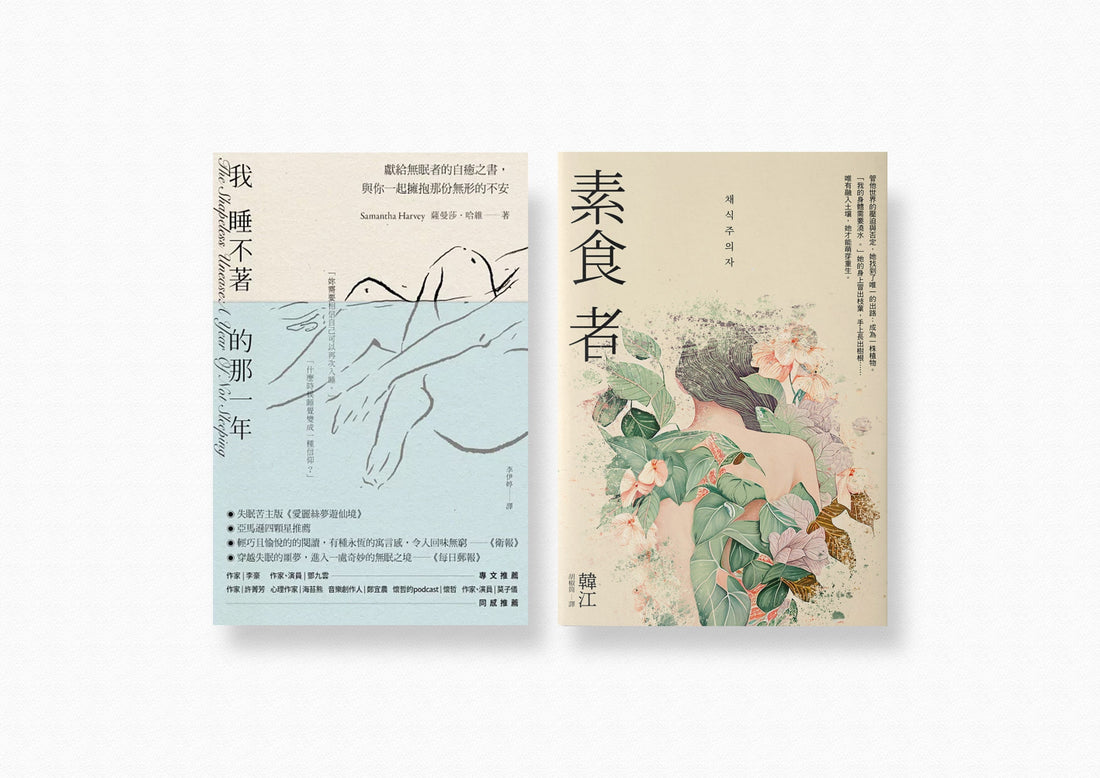
So sleep isn't something to be taken for granted after all.
I recently read books by two female authors. One is "The Year of the Sleepwalker" by British author Samantha Harvey, winner of the 2024 Booker Prize. The other is "The Vegetarian" by Korean author Han Kang, winner of last year's Nobel Prize in Literature. In both books, the authors coincidentally write about a great inner exploration that begins with the loss of sleep.
I have also experienced sustained sleep deprivation. During early pregnancy and after childbirth, due to hormones and my baby's unpredictable nighttime crying, I couldn't sleep for over a month. The depression and anxiety brought on by sleep deprivation truly frightened me. Every sunset, I would feel like crying. Lying in bed, my heart would race, and I couldn't get any real rest. The level of suffering was incomparable to the occasional sleepless nights I experienced growing up due to nervousness or excitement. With the help of friendship and maternal love, I endured it. Like most people, I didn't (or perhaps didn't dare?) try to express it in words. But Harvey's writing did. She articulated the suffering of souls who are "awake when everyone else is asleep," so real, as if I were there. Of course, her symptoms were far more severe than mine back then; I couldn't even imagine how one could survive a year of sleep deprivation.
"Writing saved her!" she says in her book. Writing replaced dreaming, and was even better. Writing gradually stabilized her emotions, freeing her from the anxious panic of her heart constantly racing as soon as she lay down. Slowly, she regained sleep. This essay collection records the incredibly real suffering of insomnia, a record I read for the first time, and it was profoundly shocking; I felt deeply understood. In addition, the book is also a retrospective of her life, searching for the source of the problem. She gradually unearths experiences from her upbringing that could have led to this great insomnia, and also documents her feelings during various types of treatment. The preciousness of the details will be understood by everyone who has struggled.
She bravely survived, and not only survived but also wrote the Booker Prize-winning novel "Orbital." This episode of insomnia was both the ultimate suffering and the ultimate healing. She found a way to dream, no longer panicking, and while sleep might not return to its former ease, it would, at least, no longer be a beast in her life.
As for "The Vegetarian," it was equally unputdownable from the first page. An ordinary Korean woman, so unremarkable you might forget her at a glance, begins to gradually use various strange behaviors—such as suddenly becoming a vegetarian, attempting to become a plant, etc.—to resist the external threat that stole her sleep. The "normal people" around her, confronted with these disordered behaviors, feel revulsion born of fear, revealing the absurdities of life. Unlike Harvey's essay, the protagonist in this book ultimately fails to find a way to live normally in society. Instead, it is her sister, a very "normal" woman who conforms to conventional aesthetics, who feels her own normal life unraveling.

"The Vegetarian" by Nobel laureate Han Kang. The first Asian work to win the International Booker Prize.
In my opinion, this is related to the society the author lives in. Although Harvey's upbringing included traumas like parental divorce and the death of a pet, overall, she did not suffer major trauma from a severely imbalanced societal gender structure. Even when her insomnia began, she had the unconditional support of her partner and friends. However, the protagonist in "The Vegetarian" not only experienced domestic violence from her father during her upbringing, but after her mental breakdown, those around her tried to "correct" her, all of which are unavoidable factors that gradually drove her towards madness.
Emotional health is an unavoidable topic in this generation. More and more people realize that various small negative emotions, if accumulated, can turn into monsters that suddenly disrupt one's life. These two books taught me that emotional monsters do not disappear by being hidden (isn't overly positive thinking like that?). Only by confronting them directly and finding ways to coexist with them can one gain inner peace.