
"Nice Girls" Visible and Invisible Walls
I imagine many parents bought the book "The Good Girl" with the hope of raising a "good girl."
In the picture book, the story begins like this... "Lucy is such a good girl..."
Lucy is quiet, intelligent, well-behaved, and obedient. One day, Lucy merges into the wall and disappears; no one can find her. Lucy opens her mouth, but no one can hear her...
"The Good Girl" has a pleasing pink cover, with many seemingly rotating suns on a pink background. The protagonist, Lucy, is centered in the image: elegantly dressed, with blonde hair and innocent eyes, standing with her feet turned inward, completely non-intrusive.

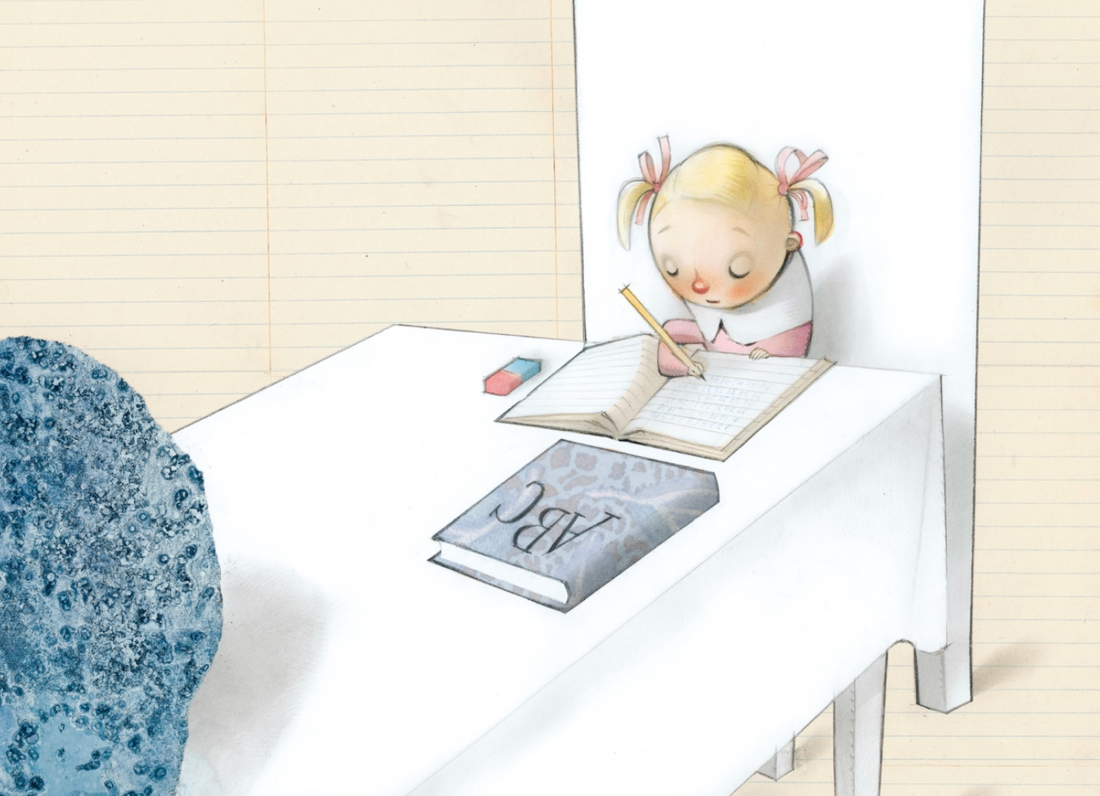
Turning the pages, Lucy is drawn on graph paper, almost transparent. The same image reveals two messages: the pink and the suns, the background of tenderness and positive energy surrounding her, are actually walls. I took "The Good Girl" for a "street shoot" and inadvertently saw various visible and invisible walls in the city.

"Walls" are ubiquitous in the images on every page. The sofa is a wall, the front door is a wall, the classroom door is also a wall (it's even locked). The adults caring for Lucy, her classmates, are all walls. They are grid paper, lined paper, graph paper. Compared to Lucy, the furniture is also enormous—the dining table, room door, birdcage, and stools, even the flowers, hair, and fabric, all look as if drawn with a ruler, rigid and angular.

"We have to do this..."
As the story progresses, what is it that drives Lucy's fate? From the very first drawing, a clock is present—the clock at home. At school, another school clock stands guard. Perhaps we are all like that, the adults (teachers) wearing watches. As the numbers tick by, Lucy blends into the clock. All the walls come from this: "We have to do this," and so she enters the realm of rules and norms, silently fading away.
"If one part were to change..."
When I view the details in the above drawings as the system causing Lucy's suffering, if any single part of them were slightly altered, would Lucy (and others like her) not have to rely solely on their own strength to break through? What if:
. The lines of the petals weren't so stiff? (Then it would be support that truly offers Lucy a beautiful experience.)
. The grid paper, lined paper, and graph paper were replaced with other patterns? (Both external and internal walls disappear.)
. The clock didn't appear in the picture. (Removing the framework and norms of "how you should be" that Lucy adheres to.)
. What if... these things never existed? Would she then be able to grow up without walls, truly free?

I like the nameless "stain" that always accompanies Lucy in "The Good Girl." I have no idea what it is. From the very first scene, when Lucy is doing homework alone at a large table, it is there, by her side. On closer inspection, that "stain" looks like the universe; it also resembles dust and melancholy accumulated over a long time. It is an endless abyss.
In an environment surrounded and raised by walls, Lucy's ordeal is bound to happen. She falls into darkness, strikes at the darkness, gazing into the abyss and suffering.
Note: While reading "The Good Girl," I always fantasized about telling Lucy, "You're not alone; there's also Giselle." — "Giselle the Glass Child" (Beatrice Alemagna)
-