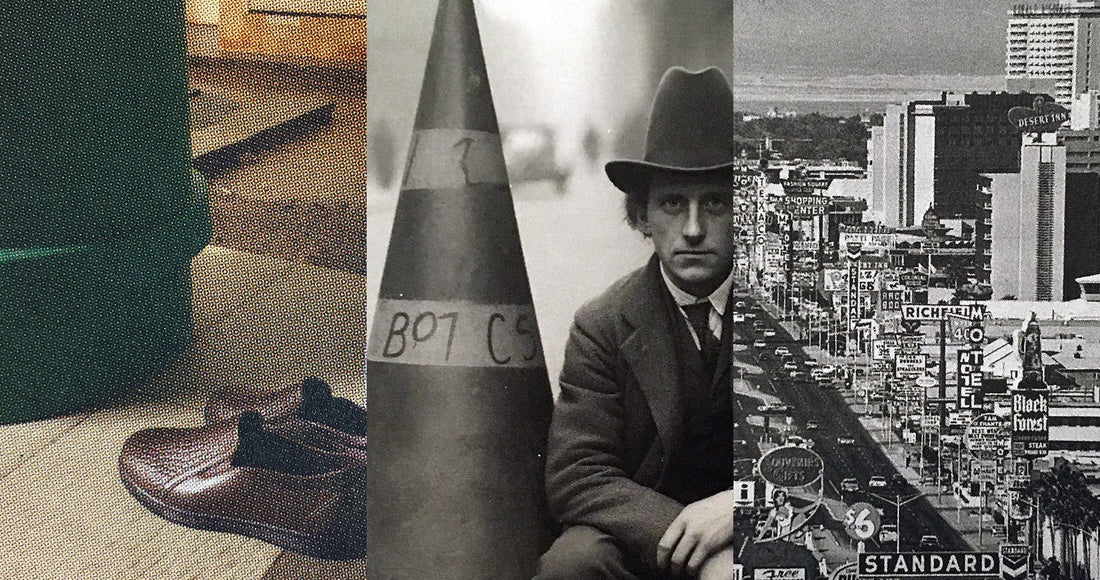
It all started because everything I saw was dull — I wanted to learn how to see objects in the city.
Cities have become too uninteresting for us. Living in them is no longer about familiarity or strangeness, nor passion or indifference. Like lost stars, we are destined to be born here, live here, and die here. All our comfort and discomfort will ultimately pass like a bustling street. Anxiety causes urban objects to waver and falter under a massive shadow; everything seen on the street becomes lifeless, devoid of detail, and unrelated to me.
However, cities co-construct our lives and aesthetics, serving as the first gateway to perceiving the world. So, who would willingly lag behind, even inadvertently, for objects appearing in the city during their journey?
Studying objects within a city is an interesting and romantic endeavor. Temporary Press, a Singaporean publisher, last year released four volumes of "Street Report" about urban objects. Each volume, authored by a different urban research unit, focuses on common but overlooked items on the street. Atelier HOKO writes about the triviality of "public bins," understanding the street through something invariably ignored. Faiz Bin Zohri observes "Hooks & Holes" at market stalls, revealing the organization and operation created by vendors themselves. Cathy Hang focuses on a long-standing transportation system through the interaction between people and the tram's "Ding Ding." Gideon-Jamie writes about "Seatings." Although presented as research reports, they incorporate various senses of humor, allowing people to understand these crucial yet often neglected urban objects, finding joy and meaning in them.

Sometimes neglected urban things are destined to be neglected. In "Street Report 1: Public Bins," trash appears next to the bin.
By observing carefully and taking notes, "Street Report" redefines, organizes, and writes about areas typically of interest only to a very niche audience, capturing the relationships between urban objects and their interactions with users or observers. For example, in the fourth report, "Urban Seating," the featured objects are not necessarily traditional chairs; they might have been repurposed, or never intended for sitting, given new meaning by people, overturning our perceptions, and revealing a bottom-up community transformation. Ryo Yamazaki, a master of "community building design" in Japan, often engages in various communications and workshops to encourage residents with no design experience to unleash their creativity, fostering consensus through continuous attempts to find the ideal implementation plan. However, the report shows that sometimes city dwellers don't need professional planning knowledge or team participation; everyday life can spontaneously foster a prototype of community involvement.

In "Street Report 4: Seatings," "chairs" that are not typically chairs are redefined by users.
If a city is a grand living room, its objects are furniture, and the traces of life are small decorations. All sorts of things in a city hold endless possibilities. Hong Kong urban scholar Horace Ip in "Hong Kong Strollology" categorizes urban observers into "hedgehog" and "fox" types. The former is interested in anything noticeable on the street, without picking; the latter focuses on a specific type of object to gain deeper insight. During concentrated observation, various imaginations often arise, sometimes complex, sometimes contradictory.
Zooming to the other side of the world, Finland's Other Editions published an interesting book, "Cone Wars," also observing common urban objects. Italian architect Lorenzo Serraglia, after extensive observation of "traffic cones," whimsically created a rich and mysterious history for them, giving them a new role, from ancient civilizations to the modern era. This blurs our historical and imaginative boundaries for these frequently seen street objects, oscillating between surrealism, "defamiliarizing" common "traffic cones," sparking curiosity about mundane things, making the city seem paradoxical, challenging common sense, and conflicting between reality and illusion. Through critical observation and re-evaluation, it encourages us to discover the world around us.

"Cone Wars" features many pseudo-historical narratives, claiming Jean Pierre Cone as the inventor of the "traffic cone."

"Cone Wars" also inserts modern "traffic cones" into medieval paintings, creating a false history.
Ironically, recent urban observation books often carry a melancholic urban tone, first assuming or admitting that the public finds cities boring, then proceeding to educate and transform city dwellers. This is precisely the urban pattern hated by postmodern architect Robert Venturi. He found modern cities monotonous, uniform, and utterly uninteresting. In his "Learning from Las Vegas," he championed the idea that the world should be designed like this casino city, even if it meant stacking shallow popular cultural elements. He believed cities should feature a plethora of such information to attract attention, discarding serious cultural significance. The vulgar, meaningless, or readily available visual elements in cities, he argued, combine to form a very appealing architectural and urban style. This symbolism has been underestimated; modern urban objects lack complexity and splendor, making them dull. Sometimes, aesthetics are discussed for the sake of discussion. A more intuitive approach can better satisfy modern people's pursuit of new aesthetics.

Las Vegas features many visual elements that don't belong there; Macau residents are likely familiar with this.

Venturi recorded all the signs and other elements appearing in Las Vegas, then analyzed their inherent aesthetic style.
I would say, "I understand." Otherwise, you can conduct your own observational experiment: try strolling through Macau's old streets in the morning and then the Cotai Strip casino area in the afternoon. You might come to an understanding.
-