
A successful but unfulfilling life
Would you believe it if I told you that a single fruit contains the entire universe? Susumu Shingu's "Strawberry" begins by speaking of the fruit's soul... (Wait, do fruits have souls?)
"In the evening, the strawberries were gone, but the land still carried a sweet scent."
"On the verdant leaves resides the soul of the strawberry." — "Strawberry"
Unseen, yet still able to stir the five senses, with a sweet fragrance. If you can't smell the earth, you can't perceive the soul of the strawberry. Strawberry seeds are buried deep in the soil; when snow falls, they gaze at the starry sky amidst the white snow.
Susumu Shingu's works are rich in poetic beauty.
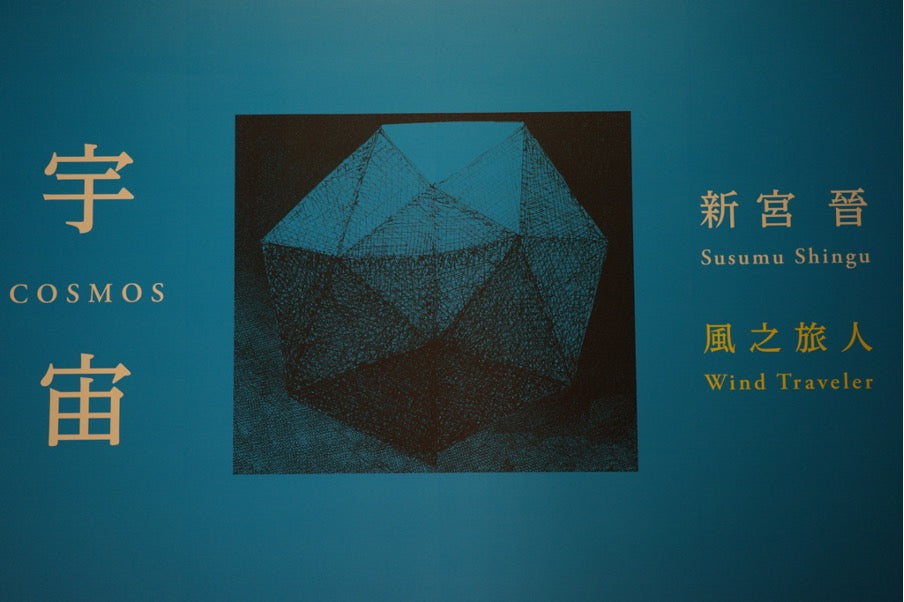
 I've always wanted to see Susumu Shingu's (SUSUMU SHINGU) kinetic wind art works in person. At the Fubon Art Museum in Taipei, the "Cosmos: Traveller with the Wind" exhibition features fifty works. These pieces are made up of artificial mechanisms of various shapes, and they maintain balance very accurately and precisely in the flow of the wind.
 Sensorily, it's a huge impact: what exactly is the relationship between man-made and nature? Both are often seen as opposing forces, so how can balance be maintained and achieved?
 Thirty small wind-powered artworks are placed on the same display stand. Visitors receive a ticket upon entry and are guided by the ticket to find one of the artworks.

The light and shadow cast by "Wing of Freedom."
Many times, I thought Susumu Shingu was creating galaxies in the human world, reproducing the cosmos or the heavens, but what he expressed was "finitude." If life is to be infinite, one must experience wind, rain, and the sun.
"Precise" yet "fragile" machines are used to respond to the greatness of intangible things — wind, light, and shadow. This expression of "micro" and "macro" also appears in Shingu's picture books. Just like "Strawberry," a single fruit encompasses the entire universe; "Whale Shark" delves into the deep sea from a whale shark, reflecting the stars. "Spider" (くも) transcends time, and "Butterfly Journey" truly amazed me: the monarch butterflies that overwinter in the Mexican forest actually take three or four generations to return to Canada, then repeat the cycle endlessly.
 Susumu Shingu said that during his childhood, spanning from World War II to the postwar period, resources were scarce, and children had no toys. To bring the world he imagined to life, he used whatever materials he could find to create things, such as human-powered aircraft and small boats that could carry children downstream. "Looking back now, these projects were too idealistic to succeed, but we were completely engrossed in them every day after school until dusk," he recalled. "Now I understand that having nothing is not a bad thing, because it means there's a lot of room for big dreams."
At the end of "Strawberry," the land is bare: "In the evening, the strawberries were gone, but the land still carried a sweet scent." To wholeheartedly invest in life's greatest desires, whether it's survival, reproduction, or creation. To feel and express the smallness of the individual in creation, and even if the scenery at the end is unknown, to still flap one's wings and fly. What the world will be like afterward is unknown; believe, and leave the fragrance of the soul unknowingly.