A Utopia for the Voiceless: Art and Literature, Thought and Critique
Independent and critical thinking can be understood as the essence of art and literature. Even when facing what one already knows and believes, it's crucial to remain vigilant and constantly challenge it, which often places this field in opposing and contradictory camps. Similarly, critics are also criticized, with questions raised: Must art and literature always have clear objectives? Should vague and pure aesthetics be diminished as lacking substance? Are artworks created solely for commerce inherently vulgar? Every theory and school of thought is always accompanied by equally strong critical schools, leading to diverse opinions. But none of this matters, as long as it sparks discussion in the public sphere, bringing issues to the surface, allowing art and culture in the city to develop healthily.
Macau is rich in resources, but the "fat profits" only flow into the gaming industry. Thus, the government decided to include a so-called non-gaming element proportion in the terms for renewing casino operating licenses, the amount depending on revenue. This mandates the six major consortiums to allocate more resources to developing culture and art, while also assigning them to different corners of Macau, vowing to introduce art into communities and change local life and social landscapes. Although in reality, most funds fall into the grey area of organizing concerts, if we exclude the entertainment industry and focus solely on art development, we gradually see community projects emerge that rarely engage with residents or local connections. These tend to be "harmless" art exhibitions and decorations, while public discourse largely concentrates on economic effectiveness, with few caring about whether it's art or not, let alone the public being able to critique and discuss what they claim to be community art and contemporary art.

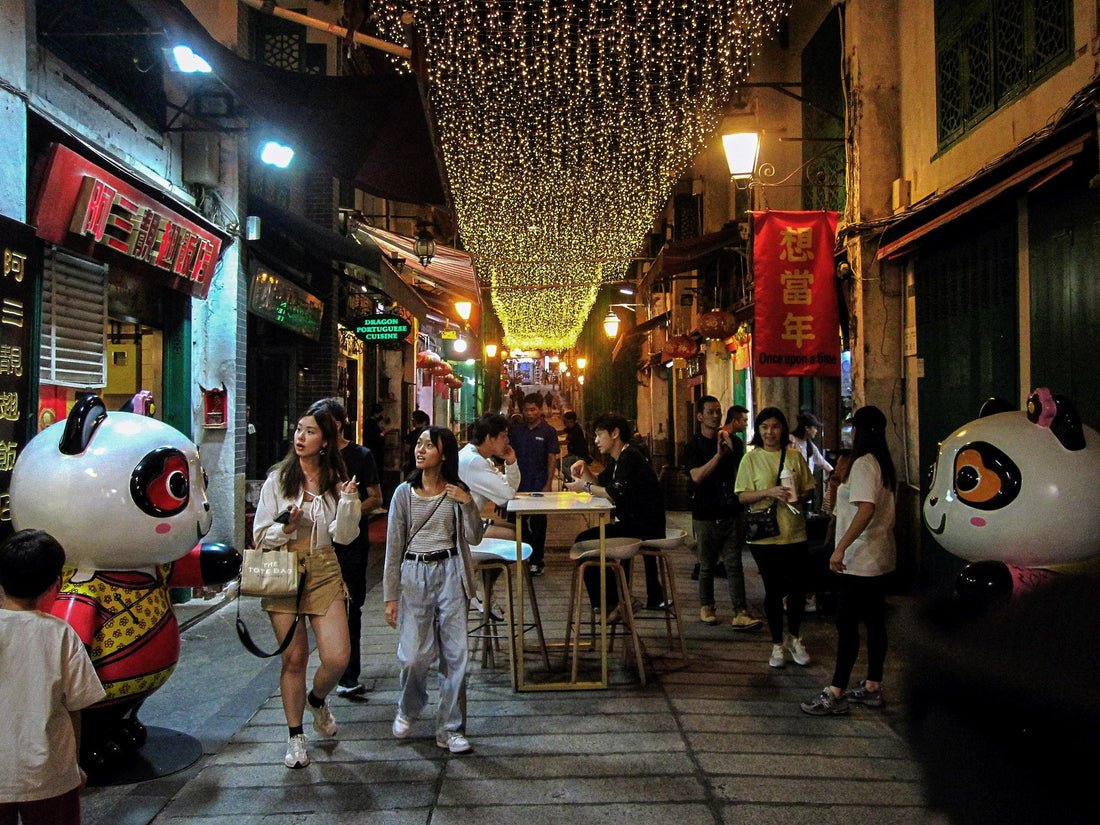
Among these, Wynn Macau's plan for the "transformation" of Rua da Felicidade became one of the most controversial activities.
Lyu Peiyi, a prominent Taiwanese curator and art critic, explored the importance and meaning of art in contemporary society in her book "Art Movement as a Public Platform." She uses various social events in Taiwan as her subject matter and examines the roles of different cultural workers, presenting the relationship and trends of art, society, and activism in the past two decades. She points out that the term "art" refers to "the creator of aesthetic experience." Quoting art scholar Boris Groys' lecture "What is Contemporary Art?", she mentions that defining "being contemporary means not only being present, here and now, but also being with time, not within a certain time." He believes that contemporary art should coexist with its era, with artists facing the present, reflecting reality, and embodying a collective spirit of the times. The core of aesthetic experience lies in presenting "experience," but whether these "experiences" are recognized is also debatable. In the millennium, the Taiwanese art magazine "ARTCO" criticized young artists for often using personal inner emotions and daily life experiences as the starting point for their creations, labeling it "micro-sensibility." This sparked a discussion in the Taiwanese art community at the time. Today, applying this to various art exhibitions in Macau might be even more apt than it was in Taiwan back then, especially given the ideological predicament where art and literature must be positive, which truly feels like being trapped in a quagmire.

The artwork "The Processing Plant," introduced in the book, reveals the complex realities of life through art, reminding us that structural societal problems remain unresolved.

The Taipei Fine Arts Museum, as an official space, can also provide an "exceptional space" for art to confront reality. Pictured is "Ketagalan Boulevard Sports Ground," an artwork from the biennial.

The book is divided into six chapters, outlining and exploring contemporary Taiwanese artworks related to social events.
Indeed, the French aesthetic notion of "art for art's sake" is already an outdated concept, as antiquated as art in the Renaissance only serving the church, or wealthy patrons commissioning paintings to support artists. Spending money to buy art to paper over problems and serve as mere decoration in public spaces seems anachronistic. When cities inevitably face these issues, ambition for change is crucial, but criticism is equally indispensable. It's vital to contemplate society's view of art and culture, and to clarify the impact of ideology on urban art. Ironically, much of history's progressive forces and new ideas have often been built by their critics.

All gaming enterprises in Macau currently have their own art exhibition halls, mostly featuring Pop Art. Pictured is a photo booth installation from an exhibition, life-sized.
Art, literature, and critical philosophy are often discussed together in the intellectual sphere. Hong Kong writer Chan Koonchung's "Marxism and Literary Criticism" fills a gap in understanding the intricate relationships within contemporary European literary knowledge. The book comprehensively covers theories such as formalism, structuralism, and semiotics, which profoundly influenced art development, and comments on contemporary doctrines and theories that have had a far-reaching impact on arts and culture. We must understand the past to have sufficient critical ability to think independently about the present. In authoritarian times, all artistic creations were merely tools to serve and promote politics, imbued with ideological political content. One must first understand how Marxism was used to constrain artistic development before one can guide contemporary artistic practice with more scientific methods.

Chan Koonchung systematically introduces the influence of various intellectual currents, such as Humanist Marxism, on literary criticism.

Various theories are presented in an accessible manner, with complex information organized logically.
Literature and art can only realize their different possibilities by genuinely engaging in a dialectical relationship with society. This is not about moral blackmail; to discuss which method is correct, one must understand criticism—of course, you can accept that art must maintain a distance from reality, needn't have much meaning, and merely appear as decorations on the streets, or be temporary exhibitions in historical sites, or involve lavishly paying international artists unknown in the city... Indeed, there might be many unspoken reasons behind it all, and the unfulfilled aspects require more people to raise different questions, fostering mutual growth, rather than remaining completely silent.
-