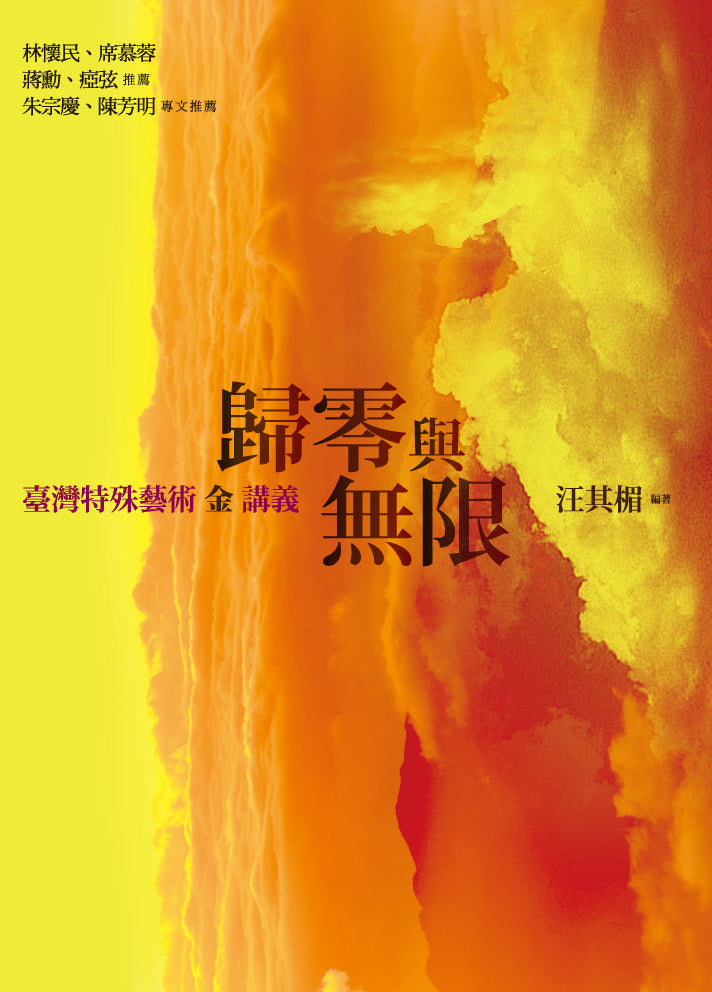

Zero and Infinity
Zero and Infinity
Couldn't load pickup availability
Every day, we seek possibilities and humbly learn the following:
How to discard what we already have, how to reset ourselves, how to remove barriers for "people," and how to find happiness.
"Through art, people connect closely, becoming more at ease and free.
We hope that the younger generation can return to their original creative hearts; not only to develop the infinite possibilities between people and art,
but also, one day, to achieve a world where there are no barriers, no boundaries, no class distinctions, and no conditions in the realm of art.
Those deemed 'less able' have proven to everyone, both in this book and beyond, that:
They thrive in seemingly impossible predicaments,
generously offering the beauty of art to a society that once treated them with indifference,
and inspiring us to look to the future and embrace change." — Wang Chi-mei
The deeply rooted local involvement of Shih Wen-han, Wen Hui-wen, and Chang Tsang-sung includes "language and cultural learning" and "disaster reconstruction experience"; Wang Wan-jung and Yang Bi-ying's solid experience in creating drama with blind individuals, and the effortless performances of deaf actors; Yen Tsui-chen and the "Bird & Water" Dance Ensemble, and Wang Man-yu and the "Little Coke Troupe" unleash a lasting impact. Huang Sheng-yuan advocates for mutual care between space and people, Yu Shan-lu champions the "non-differentiation" aesthetic, and Lin Ssu-tuan uses artistic integration to unlock physical and mental development.
Beyond expanding its scope and vision, the new edition importantly demonstrates that the future is not out of reach. We need more introspection and external descriptions; Ting Li-fen precisely highlights the infinity of mind and vision, and the boundless potential of future technological development. Cheng Tai-chiung describes how "I Take You on a Journey", in the form of a deaf sign language play, shone brightly through the collaboration of blind, deaf, wheelchair-bound, and theater actors. Hsieh Hung-wen explores the writing of people with physical and mental disabilities in children's literature, leading readers into this field that impacts children's lives. Chi Ta-wei inaugurates a new field of "disability and literary studies," hoping that through the power of literature, barrier-free art will become more profound and widespread.