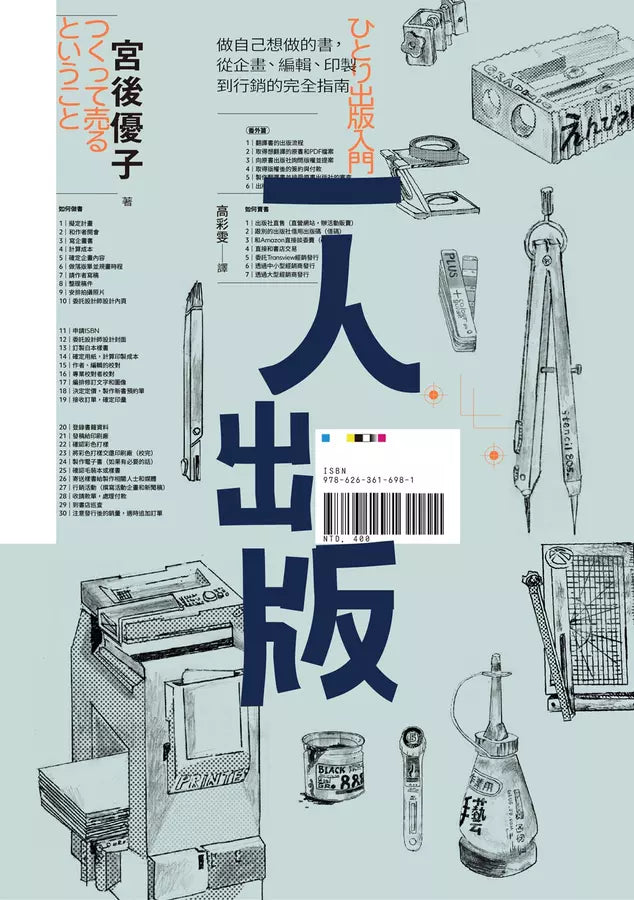

Self-Publishing: The Complete Guide to Planning, Editing, Printing, and Marketing the Book You Want to Write
Self-Publishing: The Complete Guide to Planning, Editing, Printing, and Marketing the Book You Want to Write
Couldn't load pickup availability
★ A Practical Publishing Guide You Can Do All by Yourself ★
How to Make a Book → How to Sell a Book → Case Studies of Solo Publishers
Complete Workflow + Essential Tips + Experience Reminders
Whether you're a one-person army in a solo company, a slasher dreaming of entrepreneurship, or a small cog in an organization,
this book might help!
▋ How delightful it is to make the books you want to make! ▋
The work attitudes of the new generation are increasingly changing, and post-pandemic business models are becoming more diverse. Miniaturization, small but beautiful, and one-person companies have become important trends of the times. Coupled with the increasing maturity of digital platforms and cloud integration, the threshold for creation and publishing has lowered, making solo publishing the primary option for many aspiring individuals.
The author, Yuko Miyauchi, is a veteran Japanese publisher with over 20 years of professional experience. She has also given themed lectures and accumulated numerous publishing case problems. Based on this, she has organized content that responds to actual needs and has significant reference value.
"The purpose of this book is for those who make books to create works they are genuinely satisfied with, to deliver them to readers who want to read them, and to launch books that are difficult to publish in the traditional publishing industry. In this way, more meticulously crafted books will emerge, more readers will be reached, and more books will be published; as solo publishing increases, the diversity of books will expand, enriching publishing culture." — Yuko Miyauchi (Preface)
▋ A Generous Guide to the Publishing Scene, Finally Shared ▋
The author dissects 30 steps in "making a book," including signing contracts, calculating costs, creating imposition layouts, and proofreading. She outlines channel options for "selling books" based on different book content and publishing formats. At the same time, through a questionnaire survey, she interviews several solo publishers to understand their business operations, as well as their accumulated experience and advice.
"This book does not blindly urge people to jump into solo publishing. It also candidly discusses the difficulties encountered after actually starting to make books." The entire book balances principles and practice, with concise and clear writing, offering earnest reminders. Appropriate use of diagrams, photos, and formulas ensures a clear and well-organized layout.
Although there are slight differences between Japanese and Taiwanese practices due to local specificities, foreign experiences can still serve as valuable lessons. The book's detailed explanations of publishing stages and its portrayal of the current state of the Japanese publishing industry can serve as a practical desk reference for relevant workers in Taiwan and a portable working memorandum.
"This small book neither advocates nor sugarcoats, nor does it retrospectively narrate the status and development of solo publishing in Japan. Its main purpose is to organize experiences and provide those who are 'determined to give it a try' and 'still have a personal publishing dream' with essential on-site knowledge and information; as well as the options and honest evaluations that must be considered before and during taking action." — Ding Ming-ching (Chinese Edition Introduction)