
Wandering Again: Philosophical Thoughts on the Dispersion Era and Social Disintegration
Wandering Again: Philosophical Thoughts on the Dispersion Era and Social Disintegration
Couldn't load pickup availability
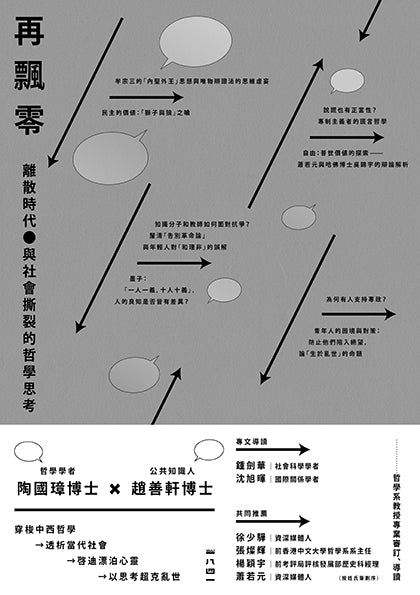
Traversing Eastern and Western Philosophy.Analyzing Contemporary Society.Enlightening Drifting Souls
Overcoming Troubled Times Through Thought
*Professionally reviewed and introduced by a Philosophy Professor*
Discussing concepts in Eastern and Western philosophy, using methodological thinking to analyze the mindsets of those in power and the general public.
Providing more precise analytical advice for readers with drifting souls.
Allowing spiritual roots to self-cultivate in a time when flowers and fruits are once again falling.
When Mou Zongsan meets Kant, how can "inner sageliness and outer kingliness" reinterpret Confucianism and modern politics?
How can the analogy of "the lion and the wolf" be used to discuss the value of democracy?
Is Hong Kong chaotic because it is too free?
Why are some people full of hatred and contradictory in their statements?
How are Mohism and Marxism similar?
Is "becoming strong" the only truth, and is humanitarianism a pink dream?
Are the feelings of loneliness, helplessness, and despair among young people caused by economic and generation gap issues?
How can Hong Kong's petty bourgeoisie find human spirituality and the ability to think?
Why do even people with doctoral degrees believe fake news?
Should teachers remain politically neutral and silent, or actively support students?
Your rationality is not my rationality; is there an objective standard for rationality?
Do you think the process or the result of a ball game is more important?
Does governing troubled times truly require severe laws?
Professor Tao Kwok-cheung and Dr. Chiu Sin-hin both graduated from the New Asia Institute, which represents the philosophical and cultural tradition of Hong Kong since the Cold War. They have also been committed to popularizing philosophical thought. This book starts from social events, discussing New Confucianism from Mou Zongsan to Chinese political history, analyzing different aspects of suicide from the phenomenon of youth suicide in Hong Kong, and comparing concepts of conscience, freedom, and authoritarianism in Eastern and Western philosophy, directly confronting social contradictions and divisions.
This book contains fourteen brilliant dialogues between the two, covering ancient and modern, Eastern and Western topics, rooted in local context. It allows readers to find a clearer mind amidst trivial and complex worldly affairs. As the book states, these dialogues aim to inherit the wisdom of past sages and continue cultural life through free discussion.