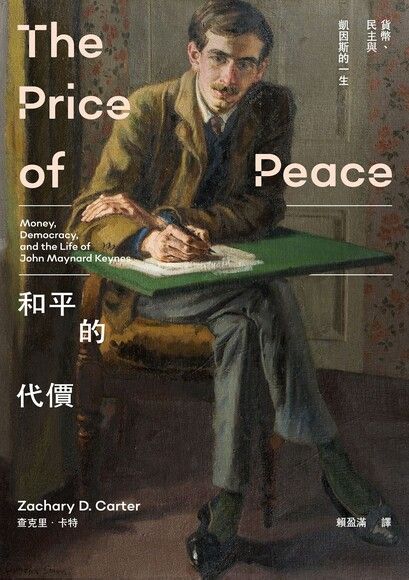

The Price of Peace: Money, Democracy, and the Life of John Maynard Keynes
The Price of Peace: Money, Democracy, and the Life of John Maynard Keynes
Couldn't load pickup availability
Inflation, economic downturns, wealth disparities, authoritarian populism, impending wars.
The world today bears a striking resemblance to the situation Keynes faced a century ago.
This economist, most renowned after Adam Smith, proposed theories for what he considered a good life, completely altering the trajectory of 20th-century economics and national policy.
In his youth, Keynes, with his extraordinary intellect, entered Eton College and Cambridge University, institutions dominated by the British aristocracy. Soon after starting university, he was drawn into a self-important secret society whose members included Russell and Whitehead, among others. Some young members of this society formed the Bloomsbury Group, a rebellious literary circle that challenged the closed and conservative moral framework of British society through their actions. Keynes's romantic entanglements and personal struggles throughout the first half of his life unfolded within this group.
Since middle school, Keynes had been involved in sexual and emotional relationships with men, but at the age of thirty-eight, he dramatically fell in love with a Russian ballerina and married her, much to the astonishment of his friend, Virginia Woolf.
At the outbreak of World War I, Keynes's unconventional advice saved the British Empire from financial collapse. Thereafter, he advised the British government, seeking American financial aid to enable the Allies to secure victory. During the Paris Peace Conference, he exerted all his efforts to prevent the victorious nations from imposing reparations that would backfire, but to no avail. At this point, he had already foreseen that disaster would strike again.
As he predicted, the European economy collapsed, followed by hyperinflation, deflation, and populist authoritarianism, and even the United States was plunged into the Great Depression due to a stock market crash. Through his experiences and reflections since World War I, Keynes realized that the classical economic laissez-faire market doctrine, which he had once held as gospel, did not align with the real world, and he gradually put forth new theoretical insights and policy proposals. This theory began to flourish in the United States through his students, and Franklin D. Roosevelt's New Deal revived the American economy, making Keynesian theory the mainstream thought in economics and national policies, and elevating the status of economists.
This biography is exceptionally rich and splendid in its layers, not only chronicling Keynes's personal life, his economic and political thought, and his interactions with British and American policymakers, but also, more notably, dedicating extensive chapters to the rise and fall of the Keynesian school and its rival, neoliberalism, tracing their evolution all the way to the current state of the world after the 2008 financial crisis.
"Keynes was full of contradictions. He was an elite bureaucrat, yet married a ballerina; he was homosexual, yet his greatest love was a woman; he was a loyal servant of the British Empire, yet opposed imperialism. He was a pacifist, yet helped finance two world wars; he was an internationalist, yet provided the intellectual foundation for the modern nation-state; he was an economist, yet challenged the fundamental principles of economics. But beneath the seemingly contradictory surface, his pursuit of human freedom and political redemption remained consistent." —Excerpt from the "Introduction" of this book