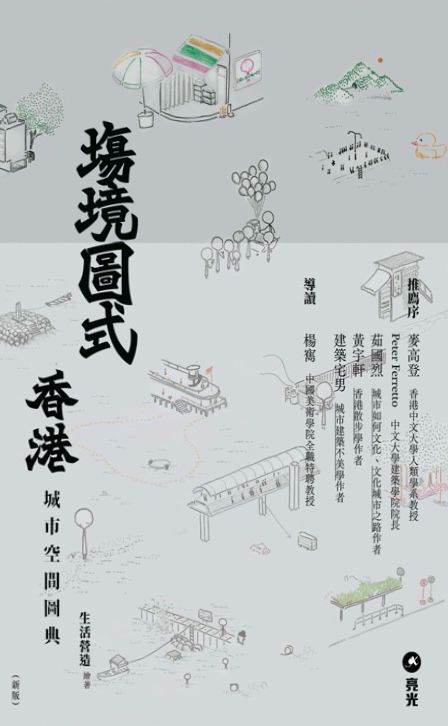

Scene and Schema: A Lexicon of Hong Kong's Urban Spaces (New Edition)
Scene and Schema: A Lexicon of Hong Kong's Urban Spaces (New Edition)
Couldn't load pickup availability
This book is a new edition of "Scene . Pattern", featuring three new forewords, as well as some revisions and new content.
The author points out: "In the years following the publication of "Scene . Pattern," I began to delve into the vast subject of architectural education. The constant need to discuss design with others led me to repeatedly ponder a question: How do people begin to design? And what might be the meaning or relationship of a scene to different people?
If you ask children to describe their rooms or homes, they'll unhesitatingly detail everything inside: from toy boxes, origami lamps, doll corners, the sofa backrest they can stand on to watch TV, the stickers on the closet door, to that helium balloon they impulsively grabbed during the New Year's Eve countdown. They love the window beside their bed, which is how they chat with the stars every night before sleeping. The rooftop of the snack stall down the street is their secret base for talking with friends. The small bookshelf by the bed… whether it's details, depth, the relationship between people and space, or even the layers and order of space, these places, one after another, and these objects, each with special meaning, make the place called 'home' incredibly lively and full of the warmth of life… But these thoughts, these details of a place, are often the beginning of architecture. And that place, that object with special meaning, is called 'scene' and 'pattern' in the book."
Reading "Scene . Pattern" again recently, I discovered another potentially viable path.
We still believe in the significance of "Scene . Pattern" as a tool in contemporary cities. Patterns, the memories of this city, the culture of life here—by understanding them, perhaps you can, like a child, become a profound and heartfelt architect."
A Study of Collective Spatial Memory in Urbanism, Architecture, and People's Science
An Analysis of the Mustard Seed Garden Painting Manual in Modern Cities
Gordon Mathews (Professor, Department of Anthropology, The Chinese University of Hong Kong): "I have always believed that architects are only interested in buildings made of stone, wood, steel, and concrete, not living beings. However, the brief content in this book changed my mind."
Peter Ferretto (Associate Professor, School of Architecture, The Chinese University of Hong Kong): "The spontaneous scenes in the book aim to highlight these often-overlooked urban spaces. It awakens architects to the daily life, social interactions, and cultural settings they often disregard."
Louis Ng (Author of "How Cities Culture" and "The Road to Cultural Cities"): "I read it with great joy, because this 'dictionary' systematically presents our familiar, memory-filled, yet hard-to-describe experiences, making me pleasantly discover that the spatial culture in our everyday lives contains a logic, a language. And if we master this language, we will understand what constitutes Hong Kong's uniqueness and can use this language to create new spatial cultures."
Wong Yu Hin (Author of "Hong Kong Walking Studies"): "I can boldly assert that among all publications about Hong Kong's urban space encountered in the past decade or so, 'Scene . Pattern' is, in my opinion, the most inspiring and admired work. It absolutely should be a book that everyone who cares about Hong Kong should read. I firmly believe that anyone who has read this book will agree that it is an indispensable work for understanding Hong Kong in the future."
Architectural Otaku (Author of "The Un-Aesthetics of Urban Architecture"): "What will Hong Kong become in the future? This is a question everyone who cares about our city asks themselves, and the reprinting of 'Scene . Pattern' at this moment might offer us some starting points for answers: we can understand space with a more open perspective, approach design with a more inclusive attitude, and explore the future in more diverse ways."
Yang Jun (Visiting Associate Professor, School of Architectural Art, China Academy of Art) specially recommended: "Compared to photographs and architectural blueprints, the drawings in the book are closer to our understanding of true memories—loose and subtly varied. While individual memories of scenes differ, the general outline is enough to evoke an impression of a certain scene."