
1
/
of
1
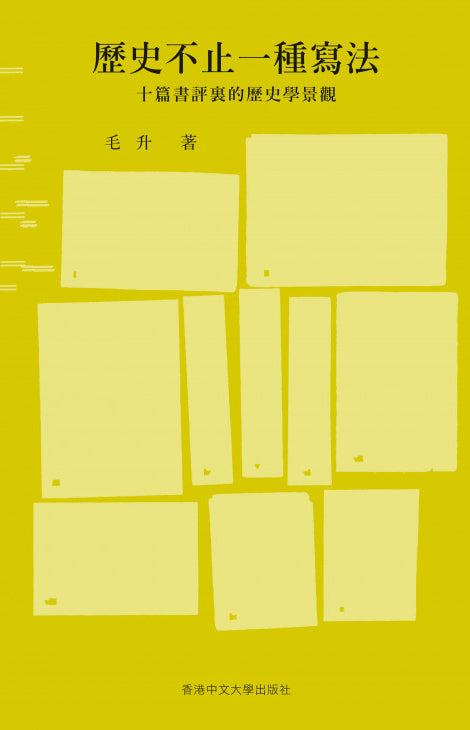
History is written in more than one way: the historical landscape in ten book reviews
History is written in more than one way: the historical landscape in ten book reviews
Regular price
MOP$103.00
Regular price
Sale price
MOP$103.00
Unit price
/
per
Couldn't load pickup availability
How else can modern Chinese history be written?
.Rewriting a century of humiliation as "a series of jokes"
.Reflecting on the complexities and paradoxes of modernity from the perspective of grassroots society
.Defining China through its frontiers
.Using small states as a method
An analysis of new research from Europe, America, Hong Kong, and Taiwan
Presenting a diverse historical landscape within multiple academic contexts
Recommended by Bei Dao, Ezra F. Vogel, Wang Gungwu, Chen Yung-fa, Wang Qisheng, and others
This book presents ten historical research maps of different landscapes, leading readers to explore views beyond mainstream historical narratives. The author selects new research on Chinese history and East Asian history from Europe, America, Hong Kong, and Taiwan in recent years, sorting out the current situation and context of relevant research fields through academic book reviews. Within this context, the author meticulously analyzes the strengths and weaknesses of the works and explores various possibilities for historical writing: writing grand history through small figures, rewriting modern Chinese history with laughter instead of tears, defining China through its frontiers, and examining modernization from a grassroots perspective...
This book covers political and diplomatic history, frontier history, social history, and cultural history, leading readers to see both the trees and the forest—not only gaining a deep understanding of the content of each work but also clarifying the author's research questions, academic origins, and the academic traditions they are based on. The author scrutinizes English-language scholarship on Chinese history and North Korean history, and also conducts detailed dissections of many academic monographs. Through these research notes and book reviews, the author points out that there is more than one way to write history. Scholars from different academic circles, based on their own research questions and academic traditions, engage in distinctive historical writing, thereby inspiring each other. Readers can also use this academic map to embark on a new exploration of modern history.
"As a historian, Mao Sheng is a counter-example to an educational system based on instrumental rationality. He wanders at the margins of so-called mainstream discourse, gaining a certain freedom to question, doubt, and retort."
──Bei Dao