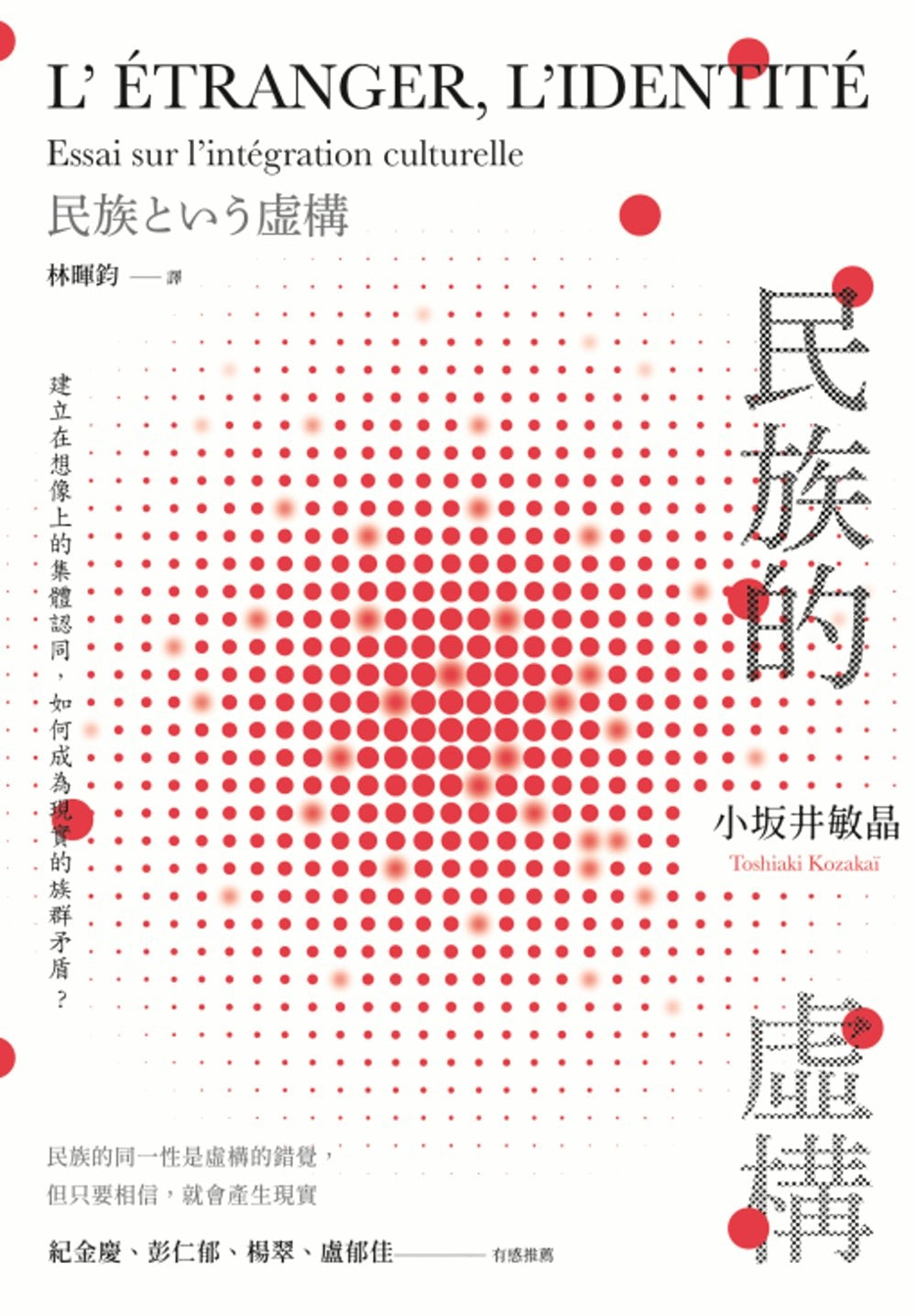

The Fictionality of the Nation
The Fictionality of the Nation
Couldn't load pickup availability
★ Using psychological experiments to demonstrate how people fabricate national identity and transform fabricated biases into real actions.
★ Explains the importance of "fictional narratives" for social cohesion, and through sociological and political philosophical arguments, shows why a community without "fiction" cannot function.
★ With the keen insight of a minority, it points out how multi-ethnic societies can both embrace different cultures and maintain their own subjectivity.
★ A game-changer, profoundly insightful for a world and Taiwan frequently grappling with ethnic issues.
The errors of history are a fundamental element in the formation of nations. ── Joseph Ernest Renan / French philosopher
Why was Hitler the driving force behind the modern Jewish state's cohesion and establishment?
Why do Arabs believe that the discovery of the New World was their contribution?
Why will all Japanese people a hundred years from now not be the same as current Japanese people, yet Japanese people will still be Japanese?
Why are future generations still responsible for rectifying and apologizing for the war crimes committed by their ancestors a century ago?
We habitually believe that "nation" is an ancient community formed by a group of people with common ancestors, lineage, and culture. However, the author of this book, Toshio Kōsakaj, argues that this community consciousness of "nation" is actually built upon "fictional" narratives that are not entirely factual.
Psychological experiments prove that when people are randomly divided into two groups, they tend to praise their own group and belittle others; biases among people, without basis or scrutiny, evolve into real social interactions.
Kōsakaj points out that "this fiction called nation" may stem from the deliberate discourse of those in power, or be formed due to survival pressure, but often it is an inevitable result of human psychological cognitive mechanisms. These mechanisms lurk beneath the surface of society, people need them to maintain group functioning, but by mistaking the fictional nation for reality, the barriers and conflicts between different ethnic groups become difficult to resolve.
Kōsakaj is a Japanese scholar who has lived in France for many years. His perspective as a foreigner has made him more sensitive to the truth and falsehood of national discourse. He draws on biology, psychology, sociology, and political philosophy to explore how community consciousness forms, is passed down, and conflicts with one another. We will discover that the transmission of the nation's "identical" subjectivity is an illusion, but as long as it is believed, it will become real. We need such fictions to maintain our relationships, but we must also know that any views of ourselves and others are only temporary. In this way, multi-ethnic societies may be able to move towards an open community that is both mutually inclusive and maintains its own subjectivity.
Toshio Kōsakaj confronts racial discrimination, continuing the unfinished journey of many, dismantling the illusory nature of the concepts of nation and race. From how textbooks in various countries create national myths, whitewash evils, and selectively highlight good deeds, to the forbidden dark histories that European academia dares not touch, there are sensational anecdotes throughout. ── Lu Yu-Chia