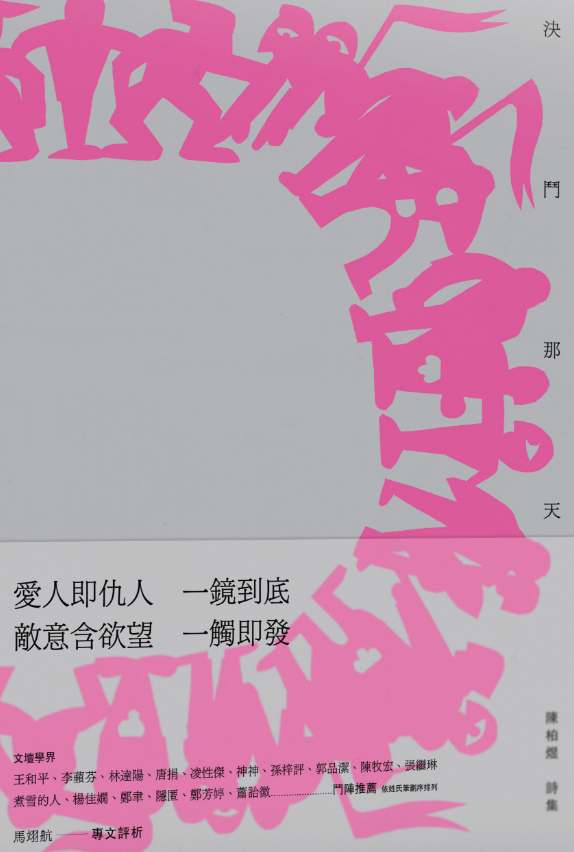

The day of the duel
The day of the duel
Couldn't load pickup availability
★Chen Po-Yu's second poetry collection after "Riding a Tiger Down"
★Selected for "Annual Taiwan Poetry Anthology" for five consecutive years
Lover is enemy, one continuous shot.
Hostility holds desire, on the verge of erupting.
"The Day of the Duel" is Chen Po-Yu's second poetry collection. In recent years, Chen Po-Yu has been prolific in his writing across diverse genres, frequently winning literary awards and being selected for annual anthologies. This latest poetry collection focuses on the poetics of homosexual desire, combining the imagery of a duel. It contains masculinity, restrained yet explosive hostility and desire. Through scene construction, allusions, and terse syntax, it aims to make "the imagery of male camaraderie overflow with queer meaning."
The inspiration for the book title comes from the documentary "The Celluloid Closet," which interprets the films "Ben-Hur" and "Red River." In "Ben-Hur," we see old friends reunited, their rapport still intact, passionately linking arms and drinking a toast. However, they soon become political enemies due to their Roman and Jewish identities. In "Red River," we see two cowboys enthusiastically exchanging pistols and competing in shooting, with one saying, "You know, there are only two things better than a fine good gun: a Swiss watch and a woman from nowhere."
Unlike his first poetry collection, "mini me," which carried a mysterious childishness, full of those tender, diminishing things, "The Day of the Duel" opens a new chapter, remarkably bright and open, yet still retaining sweetness and subtlety. It reads refreshingly, brimming with the rugged and peculiar delights of language and imagery. This new work marks a significant leap in style, as Ma Yi-Hang comments: "The briskness of 'The Day of the Duel' also comes from reducing emotional adjectives and increasing material nouns, demonstrating the poet's allocation of object positions and exploration of materiality (and emotions). ...Matter is ubiquitous and involved in everything, but the poet does not focus on microscopic details or use objects for metaphorical association. He is more concerned with the variations and trends of various 'states,' thus transforming obstacles into relationships and turning encyclopedias into love letters."
Are all you "fiancés immersed in homosexuality ready?" Hurry and catch this wave of "suffocating reading pleasure," open "The Day of the Duel," and savor "a beautiful and highly poisonous mushroom (in the words of Xiao Yi-Hui)." This is an exciting new breed of modern poetry.