
Heat wave
Heat wave
Couldn't load pickup availability
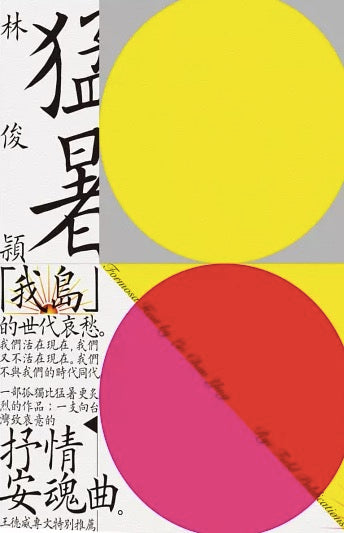
We live in the present, and yet we don't. We are not contemporary with our times.
A novel whose loneliness is more scorching than the fierce heat of summer; a lyrical requiem mourning Taiwan.
Selected for the Contemporary Novelists II series
David Der-wei Wang's special recommendation!
/
When the hawks in the sky above my island are as numerous as the mantises on the ground, butterflies flutter to form hurricanes, the headwaters of streams often thunder in the snow-capped high mountains, seven great whales doze in the southwestern coastal sandbars, when ancient trees and deer herds far outnumber humans, unaware of the Han, let alone the Wei and Jin dynasties, our ancestors foreknew such beauty would not last, and so sang eternal lamentations and requiems with their souls.
For four hundred years, my island has always been in the same camp as the chosen and victorious nations, without agency or soul, a stroke of luck? "I" examine my generation, and behind the material abundance, the truth is a sum of haste and absurdity; humanity's own plunder of this planet, the accumulated ill effects have reached a critical point... "I" am anxious that "we live in the present, and yet we don't. We are not contemporary with our times." The Island is Sleeping...
/
"Fierce Heat" tells a story of "the day after tomorrow," where nothing ever happened.
This summer, "See Taiwan" became a swansong, and "Sons of Taiwan" made a comeback; the KMT's ugly crowd vied for attention, while fundamentalists were pro-China and pro-Taiwan; the Panamanian five-star flag was raised, and the Sunflower Movement blossomed. Meanwhile, the US, China, and Japan secretly negotiated Taiwan's future. The summer heat was perfect for sleeping, and the Taiwanese had a big dream, only to wake up twenty years later, everything feeling like a different era.
This is the beginning of Lin Chun-ying's novel "Fierce Heat." He wants to see Taiwan's future twenty years from now.
"Fierce Heat" observes the inevitability of collapse from contemporary Taiwanese politics, striking a chord with readers. Lin Chun-ying uses the most intricate and ornate language to describe a page in the ebb and flow of "my islanders," prompting us to consider another facet of contemporary Taiwanese literature. Can we tolerate a dystopian novel that turns its guns inward? What is the bottom line between fictional narrative and political reality? "Fierce Heat" sees Taiwan in another form, and how should we see "Fierce Heat"—Lin Chun-ying's solo forward-looking plan?