
A Seoul Story Written by a Korean Author Exclusively for Taiwanese Readers
Discarding the Tourist Perspective, Removing Seoul's Make-up, and Exploring the City's True Fabric
Following in the footsteps of a scavenger, picking up fragments of dissident citizens in Seoul's landscape, and embarking on a journey of issue exploration
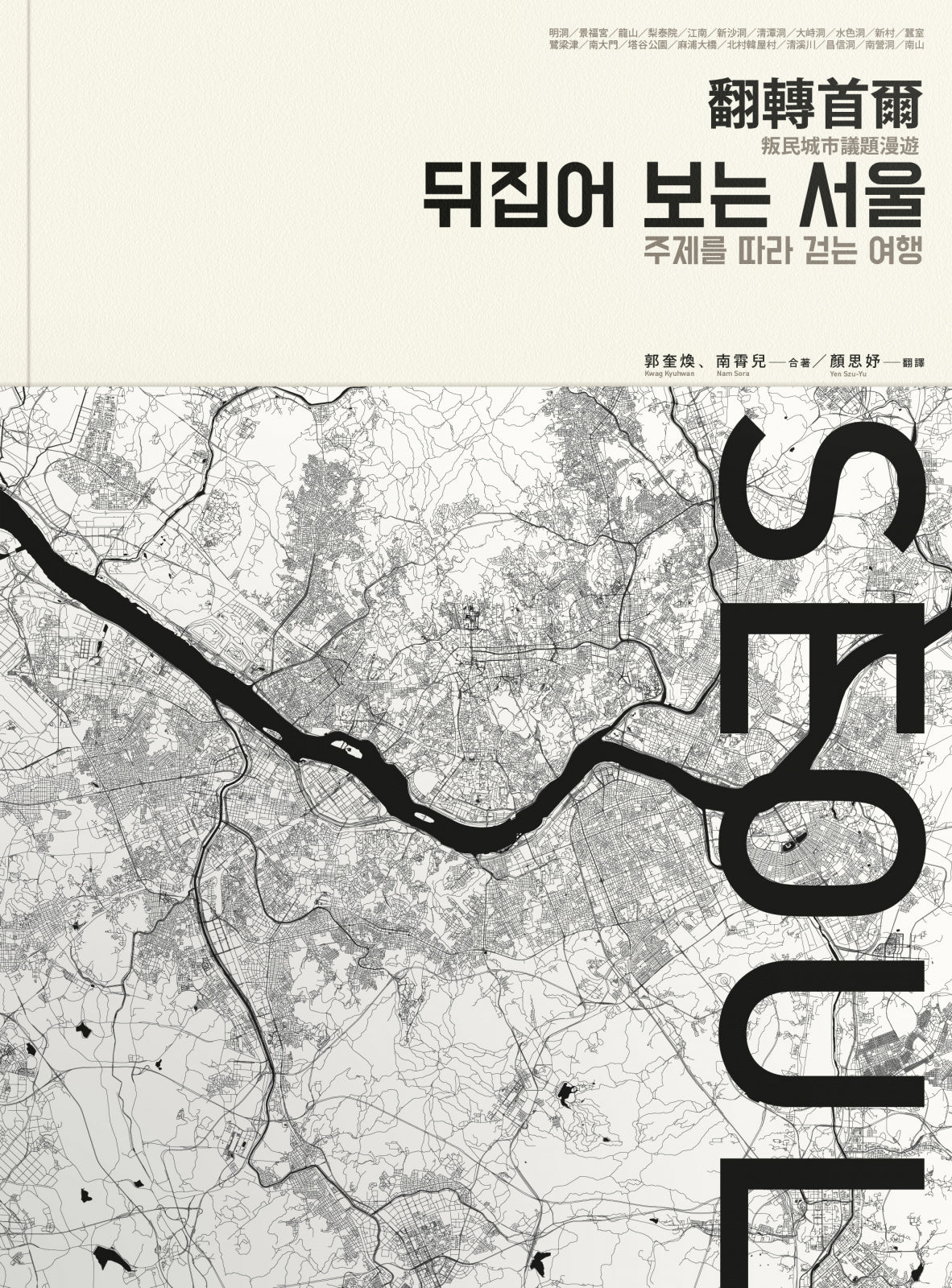
This book selects 19 of the most frequently visited Seoul attractions by Taiwanese people, discarding the tourist's perspective, routes, and desires, focusing on the subtle "rebellions" across Seoul, and attempting to present the stories behind the tourist landscape. Just as human wrinkles reflect one's experiences and adversities, joy and sorrow, memories and worries, ecstasy and pain, so too do the textures of a city. This book records "the texture of Seoul" in words, offering another possibility for exploring Seoul.
Part One, "The Other / Us – 1," focuses on the relationship between Seoul and the outside world, and between Korea and the world. Since the 19th century, the Korean Peninsula has experienced various conflicts and exchanges with external forces, and Seoul, as the capital, has personally witnessed this wave. From Hansong to Kyŏngsŏng, from Kyŏngsŏng to Seoul, the history of name changes always glimpses the shadow of "foreigners" at critical junctures. In Part One, we uncover the diverse facets of Seoul through the story of Korean Chinese (Myeongdong), the historical struggle with Japan (Palace / Gyeongbokgung), and the subtle relationship with the United States (Yongsan US Army Base).
Part Two, "Gangnam, The Realm of Desire," describes the Korean desires accumulated in Seoul. Before 1963, Gangnam was still a rural area full of rice paddies and ox carts. Today, however, it has become a symbol of Korean desire, and Part Two describes these desires. The development and gentrification of Gangnam (Garosu-gil in Sinsa-dong); the issue of gender in the craze for appearance supremacy and plastic surgery (Exit 10 of Gangnam Station); the disparity between rich and poor and extreme competition among cultural workers (Cheongdam-dong K-Star Road); the obsession with top universities and the disparity in educational resources (Daechi-dong cram school district).
Part Three, "Seoul's Daily Life and Fragments," focuses on the shadows created by desire. The desire during Korea's economic boom created today's Gangnam, but the dark shadows of these desires also enveloped Seoul. In Part Three, we wander through the dimly lit landscapes of Seoul. Places not favored by capital of desire (Susaek); the strange tale of studio apartment owners hindering universities from building dormitories for their own benefit (Sinchon boarding house street); the goshiwon village where people strive to create daily余裕 in small rooms (Noryangjin Goshiwon Village); traditional markets that compete with large supermarkets to gain a foothold (Namdaemun Market); the criticized, alienated, and excluded gathering places for the elderly and gay men (Tapgol Park and Jongno 3-ga); the meaning and site of suicide (Mapo Bridge).
Part Four, "Preservation and Taxidermy, Development and Regeneration," describes Seoul after the storm of desire, having lost its way. When the prosperity of economic takeoff is no longer, the urban strategy shifts from large-scale land development to high-end land development. In this process, various parties hold vastly different positions, oscillating between preservation and taxidermy, and Seoul is at the core of this struggle. We will explore these places one by one in Part Four. The conflict between traditional commercialization and ordinary life (Bukchon Hanok Village); the large-scale urban reorganization carried out under the strong will and promotion of the authorities (Cheonggyecheon); the corners and stories of workers (Changsin-dong sewing village and Jeon Tae-il).
Part Five, "The Other / Us – 2," further describes the internal other and us. Political power and capital power are intricately intertwined, and in this process, people distinguish between "the other and us." Unlike geographical distinctions, this distinction draws a new boundary, dividing collusion and alienation, perpetrator and victim, execution and expulsion. The capital fortress that continues to expand due to political-business collusion (Lotte in Jamsil, Jamsil of Lotte); traces of state violence rampant by the National Security Planning Agency (Namyeong-dong and Namsan); the coldness of the city and power, uprooting displaced residents (Yongsan disaster site). We will enter the border through these scenes.
Celebrity Recommendations
(Sorted by stroke count of surnames)
Wang Chih-hong | Professor, Graduate Institute of Building and Planning, National Taiwan University / Editor-in-Chief, "The Dissident City: A Dark Travelogue of Taipei"
A-Po | Writer
Yang Chien-hao | Independent Journalist in Korea / Founder, Korean Peninsula News Platform
Yang Chih-chiang | Reporter
Cheng Kai-wen | Il Il Chun Broadcasting Station (Korean Independent Music Review Fan Page)
Acclaimed Recommendations
" 'Reversed Seoul' first constructs an 'other/us' framework at the national level by showcasing the historical presence of China, Japan, and the United States in the city, immediately prompting thoughts of Taiwan's similar situation and corresponding spatial locations. Subsequently, Seoul's new Gangnam district is compared to Taipei's East District, as well as tree-lined shopping streets, gentrification, plastic surgery meccas, cram school districts, cheap rental rooms, the elderly, sex workers and LGBTQ+ individuals, university surroundings, urban renewal and demolition protests, fashion districts and garment industries, suicide bridges, and river landscaping, leading to another 'other/us' framework involving chaebol power, state violence, and public survival. There is a Taipei and Taiwan version of every single one of these. Thus, as readers follow the narrative of the book and wander through Seoul's time and space, Taipei will continuously emerge as an overlay. In other words, 'Reversed Seoul' not only leads us through 19 scenes in Seoul, examining the historical geography and human trials beyond tourist symbols, but also encourages us to reflect on, and even re-experience, the humanistic landscape of Taipei." — Wang Chih-hong (Professor, Graduate Institute of Building and Planning, National Taiwan University)
"I began reading with the expectation of an issue-oriented discussion, anticipating only the critical nature of 'dissident citizens.' However, I unexpectedly gained a 'urban tale' filled with deep affection for history and social issues. The author excels at unraveling the wrinkled textures of the city, and from them drawing out contemporary issues such as labor, commerce, gender, and even suicide, all presented clearly and with evidence, allowing history and contemporary society to converse in this space, and demonstrating different layers of profound meaning. I particularly admire the literary quality of the author's writing and the philosophical insights left at the end of each chapter, which leave one with much to ponder." — A-Po (Writer)
"Tourists, including Taiwanese, love to visit Seoul, but their goals are often limited to shopping, tasting delicious food, chasing stars, and experiencing the charm of the Hallyu wave, and they are mostly unaware of the various factors that shaped the various attractions they step on into their current appearance. 'Reversed Seoul' meticulously explores how every corner of Seoul, which we take for granted today, was formed through the intertwining of eras and generations. Behind this are various political, economic, and social factors that have triggered many human emotions, both warm and cold, and the joys and sorrows of separation and reunion, gradually accumulating to form the appearance of Seoul. 'Reversed Seoul' records many urban development phenomena that even I, who has been reporting news here for nine years, might not know or be able to clearly explain. This book is a mirror that can help you deeply understand South Korea." — Yang Chien-hao (Independent Journalist in Korea)
"Myeongdong, Gangnam, and Cheonggyecheon, among others, 19 familiar landmarks, yet behind them lie so many stories. The author leads readers through the rise and fall of the Joseon Dynasty, the complex love-hate relationship during the Japanese colonial period, the painful memories of military authoritarianism, and finally concludes with the class disparities in capitalist society. The author often compares these locations and issues with Taiwan, providing readers with the most pertinent and understandable explanations despite the seemingly distant geography. This book can inspire former visitors to Seoul to return and explore further; it can also help readers who have never been to Seoul to prepare thoroughly for a deep dive rather than a superficial tour. I recommend this book to anyone who loves Korea, or who has yet to discover it." — Yang Chih-chiang (Reporter)
"This is an advanced cultural guide to Seoul written specifically for Taiwanese readers. As the number of visits to Korea increases, Taiwanese tourists will realize that beyond Myeongdong, Gyeongbokgung, and Dongdaemun, there are many more interesting neighborhoods and stories in this city. The author not only introduces the past and present of 19 neighborhoods but also brings up issues that Taiwanese youth also encounter – such as Sinchon and residential justice, Gangnam and feminism. Furthermore, the author has deep ties to Taiwan, and the story of the Chinese diaspora in Myeongdong, as well as the subtle relationship between the Republic of China and Taiwan, are explained in great detail, which is rarely seen in most works introducing Korea." — Cheng Kai-wen / Il Il Chun Broadcasting Station (Korean Independent Music Review Fan Page)