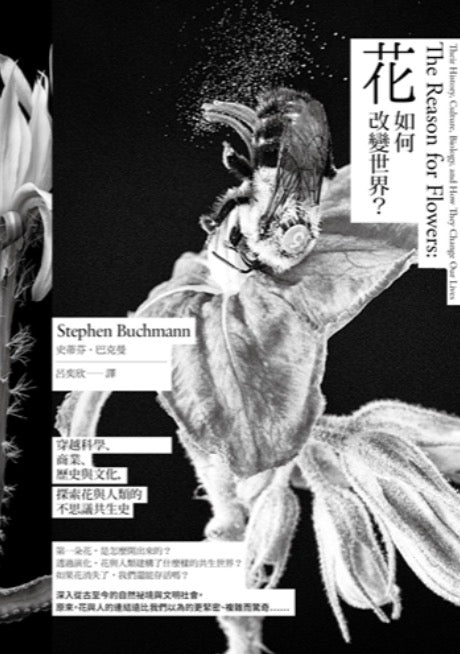

How can flowers change the world? Through science, business, history and culture, explore the incredible symbiotic history of flowers and human beings
How can flowers change the world? Through science, business, history and culture, explore the incredible symbiotic history of flowers and human beings
Couldn't load pickup availability
|The life, death, and origin of flowers: A scientist's take on flowers.
‧How did the first flower bloom?
‧What kind of symbiotic world have flowers and humans built through evolution?
‧If flowers disappeared, could we still survive?
|Flowers always bloom in an instant and wither early. Is obsessing over flowers irrational?
Among plant organs—roots, stems, "flowers," fruits, leaves, seeds, and sprouts—why is the flower uniquely poetic? Humans' love for flowers seems truly strange. Are flowers a necessity of life? Besides admiring them, why do we plant them, buy them, name them, and go to such lengths to change their growth patterns? Beyond aesthetic enjoyment, what impact have flowers had on human agriculture, commerce, and cultural life? How do gardeners, artists, scientists, perfumers, and chefs view flowers in their lives?
|How do flowers make this a flourishing world?
‧The 17th-century Dutch tulip craze actually triggered the first economic bubble in world history!
‧Why are the stigmas of saffron, whose blooms rarely last more than a day, as expensive as pure gold?
‧Without the fragrance of roses, Cleopatra VII might not have regained power and become the world-renowned Queen of Egypt.
‧After pollination, flowers transform into plump dates, wheat, and barley, nurturing the ancient civilizations of Mesopotamia.
‧Unassuming nectar has helped countless bees and pollinator populations survive, promoting thousands of years of agricultural and horticultural development.
‧Darwin's orchids and Mendel's pea flowers profoundly influenced the direction of evolutionary theory and biological gene research for the past two centuries.
‧Lilies, sage, and rosemary, common in Western funerals and weddings, besides their beauty and cultural symbolism, also have disinfecting, deodorizing, and healing effects.
It turns out that the connection between flowers and humans is far more intimate, complex, and astonishing than we ever imagined…
As a pollination ecologist, Stephen Buchmann sees the significance of flowers in botany, pollinator zoology, biotech research, global floriculture economics, and horticulture. Furthermore, humans have a multi-layered cultural intertwining with flowers in fields like cooking, photography, painting, aromatherapy, and perfume. He meticulously examines the cultural history of botany and various themes, not only observing the evolution of societal fascination with flowers but also delving into the interdependent relationship between flowers, humans, and nature.
Humans are like inhabitants of a secret garden, sharing the joy of seasonal transitions and life's cycles with flowers, but also bearing the reality of urban development, habitat loss, declining bee populations, and damaged gene pools. Buchmann not only explores why humans have an emotional and cultural need for flowers but also highlights the importance of flowers as natural and cultural assets, further demonstrating a deep contemplation of the human condition.