
Responsibility and Judgment
Responsibility and Judgment
Couldn't load pickup availability
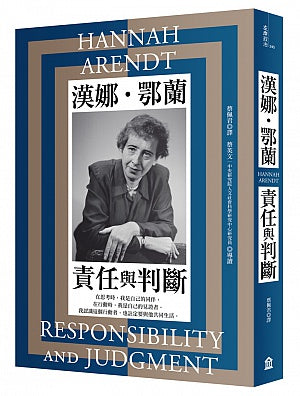
This book collects unpublished essays and speeches by Arendt from the last decade of her life, in which she raises several questions regarding moral philosophy, especially concerning "the nature of evil" and "moral choices."
No one understood better than Arendt that the political crises of the twentieth century could be viewed as a moral collapse. It was disintegrating, overtly apparent. Arendt saw the controversial, challenging, and difficult core not in human ignorance or evil, in the failure to recognize the "truth" of morality, but in the fact that the "truth" of morality was insufficient as a standard by which to judge what humans had already proven capable of doing. The only general conclusion Arendt allowed herself to draw ironically pointed to a radical and all-encompassing change, namely that everything the Western intellectual tradition had held sacred had changed completely. The tradition of moral thought was broken, not only due to political ideas but also due to the political realities of the twentieth century. The tradition was broken and could no longer be restored.
Arendt was neither a nihilist nor a moralizer; rather, she was a thinker, following the guidance of her own thoughts. To keep up with her, however, is a formidable task for the reader—not primarily a challenge to the reader's intellect or knowledge, but to their capacity for thought. What she offers is not theoretical solutions, but rich stimuli, stimulating you to think for yourself. She found Tocqueville’s insight incredibly profound: that in times of crisis or at true turning points, "the past can shed no light on the future; the mind of man wanders in obscurity." She believed that at such moments (which was precisely the case for her at that time), the obscurity of the mind was the clearest indication that we needed to re-think the meaning of human responsibility and the power of human judgment.