

Kintsugi
Kintsugi
Couldn't load pickup availability
I hope to have feathers, to rest my soul.
Is it possible for our broken selves to be mended with kintsugi?
Synopsis
“The author crafts a new narrative with a unique and elegant style, unfolding the story through deeply tender and profound images. It offers readers a poetic fable, guiding them through the various stages of loss, from complete bewilderment to the possibility of rebirth, in a simple yet confident manner.” — Bologna Ragazzi Award Jury Citation
"Kintsugi" (金継ぎ) is a Japanese art form that uses lacquer and precious metal powder to repair broken pottery. After the fragments are joined, the cracks transform into unique features, giving the object new life. This brings about a philosophical reflection: kintsugi views breakage and repair as part of an object's history, rather than merely concealing or replacing it. The repaired cracks tell the story of the "object" itself.
But what if it's a person, a home, or even… a heart that's shattered?
Do we—do we also have the "kintsugi" possibility?
This book is the latest picture book by Issa Watanabe, author of "Migrants," published in 2023. Inspired by the unique philosophy of kintsugi, it evokes a journey of resistance and repair through her captivatingly beautiful illustrations—reborn after being broken, both beautiful and unique, irreplaceable.
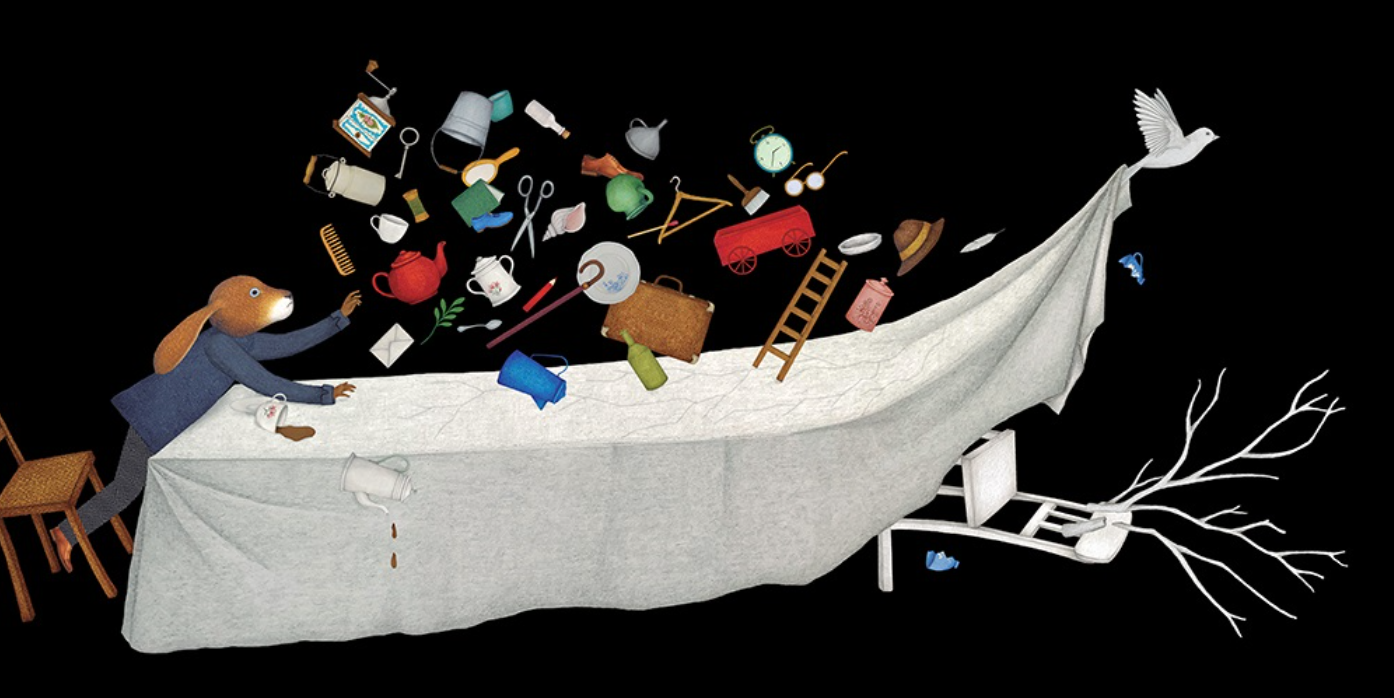
Starting from the philosophical and aesthetic concept of "kintsugi," this book depicts a rabbit and a red bird about to have a delightful tea party, much like in "Alice in Wonderland." A long dining table sprouts a forest adorned with beautiful and joyful everyday objects. However, the red bird's colors fade, turning stark white, and the bird turns and flies away.
With the bird's departure, the rabbit's daily life begins to unravel, and its past happiness shatters. The rabbit clutches a small green leaf, trying to chase after the bird, running and stumbling across the grass, encountering a giant white horse; it ventures into dense, thorny thickets, rows across a lagoon, and dives underwater… No matter how colorful the world it enters, something in a corner always starts to turn white, with death shadowing its every move… Finally, the tearful rabbit returns to where it started. It holds a broken teacup, seeing the landscape completely changed, desolate, the whole world wounded. It ponders for a moment, and decides to…
- - - -
Book Features
"Kintsugi" continues the visual style of Issa Watanabe's debut work, "Migrants," which captivated the world—wordless illustrations with black backgrounds, set against brightly colored and vibrant objects and flora and fauna, creating stunning visuals.
The author specifically quotes Emily Dickinson's poem, "Hope is the thing with feathers -," at the end of the book. This poem has been specially retranslated by poet Lin Tze-liang. This poem highlights the underlying theme of "hope," and looking back at the entire book now offers a different perspective. At the same time, we invited Jing Zhou, a Taiwanese lacquer artist skilled in kintsugi, to write a professional guided reading, which is included on the back of the small poster in the book.
We sincerely recommend revisiting Issa Watanabe's "Migrants" and the renowned Ukrainian picture book duo Romana and Andriy's "War Changed Rondo" after reading "Kintsugi" for a deeper appreciation.