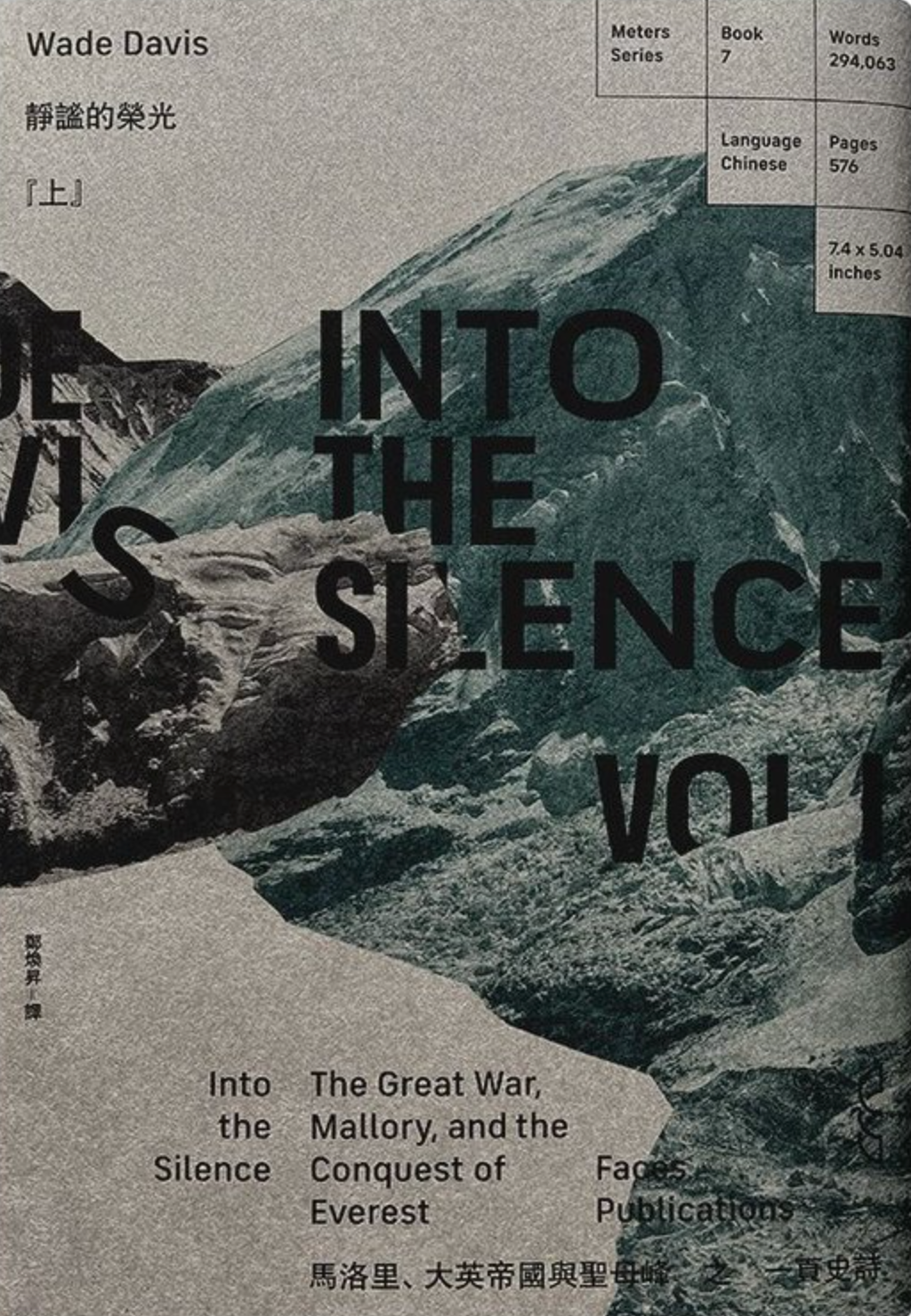

Quiet Glory: Mallory, the British Empire, and an Epic Page of Everest History (Sold as a Two-Volume Set)
Quiet Glory: Mallory, the British Empire, and an Epic Page of Everest History (Sold as a Two-Volume Set)
Couldn't load pickup availability
|Curated, Selected, and Introduced by Chan Wai-hung ── A work from the meters Mountain Literature series by Faces Publishing|
“Only those moments lived with certainty are the true value of life.”
Winner of the Samuel Johnson Prize, the UK’s highest honor for non-fiction writing
Wade Davis, Canadian anthropologist, writer, and explorer
After ten years of research, visiting the Himalayas, reading over six hundred related works, and interviewing relevant individuals
Focusing on three epic British Everest expeditions in the early 20th century, after World War I
Combining personal biographies of famous mountaineers, war history, imperial history, mountain literature, and exploration literature
Profoundly recreates the magnificent epic of humanity's encounter with Mount Everest
Wu Yuan-Ho|Chairman, Taiwan Mountain Trails Association
Chiang Hsiu-Chen|Chairwoman, Taiwan Formosa Mountain Education Promotion Association
Lu Chung-Han|Global Citizen and Explorer
Hsu Ru-Lin|Mountain Literature Author
Chang Yuan-Chih|Taiwan's New-Generation Mountaineer
Snowgoat Vision|Mountain Photographer
You Chih-Chia|Ph.D. in Forestry, National Taiwan University; Author of "Plants Connecting the World"
Tung Wei-Yen|Urban Mountain Climber (Mountain Urbanite)
Chan Hung-Chih|Writer
Chan Chiao-Yu Tri Fish|New-Generation Mountaineer
Chiang Chu-Shan|Associate Professor, Graduate Institute of History, National Central University; Director, Center for Public History Research
Hsieh Wang-Lin|Writer
Yan择雅|Publisher, Writer
──Recommended
"Because it's there."
After the shock and devastation of World War I, a generation of mountaineering elites, represented by Mallory, who coined this famous phrase,
flew halfway around the world at the fervent expectation of the British nation, ventured deep into inland Asia, expending immense effort and even sacrificing their lives,
simply to climb the world's highest peak, Mount Everest, which no one had ever summited.
And Mallory's eventual disappearance on Mount Everest became the greatest mystery in 20th-century mountaineering – was he the first person to summit Everest?
Canadian anthropologist and explorer Wade Davis spent ten years researching,
personally visiting the Himalayan region, reading over six hundred related works, and interviewing relevant individuals,
to document the entire story of the three British Everest expeditions in 1921, 1922, and 1924, and how the proud figures and spirits of a generation of mountaineers were forged.
Even though they ultimately failed, the three expeditions still set the greatest records in human mountaineering history.
The book seeks to explore not whether Mallory summited, but what drove these mountaineers to push themselves, even to sacrifice, until their very last breath?
【Praise】
As the title suggests, the book's pages begin with World War I, then shift to the conflicts between the British Empire and the Tibetan government, before finally introducing the expedition itself... I must say the author is incredibly knowledgeable, and his research and citations are meticulously clear, making the story captivating and engaging. After finishing the book, I was struck by the realization that this was a reenactment of Homer's epic "The Iliad"! Mount Everest is Troy, and the heroes of the Greek expeditionary force besieged it for ten years, with the price being a series of tragedies for both sides!
——Wu Yuan-Ho, Chairman, Taiwan Mountain Trails Association
What does it truly take to climb Mount Everest? Does preparation determine success? Especially for humanity's first encounters, from the immense manpower and resources to meticulous thought, even the mountaineers' broad knowledge and the blending and fermentation of local cultures and religions, all paint rich and precious abstract images. How small is humanity in nature? And why does climbing them make human hearts great? Witness the true world's first — Mallory and his team, after being forged by the crucible of World War I, continued to pursue Mount Everest with their scarred souls.
Through the long river of history, from its source to the traces left along its course... just as any cliff face of an eight-thousand-meter peak takes at least tens of millions of years to form, how fortunate it is to be able to climb upon it! Even if body and mind are exhausted, the soul is comforted. Today, when the world's highest peaks are conquered in a few hours of speed climbing, rather than months of trekking, the mental and spiritual insights we lose along the way will far outweigh what we gain. Reading this book, you can view the true meaning and value of pursuing Mount Everest from different perspectives.
——Chiang Hsiu-Chen, Chairwoman, Taiwan Formosa Mountain Education Promotion Association
Hearing "Mount Everest," the word conjures in my mind that rock and snow mountain, transcending a hundred years of climbing history. It is the highest point on the Earth's surface, the sanctuary of a climber's heart. When I first went to Nepal to climb in 2017, I first arrived at Namche Bazaar (elevation 3440 meters), the busiest village in the mountains. I arrived during the off-season for climbing and trekking, weaving through locals carrying goods and herding yaks, all diligently preparing for the coming season, dripping with sweat. Lazy dogs occasionally lifted their heads to gaze at us scattered tourists, like old prayer flags fluttering idly on the suspension bridges along the way. In the dark, bleak, and deserted village, there was an Everest Museum at a high point, directly facing Mount Everest in the distance. A bronze statue of Tenzing Norgay stood there, holding an ice axe, while Everest loomed indistinctly in the gloom, full of mystery. That was my true first encounter with it, inspiring awe, yet also furrowing my brow. Facing the near future, I would be close to its embrace; fate outlined a fatal gravitational pull, a lofty status deeply embedded in an enclosed halo in my generation. After that brief first meeting, I didn't know how to bid farewell upon leaving, and while it didn't immediately draw me to knock on its door, I knew it wouldn't be long.
——Lu Chung-Han, Global Citizen and Explorer
The mountain is silent, yet stories blossom from the lives that touch it. Following the emerald green that grows on ice, rock, soil, and even tree trunks, one gently traces it to its base, only to discover: the roots of the story draw nourishment from the entire earth, weaving a dense, intricate web.
Regarding the first ascent of Mount Everest, Britain, as an old giant struggling to rise from the ruins of war, probably paid a price unmatched by any other nation.
George Mallory's classic phrase, "Because it's there," became the interpretation for countless climbers' reasons for seeking the mountains, originating from the era when the British Empire, where the sun never set, established itself in the ancient civilization of Asia—India. After the inhumane devastation of World War I, "the first ascent of Mount Everest" became the spiritual Holy Grail to rekindle the empire's glory, driving an entire generation who survived the fires of war to transcend life and death in that icy wilderness, writing an immortal epic of three expeditions.
Through "Into the Silence," we can see the author's meticulous research and careful arrangement. By interspersed letters, descriptions of war history, and character and cultural portrayals, the author brings readers the origin and process of "humanity's pursuit of Mount Everest," as well as how the tragic grand era of pursuing imperial glory gave rise to all these moving and heroic events.
The political and military rivalries of various nations played a crucial role in the adventure of Mount Everest. This epic, mixed with gunpowder and blood, stained the ice peaks red, pulling us away from the purity of climbing, allowing climbers to reconsider once again: for what do we climb in this contemporary age, and what do we truly seek?
——Snowgoat Vision, Mountain Photographer