
Sadness is an elephant that needs to be understood 🐘
"If you're sad, I'll be there for you." So reads the bellyband of the picture book "The Elephant in the Shadow."
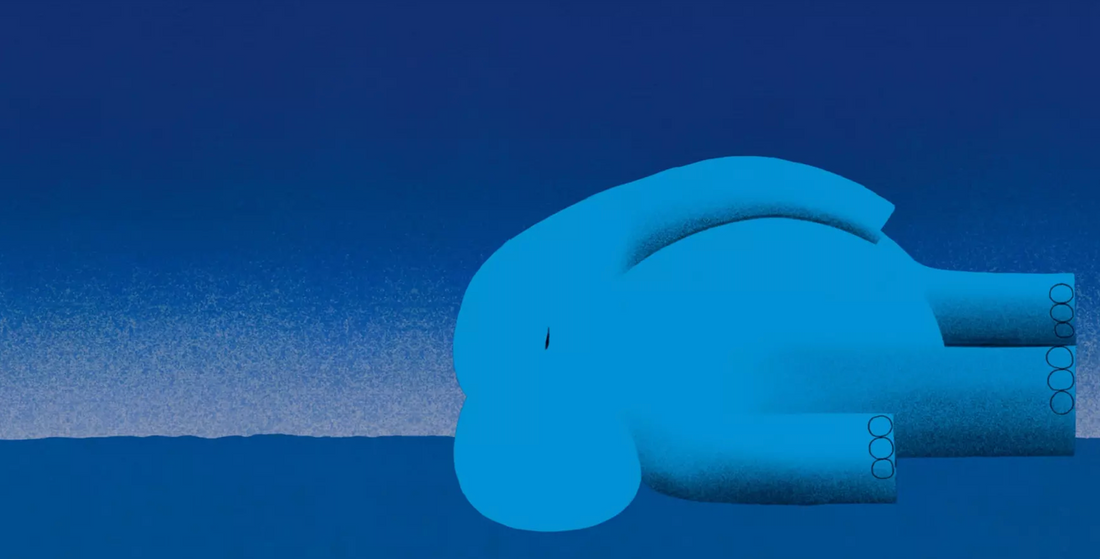
This is a picture book by Canadian author Nadine Robert. The protagonist of the story is a blue elephant who lies quietly in the shadows, seemingly cut off from the world, unwilling to move or speak, immersed in his own sorrow. When the other animals on the savanna find out, they all come to him, using various skills to try to cheer him up. Some tell jokes, others perform acrobatics. However, no matter how hard everyone tries, the elephant remains motionless, as if the weight of his sadness is suffocating him. Perhaps we have all experienced such moments, when sadness strikes, and no matter what others do, we just can't lift our spirits.

The animals were initially at a loss. They couldn't understand why their efforts couldn't bring the elephant out of his gloom, nor could they comprehend why the elephant was sad.

Until one day, a little mouse quietly sat beside him, doing nothing. So the elephant asked him, "You're not here to change my mind, are you?" The little mouse shook his head and said, "No, I just want to sit here and rest for a bit. But if you want to know, I actually..." The little mouse began to tell his own story. After listening, the elephant suddenly burst into tears. Then they slowly emerged from the shadows, little by little, towards the faint light ahead.
The little mouse didn't try to change the elephant, didn't try to force him to smile, but simply accompanied him quietly. The elephant still didn't speak, but the air around him seemed to lighten a little.
At the end of the story, the reason for the elephant's sadness is not revealed, but I think the reason is actually not important, because some sorrows are best processed alone. Everyone in our lives may have been like this elephant, carrying an unspeakable pain, and what truly brings us some comfort is often not external "answers" or actions that try to "change" people, but rather understanding and companionship.
Sadness is one of the deepest human emotions; it should not be seen as a problem or a flaw. As psychologist Carl Gustav Jung said, "Even a happy life cannot be without a measure of darkness, and the word 'happiness' would lose its meaning if it were not balanced by sadness." Sadness is a part of our psyche. Through sadness, we connect with our truest selves. We don't need to suppress it or rush to "cure" it, but rather allow ourselves to feel it, accept it, and learn to coexist with it.
Another picture book by French author Cécile Roumiguière, "My Sadness Is an Elephant," also uses an elephant to symbolize sadness, telling a story about loss and acceptance.

When the little boy's grandmother passed away, a huge elephant suddenly appeared in his life, accompanying him, making him feel oppressed and exhausted. The elephant sometimes grew very large, filling the entire room; at other times, it shrunk very small, but it was still there, impossible for the little boy to ignore. So the little boy asked his mother a question: "What do you do if you have a friend who takes up a lot of space?" His mother thought for a moment and said, "I might find a place where it can be comfortable."
So the little boy learned to accept this "elephant." When visiting the grave, he planted saplings and created a garden for his grandmother, and quietly told the elephant, "You can live here too." From then on, the elephant gradually shrunk, eventually becoming the little boy's good friend, and they often missed grandmother together. The picture book personifies sadness as an elephant. An elephant is cumbersome, but we have the ability to shrink this elephant, making it small enough to carry around without taking up space.

It turns out that when facing sadness, we don't need to rush to find ways to "solve" it or make it disappear. Instead, we should listen and be present. Perhaps, when we give sadness enough space, it will find its own way to resolve, and we will, in turn, understand ourselves better.
-