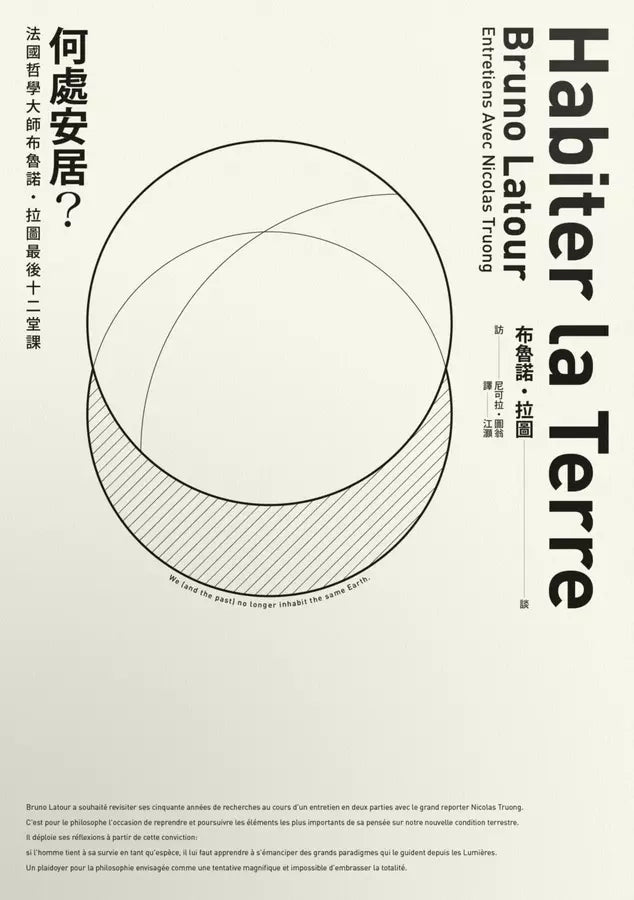

Where to Dwell? The Last Twelve Lectures of French Philosopher Bruno Latour
Where to Dwell? The Last Twelve Lectures of French Philosopher Bruno Latour
Couldn't load pickup availability
Philosophy × Anthropology × Sociology
We Are No Longer Living on the Same Planet
Over 10,000 Copies Sold in France One Month After Publication!
💡Acclaimed Recommendations (in order of surname strokes):
Hung, Kuang-chi|Associate Professor, Department of Geography, National Taiwan University
Lin, Hsin-hui|Novelist
Chen, Tsung-wen|Distinguished Professor, Department of Sociology, National Chengchi University
Chen, Jung-tai|Translator of "Facing Gaia", Anthropological Researcher
Fu, Ta-wei|Emeritus Professor, Institute of Science, Technology and Society, National Yang Ming Chiao Tung University
A series of interviews with a master of philosophy, simplifying complex ideas, the last Latour book for his followers' shelves,
and the best guide for us coexisting on Gaia to understand Latour.
The renowned French philosopher Bruno Latour, who recently passed away, was interviewed by journalist Nicolas Truong in 2021. The French publisher compiled this series of interviews into a book, serving as Latour's farewell gift to the world.
This book contains 12 interviews. In the first half of the book, Latour explains how we have changed the Earth and how environmental disasters have become an unavoidable part of modern life. The second half lists Latour's lifelong philosophical reflections on the truth of religion, the achievements of science, and the interactions of politics. It is like entering a "Latour Museum" to gain a comprehensive understanding of his thought, from beginning to end, clear and complete.
Since the 17th century, the world has been considered to consist of two disconnected levels: on one side, the objectively real world known by science; on the other, the subjective world constituted by people's imagination, feelings, or impressions of the world. The latter is subjective and interesting but not constitutive of the world. This "forked world" was considered by Latour to be the definition of the "modern world."
Today, people are disoriented by ecological problems (climate, viruses, bacteria, etc.) and unable to respond quickly to catastrophic situations. Bruno Latour believes this is because people mistakenly think they are still living in the past—a physical world without agency, controllable and calculable; a scientific world that can be owned; a rich and comfortable world provided by production systems. In fact, we are leaving this object-world known by science and entering a surprising "living" world.
Taking COVID-19 as an example, Latour points out that when people claimed that great economic movements would continue to develop, the huge machine of development and progress suddenly stopped within a few weeks. He reiterated and became more certain that "modernization" is a front of destruction; if we modernize the world, it will become uninhabitable for humans, because modernization contradicts human existence as an ecological subject.
Latour juxtaposes the realization that "we are no longer living on the same planet (as in the past)," and the research based on this realization, with the scientific historical moment of Galileo in the early 17th century, believing that the first scientific revolution and the transformation of the modern world are equally monumental undertakings, and can similarly change the world.