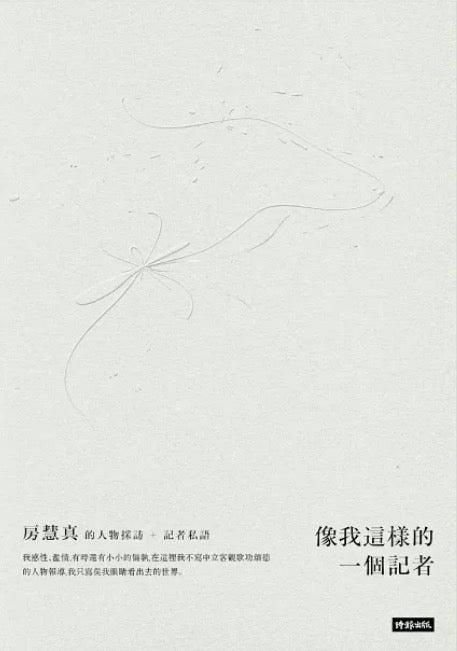

A Journalist Like Me: Fang Hui-chen's Interviews and Personal Musings
A Journalist Like Me: Fang Hui-chen's Interviews and Personal Musings
Couldn't load pickup availability
▋ Fang Hui-chen's first collection of interviews ▋
From essayist to rookie reporter
From Next Magazine to The Reporter
Reporters don't always have to be detached observers
Scorching words can also draw hot blood
◤ Included with the book ◢
・48-page "Whispers" supplement
≡ Special features ≡
・"Interviewing Techniques" – the essence of a reporter's training, fully revealed
・"Nie Yinniang and Her Master" – a widely shared online article
・Two articles documenting and reflecting on the "March 18 Student Movement"現場紀實與省思兩篇
This book collects thirty-three of Fang Hui-chen's interviews, thirteen "reporter's whispers," seven "post-interview reflections," two "on-site documentations," and one "interviewing techniques" article. In 2011, she became a rookie reporter halfway through her career, coinciding with a turbulent era of fragmented news and media behemoths. Lacking the traditional background of a journalist, she gained rigorous training at Next Magazine and developed her own comprehensive understanding, becoming a representative of the unconventional reporter: with cool, rational eyes, a scorching, emotional pen, and a fervent, sincere heart.
This is not just a collection of interviews; it is also a reporter's book of cultivation, using introspective confessions to portray a turbulent media era. The "interviews" are divided into four sections based on their characteristics: "Engaged in Art," "Committed to the Tao," "Adhering to Benevolence," and "Grounded in Virtue." The author vividly depicts the charm of her subjects while also unearthing the hidden dark side of the moon, where light and shadow coexist. "Reflections" are post-interview musings and additions, like an off-screen voice and the reporter's personal thoughts. "Restricted Places" documents the March 18 Student Movement from its initial stirrings to the decline of its star figures, a period of dramatic change akin to the shifting sands of time.
The supplement, "Whispers," includes self-questioning, emotional self-analysis, and late-night recollections of friends and poetic ramblings, revealing the arduous and winding path of a reporter. The five-thousand-word "Interviewing Techniques" at the end of the text is the author's unreserved secret manual of skills acquired, allowing anyone aspiring to be a reporter to navigate the path of journalism more broadly and enduringly.