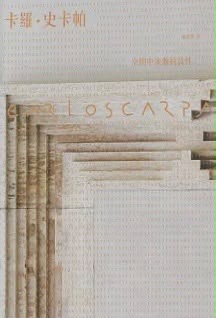

Carlo Scarpa: Poetics in Flowing Space
Carlo Scarpa: Poetics in Flowing Space
Couldn't load pickup availability
Carlo Scarpa (1906-1978), hailed as one of the most important architects of the 20th century, possessed a unique artistic talent and a deep respect for history, setting his works apart from those of his contemporaries. Born in Venice, Italy, Scarpa's designs are a crystallization of profound cultural and historical observations.
Scarpa's "design" is a new expression that condenses deep cultural and historical observations. The so-called "Scarpa's cultural re-representation imagination" comes from how it opens up a new "heartfelt perspective" for us to rethink architectural space, awakening it from the dust of time through architectural details, spatial sense, and colors. He used design to express a unique and deeply contemplative cultural viewpoint.
Italian architectural historian Manfredo Tafuri called his eccentric individuality a counter-force to modern commercial culture. K. Frampton, an architectural historian at Columbia University, stated that Scarpa's architecture was a watershed in 20th-century architectural design, especially his unique syntax and experiments in combining multiple elements with a montage technique. Many contemporary architects, including Fumihiko Maki, Arata Isozaki, R. Moneo, Thom Mayne, and Eric Moss, admire the imagination, details, and aesthetics of Scarpa's works. Fumihiko Maki even described it as "superb appreciation under the highest capability, an absolutely incomparable heroic sense in the private realm." What he offers us is an endless source of creative inspiration: his imagination and constructive expressiveness remain an unparalleled asset in architectural history.
If we believe that "master spirit" in design education is an important factor in shaping a designer's creativity and emotional connection, then Scarpa is undoubtedly one of the key figures among them.
The author of this book, Chu Jui-chi, an architectural scholar and critical writer, studied under Marco Frascari (b.1945), a student of Scarpa during his time teaching at the Venice School of Architecture, while Chu was studying at the University of Pennsylvania's Department of Architecture. Frascari, as one of the central figures in Scarpa's theoretical research, has at least six works on Scarpa that are widely considered primary sources for understanding Scarpa's creative spirit and design theories. Starting from this foundation, the author of this book writes and researches Scarpa's architectural style and design works, analyzing the invaluable assets he left in architectural history.
The book is divided into three parts. The first part, "A Profile of Carlo Scarpa," describes his upbringing in Vicenza and his subsequent learning and professional experience in Venice, as well as the people, events, and things that profoundly influenced him throughout his career, allowing readers to experience the process of how a master's personality was shaped. The second part, "The Thinking of Carlo Scarpa," distills the various axes of Scarpa's design philosophy, exploring the rich, internal, and expansive sources of his design. The final part, "The Designs of Carlo Scarpa," selects seven important works by Scarpa, transforming them into a viewing route through text and images, leading readers to experience the master's architectural spaces firsthand.