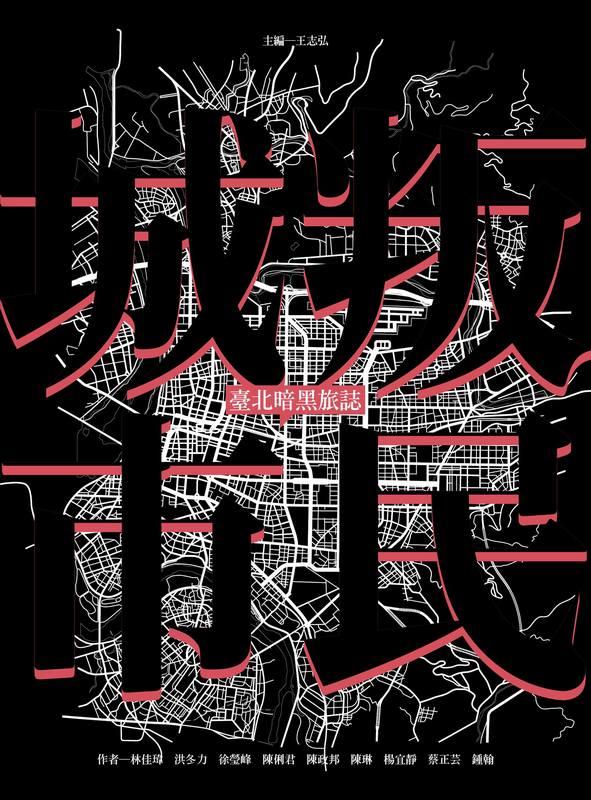

See the hidden history of the city through the eyes of the rebellious;
Explore the complex urban fabric with the heart of a traveler,
Catch a glimpse of the rebellious soul that continuously emits faint light behind the dazzling landscape.
Taipei has been shaped by various regimes, capital developments, and institutional frameworks, creating its current landscape with multiple layers. Beyond the mainstream image, does this capital city still have room for the marginal, the interstitial, the vulnerable, the底层, the alternative, and other rebellious scenes? How can people experience this city differently, and thus perceive the entanglements of justice and injustice, desire and trauma, anxiety and suppression in urban life? To this end, this book, as an experimental project, attempts to plan an alternative city tour, allowing people to see a "rebellious city" that escapes mainstream narratives.
In this book, "rebellious people" has two connotations. First, rebellious people refer to those who participate in various organizations or actions that challenge the establishment. Second, rebellious people also refer to groups or things that are at odds with the mainstream urban landscape, and are discriminated against, excluded, and stigmatized. The first part of this book, based on the experiences of these two types of rebellious people, selects fifty-two locations or events as tour spots, introducing the context and controversies of the events, and guiding readers to visit them. The second part designs six columns (including protest victory/sacred sites, political rights, gender issues, youth subjectivity, anti-displacement movements, and historical preservation), discussing them in lengthy essays, providing readers with a more macroscopic context of rebellious Taipei.
This book also provides two sets of themed itineraries that can be practiced on-site. The first itinerary, centered on anti-displacement and preservation, plans visits to Huaguang Community, Shaoxing Community, Treasure Hill, and Parks 14 and 15, thereby reflecting on the tension between the removal of urban spatial textures and specimen-like preservation. The second, purely walking itinerary starts from the Bo'ai Special Zone, the center of power, and follows "Zhongshan North Road," the road of power since Japanese colonial rule, to explore marginal and alternative urban experiences, including: the male homosexual experience in 228 Peace Park, the ethnic landscape of Taipei Main Station and Indonesian Street, and the Shangyang Records store incident and street guerrilla tactics triggered by Chen Yunlin's visit to Taiwan. It is hoped that readers can later connect the locations and events introduced in the book to design their own rebellious city tour, and thus uncover those still-buried urban memories.
Features of this book
★Includes a "Rebellious City" tour map and two tour itineraries.
★This book serves as a "guide to everyday social movements," fully embodying the spirit of the "Scenes" series: piercing through obscurities with observation, combating oblivion with documentation, and relentlessly resisting in everyday life.
★This is a living book, a breathing book, a book that should be taken with you. This book comes with two themed itineraries, and a series of guided tours will also be launched upon publication. The meaning of reading lies in putting it into practice, uniting person and book.
Endorsements from renowned individuals
Rebellious Recommendations
"Historical buildings, hipster alleys, delicious food, and coffee are all great, but "Rebellious City" makes you directly clash with Taipei, exploring its true underlying texture." —Pi Heng-da (Professor, Graduate Institute of Building and Planning, National Taiwan University)
"The authors call themselves 'rebellious' and introduce 'rebellious' people because they refuse to go through the motions and waste their days, which is why they enthusiastically transform urban research into lively tourism." —Su Shuo-bin (Associate Professor, Graduate Institute of Taiwanese Literature, National Taiwan University)
"Practice becoming a rebel, walking in an always uncomfortable and uneasy posture, rising up in the darkness. Practice imagining the light ahead and the utopia that can be reached." —Wu Yi-jui (Assistant Professor, Medical Humanities and Medical Education Centre, The University of Hong Kong)
"If one day we can re-interpret the city, make ourselves feel strange and confused, and re-understand how the urban landscape is complexly composed by people, perhaps we will have more delicate empathy." —Huang Shu-mei (Project Assistant Professor, Graduate Institute of Building and Planning, National Taiwan University)
Rebels Emerge, Active Recommendations
Wu Yi-chen, Author of "Free Backpacker: A Small Trip to Taiwan's Democratic Sites"
Chen Yi-chi, Author of "Dog-Beating Cycling: Cycling Exploration of Kaohsiung Port History"
Pi Heng-da, Author of "Space is Power," "Space is Gender," "Space is Imagination"
Su Shuo-bin, Author of "Invisible and Visible Taipei"
Chiu Yi, CEO of "Taipei Walking Tour" (www.taipei-walkingtour.tw)
Xiao Yu-chen, Head of Historical Text at "Taiwan Bar" (www.taiwanbar.cc)
Wu Yi-jui, Assistant Professor, Medical Humanities and Medical Education Centre, The University of Hong Kong
Huang Shu-mei, Project Assistant Professor, Graduate Institute of Building and Planning, National Taiwan University
Huang Ke-hsien, Assistant Professor, Department of Sociology, National Taiwan University
Fang Yi-chieh, Assistant Professor, Institute of Anthropology, National Tsing Hua University