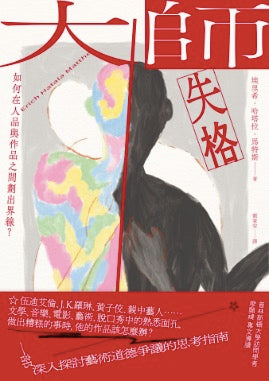

Master Disqualified: How to Draw the Line Between Character and Work?
Master Disqualified: How to Draw the Line Between Character and Work?
Couldn't load pickup availability
Woody Allen, J.K. Rowling, Mickey Huang, pro-China artists...
Familiar faces in literature, music, film, art, and stand-up comedy,
When they do something terrible, what should happen to their work?
Can we separate our feelings for creators from our evaluation of their work?
Is it wrong to appreciate the work of morally flawed creators?
In recent years, numerous moral controversies have erupted both domestically and internationally involving renowned creators, who may be famous and popular directors, writers, actors, painters, talk show hosts, or singers. As their past immoral deeds are exposed, the value of their work is inevitably re-evaluated.
Facing these "fallen" masters, some advocate for boycotting their works and removing them from public view, otherwise it is complicity with the creators' misdeeds; some call for "art for art's sake, morality for morality's sake," believing that a creator's life should be separated from their work to fairly assess its value; others feel deeply betrayed and hurt, unable to support their beloved works anymore. Why are there these divisions? Can we separate our feelings for creators from our evaluation of their work?
When facing moral controversies, how do we find our moral compass?
The author of this book, Mattes, is a philosophy professor at Wesleyan University in the United States. In 2021, Hollywood director Woody Allen was embroiled in a sexual assault scandal, and Mattes, as a Woody Allen fan himself, found that he could no longer view the famous director's films with the same eyes. Starting from this seemingly isolated controversial incident, he realized that for a long time, the trade-off between aesthetics and ethics has been a hotly debated topic in the art and cultural fields.
Mattes uses a familiar tool—philosophy—to guide us in contemplating the difficult issues of art ethics. With a witty yet humorous touch, he explores the relationships between creators, their works, and their audiences; he also integrates contemporary issues such as online backlash, the #Metoo movement, and cancel culture, to sort out the moral responsibilities of individuals and the public. This book provides us with long-term and profound insights into how to choose our values and thereby change the consumer society and artistic and cultural spheres we inhabit.