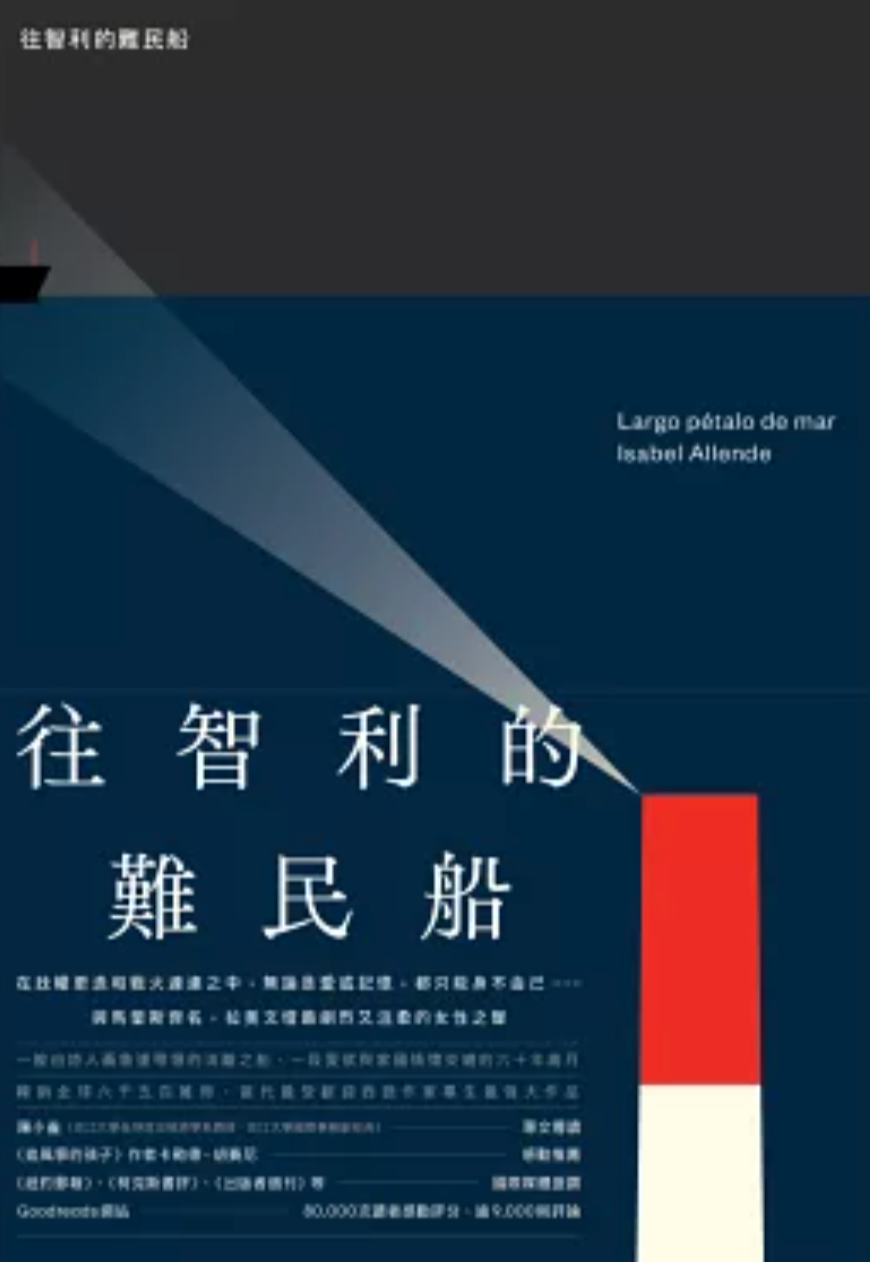

Refugee boat to Chile
Refugee boat to Chile
Couldn't load pickup availability
Amidst regime changes and endless wars,
Both love and memory are at the mercy of fate...
On par with Márquez, the fiercest yet tenderest female voice in Latin American literature.
A ship of displaced people led by the poet Neruda
Sixty years intertwined with love, desire, and national sentiment
The most powerful work by the contemporary Spanish-language author who has sold 65 million copies worldwide
=Jointly curated by renowned experts for the Traditional Chinese Edition=
Chen Hsiao-chueh (Professor, Department of Global Political Economy, Tamkang University; Vice President for International Affairs, Tamkang University) provides a special introduction.
Aaron Nieh – Binding Design
▍Book Features
1. The author of this book is the most widely read contemporary Spanish-language author, having won over fifty literary awards. Her works have been translated into thirty-five languages, with global sales exceeding 65 million copies.
2. Highly recommended by international media and writers. A New York Times bestseller. Over 80,000 reader ratings and more than 9,000 reviews on Goodreads.
3. Weaving family stories with real historical events, it addresses concerns about refugee issues, life in foreign lands, and cultural roots.
▍Synopsis
The turmoil of the era brought together people who otherwise would never have fallen in love.
They would always be each other's strongest support,
Because before they fell in love, they had already deeply entered each other's lives...
As World War II broke out, civil war also swept Spain, forcing hundreds of thousands to flee to the French border. Roser, pregnant, bravely scaled mountains in bitter cold, finally reuniting with Victor, the brother of her beloved who had died in the war. At that time, the poet Neruda was organizing a refugee ship bound for Chile. Thus, the two had no choice but to enter into a marriage of convenience to gain passage as a couple to the unfamiliar continent of the Southern Hemisphere and settle down. Roser's child was born safely, and Victor, while studying hard to regain his doctor's license, also ran a small tavern. Roser, with her piano talent, gradually became a well-known local musician. Initially partners rather than lovers, during their long exile, Victor fell in love with a local wealthy woman, and Roser had a fleeting romance with a fellow refugee. Yet, their understanding and dependence on each other deepened over years of companionship. Just as everything was slowly getting on track, a coup erupted in Chile, leading to the death of President Salvador Allende, with whom Victor had a good relationship. Their lives were once again thrown into turmoil...
Isabel Allende, the most renowned bestselling author in the Spanish-speaking world, has garnered widespread attention in the masculine Latin American literary scene with her unique female perspective, establishing herself as a pioneer of the female voice. This novel, spanning sixty years, tells the story of displacement and rootedness amidst great historical changes, from Neruda's refugee ship during the Spanish Civil War to the death of President Salvador Allende during the Chilean coup. Despite the cruel times, her writing is warm and gentle, skillfully combining historical facts with moving stories. In an interview, she once said, "A novel is a lie, but also another form of truth." Khaled Hosseini, author of "The Kite Runner," highly praised her work, believing she is an author who will undoubtedly be celebrated by future generations.
▍About Isabel Allende and "A Long Petal of the Sea"
1. The Mysterious January 8th
Isabel's first novel, "The House of the Spirits," was written on January 8, 1981, and became an internationally renowned bestseller. Since then, she has begun writing each of her long novels on January 8th, including "A Long Petal of the Sea."
2. A Novel Rooted in Reality
Isabel Allende writes about displaced people and immigrants, drawing from her own experiences. In addition to her upbringing in a diplomatic family, she herself fled to Venezuela after her uncle, President Salvador Allende, was assassinated. At the time, no one expected this departure to last twenty years—foreign lands, hometowns, and other lands are also important themes in her works.
3. The Main Character Victor in the Story
During her exile in Venezuela, she met a Spanish man named Victor who had previously traveled to Chile on the refugee ship Winnipeg. He told her his story, and forty years later, Isabel used him as a prototype to create the tall, melancholic Victor in her novel.
4. Neruda's Influence
Neruda's poetry not only served as her literary awakening but also played a crucial role in shaping her sense of identity with her homeland. She said that while she lives in English, her writing is in Spanish. Neruda once told her during an interview that Allende was the worst reporter in the country, unable to remain objective and too imaginative, and that she should be a novelist.
5. Isabel's Love Story
In "A Long Petal of the Sea," the relationship between Victor and Roser represents what Isabel considers the most beautiful state of love. She once said she liked love stories and happy endings but could never write them because happy marriages in reality are often fleeting. She herself has had several marriages. At the age of seventy-four, a comment she made on National Public Radio sparked listener dissatisfaction, leading to a long correspondence and debate between them. This listener later became her husband.
6. Writing Amidst the Masculine Latin American Literary Scene
As the Latin American literary scene, led by Márquez, swept the world, Isabel, as the only bestselling female author, became an awkward figure for critics of the time (Isabel stated that despite the significant number of Latin American women writers since the 17th century, they had all been ignored). After the unprecedented success of "The House of the Spirits," publishers suddenly became aware of the rising female readership, which was considered a significant contribution to gender balance in the Latin American literary scene.
▍Litterateur Series: Establishing European and American Literary Landmarks
(Listed alphabetically by surname)
Chu Chia-han (Writer), Lee Ming-tsung (Sociologist, Writer), Fang Hui-chen (Writer, Journalist), Chi Ta-wei (Writer, Associate Professor, Graduate Institute of Taiwan Literature, National Chengchi University), Chen Po-ching (Writer), Chen Xue (Writer), Chen Rong-pin (Translator, Writer), Tung Wei-ko (Writer), Feng Ping-chia (Chair Professor, Department of Foreign Languages and Literature, National Chiao Tung University), Huang Chung-kai (Writer), Yang Kai-lin (Writer, Professor, Graduate Institute of Trans-disciplinary Arts, Taipei National University of the Arts), Liao Mei-hsuan (Writer), Tsai Hsiu-chih (Professor, Department of Foreign Languages and Literatures, National Taiwan University), Chiang Ya-ni (Writer), Deng Yi-ching (Associate Professor, Department of English Language Teaching, National Tsing Hua University), Deng Hung-shu (Associate Professor, Department of English, National Taitung University) — Unanimously Recommended
▍Series Introduction: Why Do We Read Litterateur?
The 21st century is an age where everything has an answer,
Yet we are not truly omniscient or omnipotent.
Life is always trapped in a daily metamorphosis,
And we remain strangers with nowhere to go.
Join us as we traverse mountains and rivers through the myriad words of influential European and American masters,
Facing unresolved issues from the last century
With a new reading list for a new era.
Amidst the spiritual mists of politics, religion, gender, and culture,
We steadfastly use literature as our compass,
To comprehensively survey the most mysterious spiritual landscapes of humanity in the 21st century.
Litterateur Series Titles —
Michel Houellebecq "Submission"
Salman Rushdie "Two Years Eight Months and Twenty-Eight Nights"
Julian Barnes "The Sense of an Ending"
Doris Lessing "The Grandmothers"
Doris Lessing "The Golden Notebook"
Éric Vuillard "The Order of the Day"
Michel Houellebecq "Serotonin"
John Berger "Once in Europa"
Howard Jacobson "J"
Chuck Palahniuk "Fight Club"
Isabel Allende "A Long Petal of the Sea"
Litterateur Series Forthcoming — (Titles and publication order are tentative)
Simone de Beauvoir "The Inseparables"
John Berger "A Fortunate Man"