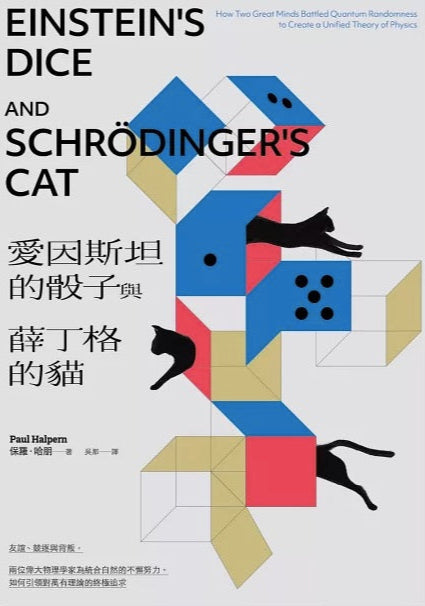

Einstein's dice and Schrödinger's cat
Einstein's dice and Schrödinger's cat
Couldn't load pickup availability
The late 19th and early 20th centuries were a flourishing period for physics. Thanks to the efforts of numerous pioneers, modern physics was pushed to successive peaks. Albert Einstein, in his miraculous year, gained worldwide fame with three pivotal papers. Concurrently, Erwin Schrödinger became a rising star in physics for his contributions to wave physics with the Schrödinger equation. The theoretical achievements of both men greatly propelled a new discipline: quantum mechanics.
Although Einstein's and Schrödinger's achievements became cornerstones of quantum mechanics, both resisted the quantum mechanical trend, disagreeing with the notion of randomness in the ultimate nature of reality. Einstein repeatedly emphasized, "God does not play dice," while Schrödinger created the thought experiment "Schrödinger's Cat," which later became deeply ingrained in public consciousness, to mock the absurdity of randomness in quantum mechanics.
❏ "If we have to put up with these damned quantum jumps, I am sorry I ever had anything to do with atomic theory."
When the fuzzy uncertainty of quantum mechanics overturned Newton's orderly world, Einstein and Schrödinger were never satisfied with quantum mechanics' interpretation of the truth of the universe. They chose to stand at the forefront of the revolution—to construct a theory that could encompass fundamental forces and exclude randomness. On this path to pursuing a unified theory, Einstein and Schrödinger did not struggle alone; they became steadfast partners and comrades, jointly resisting the tide of quantum mechanics.
In this book, physicist Paul Halpern tells a little-known story in a fascinating narrative: how the brilliant physicist who shone during his miraculous year and the emerging young scholar became cherished friends under serendipitous circumstances; why political circumstances and personal vanity led to betrayal and rupture; and how this pursuit, which consumed countless hours and energy, ultimately ended in inevitable failure.
❏ "I cannot believe that God plays dice, but perhaps I have earned the right to make mistakes."
The lives of Einstein and Schrödinger teach us that even the most outstanding scientists are human. In addition to their astonishing insights, they endured long periods of effort with no progress. In their private relationships, there were also moments of tenderness and acts of betrayal. They might chase fleeting illusions before returning to those who truly cared about them.
Although their efforts ultimately failed, they were far from futile. Their persistence propelled the progress of physics, and countless successors will carry on their aspirations, continuing on the path to unifying fundamental forces and creating remarkable achievements.