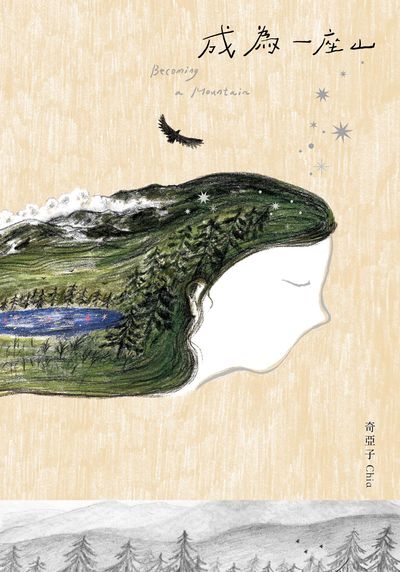

Becoming a Mountain: Becoming a Mountain
Becoming a Mountain: Becoming a Mountain
Couldn't load pickup availability
Dedicated to you, who are growing, crumbling, and rebuilding yourself.
From girl to woman, from body to land,
5 short stories, traversing a lifetime's inner journey.
"Growing up slowly is also a kind of bravery."
"Some wounds will turn into scenery."
An illustrated poem about nature, women, and soul healing
Illustrated creation × Art therapy × Women's growth
From a bud to a forest,
She walked through wounds, walked through mountains, and walked back to herself.
Women × Self-discovery × Nature healing
A five-part life symphony with the mountain as its stage
Pencil hand-drawn × A quiet yet powerful graphic novel
Everything Chi Tzu wants to convey is also what I, what we, many explorers of feminine power, want to convey. The more you love nature and the land, the more you will love yourself. Close your eyes, and I am the mountain forest, and the mountain forest is me.
—Liu Chung-Feng | Writer, Nature Guide
Growth is a cocoon that covers oneself, blurring one's original appearance, becoming smooth, hard, and useful (!?).... Chi Tzu's black and white stories gently call out to those of us who are self-bound. To become a tree, to become a mountain, to become oneself.
—Croter | Illustrator
【Heartfelt Recommendations】
Liu Chung-Feng | Writer, Nature Guide
Chang Hsiao-Ching | Non-Bookstore Manager
Chioh S. | Illustrator
Croter | Illustrator
Chen Shu-Li | Illustrator
ØZI | Music Creator
Tseng Hsin-Yi | Director of Banlu Psychological Treatment Center
“Becoming a Mountain” is a graphic novel centered on the life journey of women and the cycle of nature. The entire book is set against the backdrop of the same mountain range, using five chapters—Bud, Tree, Forest, Mountain, Soil—to depict how women at different ages face themselves, trauma, and their relationship with their bodies and the land.
The story begins with "Little Bud," a girl who grew up in the mountains. She is seen as an outcast by her peers due to her appearance and lifestyle, but during a shared mountain path and conversation, she reveals an alternative rhythm of life in harmony with nature. As time progresses, the characters gradually grow into forest rangers, art therapists, women running in the wilderness, and ultimately elders who return to the land and live as shamans.
These characters are not linearly connected but resonate and interweave within the same mountain, forming an invisible脉絡 of life. The work delicately explores gender, power, the body, self-healing, and the empathy between humans and nature, pointing out that healing is not an escape from reality, but rather confronting one's inner self and allowing experiences to settle into a soil that can sustain life.
This is a story about "becoming oneself" — not stronger, not more correct, but more honestly standing in the world.
This is a mountain forest fable about women, trauma, and rebirth.
Amidst silence and scars—
Learning to let the soul flow again
After being defined, doubted, and suppressed—
They did not collapse,
They simply, in their own way, grew anew.
【Content Introduction】
★Mainly pencil hand-drawn, with a strong notebook feel and subtle black, white, and gray layers
Chi Tzu's creative style is introspective and intuitive, constructing an almost notebook-like visual language with pencils and mixed media. The female body in her works is no longer gazed upon but returns to nature and self, presenting a primitive, quiet yet resolute power. Her work focuses on women's life journeys, trauma, and healing, intertwining nature, land, and bodily sensations into a tender yet profound narrative rhythm.
Through her engagement with art psychotherapy, bodywork, and natural therapies, she gradually realized that true healing is not about escaping pain, but learning to coexist with experience. She hopes to write about how women at different stages face wounds, their bodies, and the land through the life cycle of a mountain, and find their footing within it.
#01|Becoming a Bud
The protagonist, "Little Bud," grew up in the mountains, with long black hair, and her family still used firewood for fuel. Because her appearance and lifestyle differed from her peers, she was ridiculed at school, seen as an outcast, and even labeled a "witch."
One day, a child who transferred from the south approached her. This child had no prejudices about Little Bud's life; instead, she was eagerly looking forward to visiting her home. The two took a long bus ride, walked through the mountain paths, and through conversation and companionship, gradually saw each other's different yet equally real worlds.
The ashes left from burning wood, seemingly waste, can nourish tender sprouts. Little Bud's story symbolizes the initial state of life—fragile, observed, misunderstood, yet harboring the power for future growth.
#02|Becoming a Tree
The story begins with a Taiwanese cypress that has been illegally logged. Xiao He is the only woman in the forest patrol team, whose daily work includes patrolling the mountains, promoting conservation, observing soil and water, clearing traps, and even confronting armed poachers.
She devoted herself to this job out of love for ancient trees, but gradually discovered that the way modern people view the mountain forest was far from her inner beliefs. As a woman, she faced doubts and pressure from both external sources and herself in this field.
This chapter describes not only the daily life of a professional but also how a tree stands firm in wind and rain—it is about gender, role expectations, and the question of whether "steadfastness must come from external recognition."
#03|Becoming a Forest
Art therapist Jia Lin takes on a case involving a female art student. Through art therapy, the client finally reveals that she was assaulted by a professor in her department.
This process triggers Jia Lin's long-buried memories—when she was young, she also dreamed of art, worked hard to get into the same school, and even met the same professor. In the real world, many women, in their growth and lives, have faced power imbalances and trauma.
"Becoming a Forest" tells how women slowly root themselves amidst their wounds. Healing is not instantaneous; it is a slow, winding, and patient path that ultimately grows into a woodland that can shelter oneself.
#04|Becoming a Mountain
A group of women gather around a campfire in the wilderness. Each carries different secrets, pain, and desires, coming only for warmth and to find an outlet.
However, true change is not just about listening and telling stories by the firelight. They must rise up and act, run, howl, and, like wild beasts, regain their bodily instincts, searching anew for their own place of refuge.
This chapter symbolizes the state of women after middle age—no longer just enduring, but choosing to stand, choosing to become a being who can carry others.
#05|Becoming Soil
The protagonist is the shaman (witch) "Mumu," and a little girl who accompanies her. Mumu lives in harmony with the land, performing rituals for people with acacia trees, living a low-key life, like any ordinary elder in the mountains.
One day, they go to the city to participate in a "Shaman Cultural Festival." The scene is filled with curious, suspicious, and witch-hunt-like gazes; people question magic, question rituals, and question the wisdom of the land.
Through this journey, the work points out that true healing comes from re-synchronizing one's body and breathing with nature. What is called magic is not mysterious, but rather humans finally remembering that they inherently belong to this land.