
General Handbook Vol. 1: Generational Puncta
General Handbook Vol. 1: Generational Puncta
Couldn't load pickup availability
"But if nothing is 'necessary,' why do we still have to ask questions?"
For a long time, literature and art, and indeed too many humanities disciplines, have been regarded as only posing problems without solving them. However, we cannot help but ask: once a problem is raised, is "solving" it the only outcome? If a problem is quickly "solved," is it a premature conclusion? If the meaning of a conclusion is the cessation of experience, perhaps asking questions can allow experience to maintain its continuity of life.
The initial motivation for founding The Universal Handbook stemmed, to some extent, from a lingering dissatisfaction with the existing state of academic writing. Author Wang Huan and her team hoped to publish speculative texts that differed from academic papers, and "questioning" thus became the starting point for initiating speculation.
The Universal Handbook hopes to retain the courage to question everything. Here, the use of the word "universal" in the title is not to identify the universal meaning of things, but rather based on the uniqueness generated by "universal consciousness" within conventional knowledge. Most articles published in the journal intersect different disciplines, believing that writing itself is interdisciplinary, belonging neither to literature nor, of course, to art; no discipline or knowledge "owns" writing — writing coexists with humans in their long lives as a parasite.
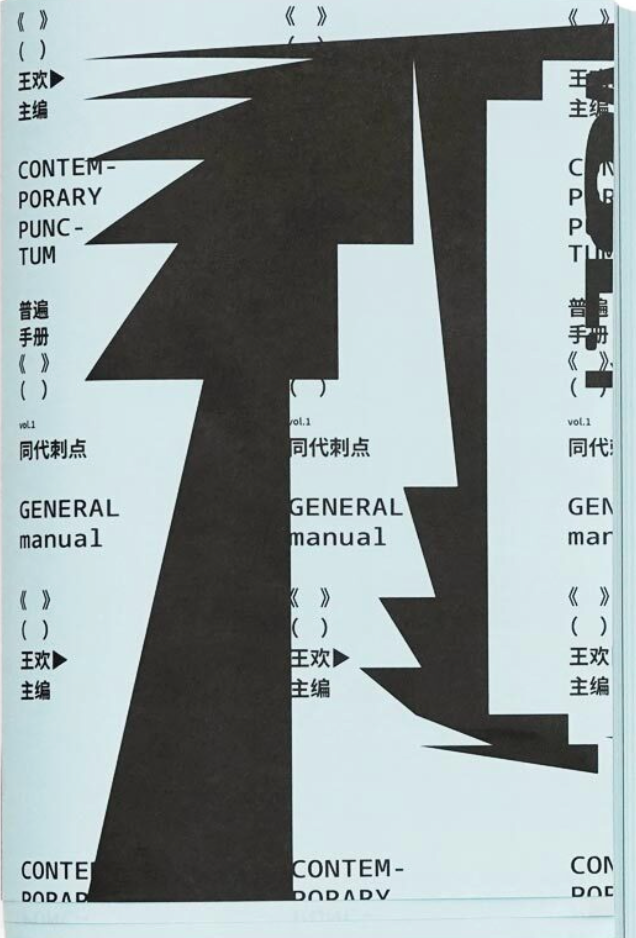
This publication primarily concerns itself with the various problems and predicaments faced by contemporary humanity. It publishes articles by scholars, artists, and activists from the art world, philosophy, and cultural circles, including essays, prose, novels, and other forms of works, encouraging a cross-cultural and interdisciplinary public writing consciousness, integrating dispersed cognitions into coherent fields, and allowing academic writing to drive theory. The inaugural issue, titled "Contemporary Punctum," does not set a specific theme but advocates for following the footsteps of multiple researchers to trace back those "universal problems" that are intimately connected with contemporary people. The journal is designed by Ma Shirui and Zang Liping (typo_d). As an academic writing "handbook" that is not dull to read, it adopts a small format, using a single line to transform "paper" into a "book."
The book contains 23 articles, consisting of those already published on the website and some preliminary articles. Authors in this issue include: Brion Gysin, Chen Jiaying, Chen Xiaoyi, Chen Min, Dong Yuxiang, Gao Yijie, Hu Hao, He Zike, Lin Weibin, Long Xingru, Liu Zhang Bolong, Li Suchao, Wang Kaimei, Wang Min'an, Wang Hongqiang, Wang Juyan, Wang Huan, Burroughs, Xu Zheyui, Xin Wei, Xi Lei, Yang Beichen, Yang Yunchang, Ye Funa.
As a contemporary individual, which universal problems will prick you?