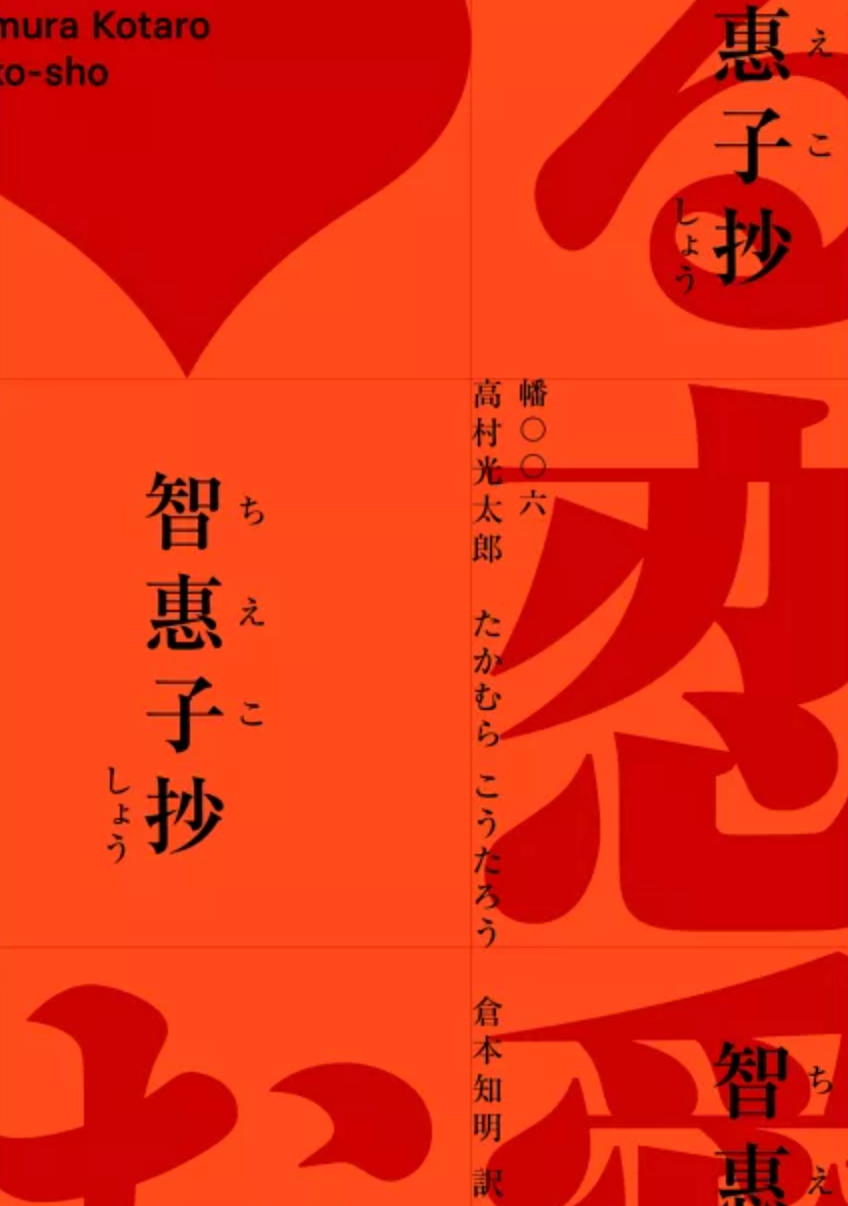

Chieko
Chieko
Couldn't load pickup availability
Because I know there will never again be a pair of eyes looking at me with such passion in this world."
Praised as the "Father of Modern Japanese Poetry," the best-selling work in the history of modern Japanese poetry
[Features of this book]
1. Alongside Hagiwara Sakutarō, a representative poet of Japan's "Taishō Romance," he jointly pioneered a new era for Japanese poetry, liberating the moving energy contained within poetry through colloquial and free literary forms.
2. A long love letter to his beloved wife spanning thirty years, expressing the joys and sorrows of love while simultaneously demonstrating the high achievement of classic literature. It is a great poetic work that has been included in school textbooks in Japan multiple times.
3. Translated by Kuramoto Tomoaki, an expert in Japanese literature, leading readers back to the romantic era of a hundred years ago and the bittersweet world of lovers.
4. Includes three essays by Takamura Kōtarō commemorating Chieko's passing and their love story: "Chieko's Half-Life," "Early Summer at Kujūkurihama," and "Chieko's Paper-Cuts," as well as color inserts of their artworks at the beginning of the book.
5. Exclusively includes Takamura Kōtarō's last important literary criticism before his death, "Characteristics of Japanese Poetry," which accurately presents the shifting position and process of Japanese poetry in the field of world literature, explaining why Japanese poetry has short forms, the development of poetic rhythm, and the emergence and transformation of colloquial and free verse. It is an important article that countless Japanese artists and scholars continue to read and cite to this day.
6. The novel "Chieko-shō" was rewritten by Culture Medal laureate Satō Haruo, and the novel "Flying Chieko" was rewritten by Akutagawa Prize winner Tsumura Setsuko.
7. The film "Chieko-shō," adapted in 1967, was nominated for Best Foreign Language Film at the 40th Academy Awards.
8. It has been adapted into Noh plays, stage plays, and musical works multiple times, demonstrating the outstanding potential of "Chieko-shō" across artistic forms.
9. Professor Emeritus Makoto Ueda of Stanford University's Department of East Asian Languages and Cultures, acclaimed Japanese translator Hiroaki Satō, renowned Japanese author Matsuura Yataro, Director of the Kōtarō Takamura Memorial Society Taichi Kitagawa, and Phyllis Birnbaum, winner of America's oldest Japanese literature translation award, all highly praise and endorse it.