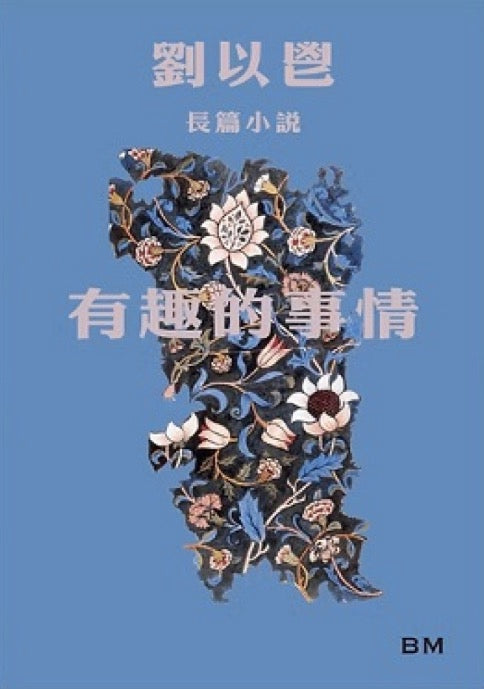

Fun things
Fun things
Couldn't load pickup availability
I am very willing to go my own way and write experimental novels. However, when writing seven or eight thousand words of low-quality material daily, I simply cannot spare the time to prepare adequately before creation, and the finished novel always falls far short of my initial ideals. My 1972 work, "Tête-bêche," is a clear example of this. ...In October 1965, I began writing the serialized novel "Interesting Things" for the Xin Sheng Evening News, initially intending to write a serious long-form work. However, due to the nature of writing and publishing simultaneously, it became increasingly chaotic, like a tangled mess of weeds, not only not "interesting" but rather "cringeworthy." Later, when the Youth Cultural Enterprise Co., Ltd. in Taiwan published my book "The Temple," I extracted a section about cockroaches, made slight modifications, and turned it into a novella. These two examples clearly illustrate that as a writer who has long made a living in Hong Kong, I always struggle to reconcile my contradictions: on one hand, I let myself get lost; on the other hand, I try to find myself again. Nevertheless, no matter what the circumstances, I have never lost my interest in learning to write.
Chapters 6 to 11 of the present edition of "Interesting Things" adopt the author's revised 1974 version of "Cockroaches," while other chapters retain the serialized version from the Xin Sheng Evening News, with no alterations made except for obvious typos.
There are many "interesting things" about the novel "Interesting Things," but the most "interesting" must undoubtedly be Liu Yichang's depiction of Hong Kong: confronting the inflation wave of soaring prices in 1966, the riots and curfew triggered by the Star Ferry fare increase, the protagonist, while worrying about housing problems, also calls on the government to print exquisite stamps as a way to increase treasury revenue (the author, as a stamp collector, always looks out for his own well-being); the criticisms of the Oscar and Cannes film selections of that year and the proliferation of "four-dime novels" in Hong Kong reveal how the author detested the vulgar cultural trend of the time; Macau, the gambling city across the sea, illuminates how many desires for fleeting dreams, pursued by crossing the sea, were shattered, further implying the divergent historical paths of the two cities around 1966. All of these interestingly challenge the boundaries between fiction and reality.
"The beautification and modernization of Hong Kong have become an undeniable fact; however, it does not possess the conditions to become the world's greatest metropolis."
Sixty years later, looking back at this assertion voiced by the author through a character in his novel, one cannot help but smile. Nevertheless, whether from the perspective of its newspaper serialization and the debate between high and low literature, or from the urban observations unfolded within its historical context, "Interesting Things" should not be overlooked by readers who care about the cultural memory of our city. —Leung Sai-to