
Read out the violation
Read out the violation
Couldn't load pickup availability
The Human Touch and Atmosphere in the Cracks of the City—
The Hidden Order in Contemporary Asian Cities, from the Most Natural Daily Needs
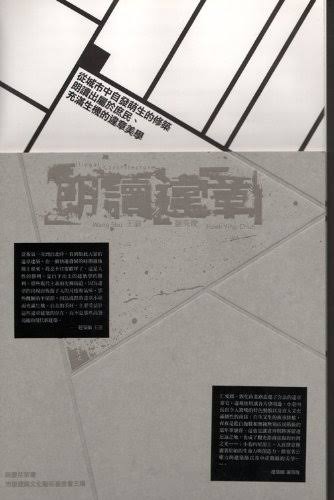
"Illegal constructions" are the embodiment of common people's lives that sprout from the cracks of the city. They are the people's architecture, outlining the true texture of everyday life at the grassroots; they are also a hundred ways to stand with the people, an extension stemming from the human body and life. They are illegal small revolutions, temporary and guerrilla-like, yet they constantly emerge everywhere without ceasing. They are the concrete form of the vitality achieved by the urban underclass.
"Reading Illegal Architecture: Wang Shu x Hsieh Ying-Chun Architecture Exhibition," curated by Ruan Qingyue and executed by the JUT Foundation for Arts and Architecture, features two architects, Wang Shu and Hsieh Ying-Chun. They each designed two works, "Square and Round Alike" and "A Peach Blossom Spring in the Back Alley," on the rooftop and in the back alley of the Art District in the city center. These works utilize quickly dismantlable and assembleable wooden structures and common steel pipe scaffolding. These two works extend the architects' continuous design philosophy in terms of temporal depth and also echo not only the phenomenon of illegal construction in Taipei and Taiwanese cities but also the hidden order of life in Asian cities in terms of spatial breadth.
This book not only includes exhibition records but also starts from the exhibition as its core, sifting through the representative works and philosophies of the two architects. It also invites five architects and architectural critics—Marco Casangrade, Chu Rui-Chi, Yen Chung-Hsien, Wu Qi-Lin, and Wu Chieh-Chen—to engage in dialogue with the works. The aim is to continue stimulating energy from "illegal construction" through the form of a book after the exhibition ends. In this book, we start by reading illegal architecture as a starting point, then delve into understanding illegal architecture, and a bottom-up philosophy of spatial production/extension.
Therefore, the book also includes a small booklet containing a classification study of "Three Methods of Illegal Construction" by Wang Ning and Li Mo, graduate students of architect Wang Shu at the China Academy of Art. This study analyzes illegal constructions in Taipei from three aspects: space, materiality, and environmental relations, providing a clear logical approach to understanding illegal constructions in the city.
Two Participating Architects
Taiwanese architect Hsieh Ying-Chun was awarded the American Curry Stone Design Prize in 2011, known for its humanitarian concerns. Since the 921 earthquake in Taiwan, he has been involved in house reconstruction in disaster areas, including the Sichuan earthquake in mainland China and Typhoon Morakot in Taiwan. He has long been dedicated to post-disaster reconstruction. Compared to building luxury homes, his focus has always been on "the housing problems of 70% of humanity."
Chinese architect Wang Shu was awarded the German Schelling Architecture Prize in 2010; his work "The Decomposing Dome" for the 2010 Venice Architecture Biennale main exhibition received a special mention. He named his studio "Amateur Architecture Studio," believing that "architectural design should only be an amateur activity, and life is always more important than design."
Book Features
Scan the QR code on the back cover of the book with your mobile phone to watch a 26-minute documentary on the highlights of "Reading Illegal Architecture: Wang Shu x Hsieh Ying-Chun Architecture Exhibition." The camera delves into the curation and construction process, fully capturing the human touch and atmosphere of "Reading Illegal Architecture" in the cracks of the city through images.