
The birthplace of the global Hallyu wave
Surprisingly comes from a place once known as the "Hermit Kingdom."
Wonderful legendary tales paired with precious cultural relic images
A complete exploration of the cultural roots of the Korean Peninsula
Surprisingly comes from a place once known as the "Hermit Kingdom."
Wonderful legendary tales paired with precious cultural relic images
A complete exploration of the cultural roots of the Korean Peninsula
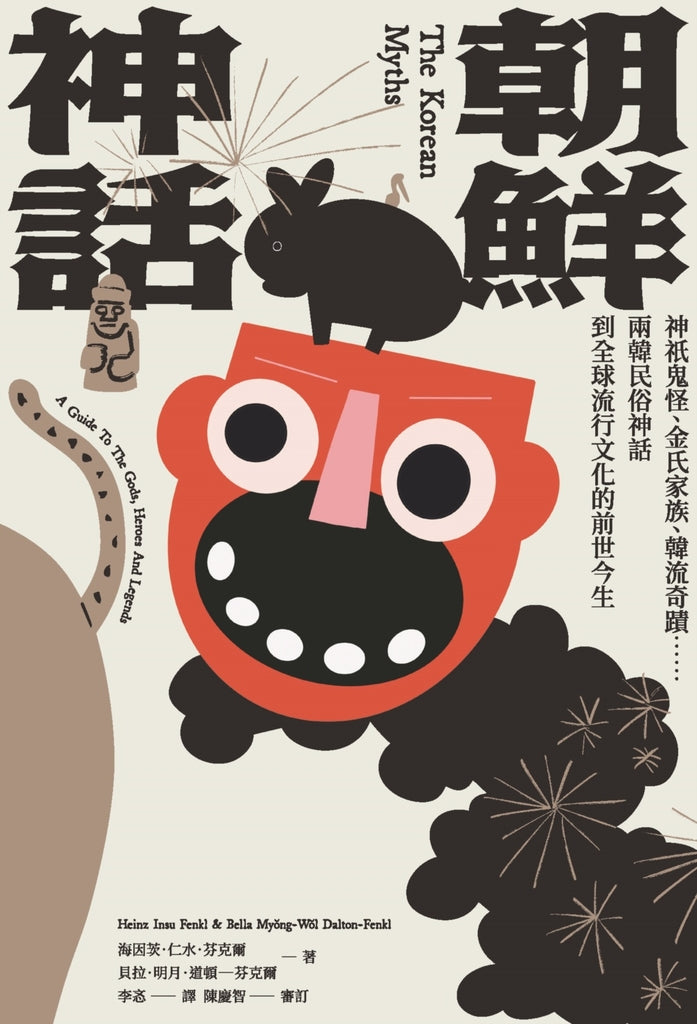
The global Hallyu wave seems to possess an irresistible magic, yet, oddly enough, its origin lies in a place once famous for its reluctance to engage with the outside world, known as the "Hermit Kingdom." This dynamic paradox is one of the features that makes Korean culture and mythology so captivating. All narratives resonate within a culture blending Confucian, Taoist, and Buddhist philosophies, along with older traditions, forming the deep wellspring that nourishes the contemporary Hallyu phenomenon. Myths continue to live and evolve in present-day Korean society.
This book begins with the unique creation myths of the Korean Peninsula. Through an examination of mythological texts such as "Changga," "Cheonjiwang Bonpuri," and the giantess Grandmother Mago, it analyzes the cosmology of Korean mythology. It then fully presents the rich and colorful spiritual world of the Korean people, drawing from diverse religious beliefs, flora and fauna, and folklore, such as the tiger, considered a symbol of Korea, and the mischievous goblins who love to play tricks on humans.
●Korean works are so fun! I also want to know the origins!
The cute tiger and magpie in the globally popular animated film "Kpop Demon Hunters" actually come from the Korean folk painting "Magpie and Tiger Painting"?
Revisiting "MapleStory," quickly grab this book and find out where the story characters are in Fairy Tale Town? Red Bean Lady, Shim Cheong, and goblins are all here!
Who is King Sejong mentioned in "Semantic Error"? Is he actually the origin of the Korean language?
Dangun Wanggeom, the Bear Woman, Jeon Woo-chi... "Omniscient Reader's Viewpoint" tells the intricate stories behind the stars (but no spoilers)!
The abundant myths and folk tales of the Korean Peninsula are precisely the cultural roots of today's Hallyu works. Their traces can be found in dramas, video games, and comics. Let's find out what other Korean cultural elements are in your favorite works!
The cute tiger and magpie in the globally popular animated film "Kpop Demon Hunters" actually come from the Korean folk painting "Magpie and Tiger Painting"?
Revisiting "MapleStory," quickly grab this book and find out where the story characters are in Fairy Tale Town? Red Bean Lady, Shim Cheong, and goblins are all here!
Who is King Sejong mentioned in "Semantic Error"? Is he actually the origin of the Korean language?
Dangun Wanggeom, the Bear Woman, Jeon Woo-chi... "Omniscient Reader's Viewpoint" tells the intricate stories behind the stars (but no spoilers)!
The abundant myths and folk tales of the Korean Peninsula are precisely the cultural roots of today's Hallyu works. Their traces can be found in dramas, video games, and comics. Let's find out what other Korean cultural elements are in your favorite works!
●The rich spiritual world of the Korean people – diverse religions, abundant mythical creatures
Taoism, Buddhism, Christianity... and Shamanism, all on the same peninsula!
The Yin and Yang Bagua of the South Korean flag each hold meaning, and ancestral shrines and churches stand side by side. Religious beliefs have long influenced Korea's development, and folk tales are rife with unique mythical creatures, such as the gumiho (nine-tailed fox) that absorbs vital energy, the dokkaebi (goblins) wielding clubs, and various animal fables, forming a diverse cultural landscape.
Taoism, Buddhism, Christianity... and Shamanism, all on the same peninsula!
The Yin and Yang Bagua of the South Korean flag each hold meaning, and ancestral shrines and churches stand side by side. Religious beliefs have long influenced Korea's development, and folk tales are rife with unique mythical creatures, such as the gumiho (nine-tailed fox) that absorbs vital energy, the dokkaebi (goblins) wielding clubs, and various animal fables, forming a diverse cultural landscape.
The tumultuous history of the Korean Peninsula has brought diverse beliefs to its people, adding an extra layer of interest to its already rich folk tales. As the Korean Peninsula was divided into two, with each country embarking on different destinies, the meaning of "myth" has also been reinterpreted. This not only explains the myths created by the North Korean Kim family to consolidate their power but also includes South Korea's cultural export myths in literature, film, music, and other fields:
●Hermit Kingdom – North Korea! The Kim family's myths and power
From Kim Il-sung, Kim Jong-il to Kim Jong-un, beyond the totalitarian wall, we can only see the circulating Kim family myths.
Kim Il-sung turned pine cones into grenades, Kim Jong-il invented hamburgers. When Kim Jong-un inherited power, he changed his father's leadership style and began to lead North Korea toward scientific development!
Under the Kim family's high-pressure rule, North Korean comics have a unique style. Works like "General Wei Chi," "The Secret of Frequency A," and "Tropical Snowstorm" promote North Korea's Juche ideology, but also reflect North Korea's diplomatic situation at the time!
●Experts in cultural export, the trendy myths of modern South Korea
"Hallyu" – in Taiwan, it originally described the potential cold and warm impact of the depreciation of the Korean won during the Asian financial crisis on industries. Now, it has transformed to describe how the abundant energy of South Korea's cultural industry sweeps the world, evident in dramas, music, literature, and more.
From "Winter Sonata" to "Squid Game," with diverse styles and excellent, exciting plots, which is your top K-drama?
Kpop has brought countless boy and girl groups to the world stage. While idolizing has become a global language, it also seems to bring concerns about appearance anxiety.
Even literature has seen a Hallyu wave! Shin Kyung-sook became the first Korean writer to win the Man Asian Literary Prize with "Please Look After Mom." Five years later, Han Kang became the first Korean writer and first Asian female writer to win the Nobel Prize, further raising expectations for the future development of Korean literature.
From Kim Il-sung, Kim Jong-il to Kim Jong-un, beyond the totalitarian wall, we can only see the circulating Kim family myths.
Kim Il-sung turned pine cones into grenades, Kim Jong-il invented hamburgers. When Kim Jong-un inherited power, he changed his father's leadership style and began to lead North Korea toward scientific development!
Under the Kim family's high-pressure rule, North Korean comics have a unique style. Works like "General Wei Chi," "The Secret of Frequency A," and "Tropical Snowstorm" promote North Korea's Juche ideology, but also reflect North Korea's diplomatic situation at the time!
●Experts in cultural export, the trendy myths of modern South Korea
"Hallyu" – in Taiwan, it originally described the potential cold and warm impact of the depreciation of the Korean won during the Asian financial crisis on industries. Now, it has transformed to describe how the abundant energy of South Korea's cultural industry sweeps the world, evident in dramas, music, literature, and more.
From "Winter Sonata" to "Squid Game," with diverse styles and excellent, exciting plots, which is your top K-drama?
Kpop has brought countless boy and girl groups to the world stage. While idolizing has become a global language, it also seems to bring concerns about appearance anxiety.
Even literature has seen a Hallyu wave! Shin Kyung-sook became the first Korean writer to win the Man Asian Literary Prize with "Please Look After Mom." Five years later, Han Kang became the first Korean writer and first Asian female writer to win the Nobel Prize, further raising expectations for the future development of Korean literature.
From creation myths and contemporary politics to becoming a major exporter of global popular culture, through the evolution of ancient history, the only constant is the diverse cultural landscape of the Korean Peninsula, long-standing yet ever-changing, which we can witness in countless works.