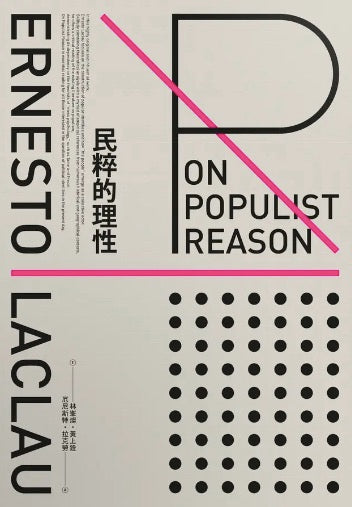

The rationality of populism
The rationality of populism
Couldn't load pickup availability
Why have the shadows of populist movements been visible in major political changes across various countries in recent years?
Behind seemingly hollow and passionate populist slogans, could there be a social rational logic at work?
Following "Hegemony and Socialist Strategy," the political philosophy of post-Marxist founder Laclau reaches new heights!
From fundamental distinctions like universal/particular, identity/difference, and enemy/friend
It explores profound questions such as "what is politics," "what is democracy for," and "how to represent the people."
"There is an ethical mission in intellectual work that Leonardo da Vinci called 'stubborn rigor.' Practically, this means that individuals must resist certain temptations when discussing political issues, especially those that evoke extreme emotions. ...When condemnation replaces explanation, the causes of such anomalous phenomena are treated as having no rational basis. Only when we view fascism as one of the inherent possibilities of contemporary society, rather than something beyond any rational explanation, can we begin to understand it."
Brexit, the Trump phenomenon, and even certain political fads in Taiwan in recent years have all been labeled "populist." However, what exactly is populism? Many commentators link populism to the conservative right. Yet, from the historical American Populist Party and Argentina's Perón to today's Podemos in Spain, we have witnessed the vibrancy of left-wing populist parties. From this, it is evident that it is difficult to define so-called populism by the "content" of political stances such as left/right or unification/independence; populism is rather a political logic, and every political form contains some element of populism.
This book points out that when populism occurs, society is divided into two: one side is "the people," and their opposing camp is the ruling class. However, modern society is highly complex, and each group has its own demands, making it never easy to unify them. Only by establishing their "greatest common denominator," allowing various groups to seek common ground while preserving differences, and identifying a common enemy, can "the people" be constructed and then evolve into a force that the dominant class must confront.
If conventional politics means that the power elite hopes to satisfy diverse groups with a logic of differentiation, then populist politics is an attempt to resist the "divide and conquer" tactics of the powerful and to forge alliances among numerous disparate demands through equivalence. This is where populist rationality lies. When representative politics fails, populism indeed has the opportunity to salvage democracy. This book bridges rich historical cases with theoretical approaches, demonstrating the possibilities of left-wing populist practice, and thus helps civic groups consider how to connect their demands to a more heterogeneous public.