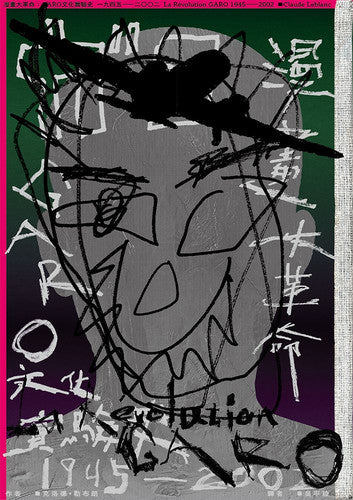

In that era, we championed manga in the abyss of the world!
The first historical revelation for the 60th anniversary of the legendary magazine "GARO"
■Sanpei Shirato, ■Yoshiharu Tsuge, ■Shinichi Abe, ■Shigemaru Anzai, ■Usamaru Furuya
↑↑↑These are the origins of the people who changed manga↑↑↑
↓↓↓And the starting point for the complete expression of manga↓↓↓
The first historical revelation for the 60th anniversary of the legendary magazine "GARO"
■Sanpei Shirato, ■Yoshiharu Tsuge, ■Shinichi Abe, ■Shigemaru Anzai, ■Usamaru Furuya
↑↑↑These are the origins of the people who changed manga↑↑↑
↓↓↓And the starting point for the complete expression of manga↓↓↓
"Please boldly draw original stories using your own techniques first." —Sanpei Shirato
■■■■■■■■■■■■■■■
■Katsuichi Nagai, a man who had come close to death due to tuberculosis, awoke with anger on his muddled publishing journey, wanting to confront a world always controlled by conservative right-wingers.
■Sanpei Shirato, bullied and discriminated against since childhood due to his father's communist ideology, dreamed of conveying the reality of a cruel world and the vision of an egalitarian society through manga to the young saplings who held Japan's future.
In the 1960s, when rental manga stores were gradually declining, the two decided to rise up against the "malice" directed at manga, and in doing so, unexpectedly revolutionized manga expression, transforming the "children's story empire" established by ■Osamu Tezuka into an "anarchism" that "faced the darkness." This further ignited the "God of Manga's" desire to confront, leading to the creation of the short-lived "COM," and thus began the great battle of youth manga.
But "GARO," with its avant-garde spirit, remained unperturbed, presenting ■Yoshiharu Tsuge's groundbreaking work "Neji-shiki" (The Screw Style), which attracted ■Shinichi Abe, ■Seiichi Hayashi, and others. Their deeply personal "watakushi manga" (I-novels in manga form) resonated with the minds of young Japanese in the 1970s, reflecting the shift in Japanese society from the passionate student movement generation to the comfort of individualism.
As time entered the mid-to-late 1970s, although the commercial reality, led by ■Shinbo Minami, allowed "GARO" to explore the "clumsy-skillful" dimension of manga in a more avant-garde way, it could not escape the fate of discontinuation, unfortunately disappearing from public view in a state of indifference. However, "GARO's" thirty-eight years of existence, propelled by several generations like ■Kazuo Kamimura and ■Suehiro Maruo, ultimately transformed manga into a "complete medium." It is both entertainment and art, literature and not literature, a unique form of expression, and a read for all ages.
"GARO's" bold, egalitarian, and free spirit has long been deeply ingrained in Japanese manga, spreading globally with the translation of countless works. However, its experiences have never been fully chronicled. The details of this "manga revolution" were only revealed to the public for the first time after extensive research by the French author of this book, ■Claude Leblanc. Let us witness this most brilliant and yet little-known history of Japanese manga expression!
■■■■■■■■■■■■■■■
"This book is fascinating from cover to cover, Claude Leblanc is so learned, and we are impressed by the many references he cites, and these details enrich the presentation of the book, never boring anyone. If there is one book that can shed light on this still dark period of Japanese manga history, it is definitely 'Manga Revolution: A Cultural Experiment History of GARO 1945-2002.' This will be a very important reference book for those curious manga fans who want to know more. We highly recommend it." —French manga review website ■sceneario.com
"In the history of modern manga, if we could only remember two years, the first would be 1947, and the second 1964. If Osamu Tezuka had not published 'New Treasure Island' in 1947, helping 'Made in Japan' manga emerge en masse and regulating most of its expressive formulas, then the manga magazine 'GARO,' launched in 1964, might not have been born, and would not have been able to play such a revolutionary role, comparable to the works of the 'God of Manga'." —French news radio ■Franceinfo
"Claude Leblanc has laid an important cornerstone in manga research, which will attract all enthusiasts of manga history." —French reading news website ■ActuaLitté
"GARO was the pioneer of youth manga!" —"Mazinger Z" author ■Go Nagai
■■■■■■■■■■■■■■■
● Shortlisted for the 2024 Festival Gribouillis de Bordeaux Classic Book Award
● Nominated for Best Manga-Related Book at the 2024 SoBD Comics Salon in Paris
● Traditional Chinese edition includes a special preface by Mangasick and a chronology of GARO-related events
● Binding design by Guishi, boldly using clumsy-skillful + surreal techniques to create a film-style book cover, interpreting the experimental spirit of the magazine