
1
/
of
1
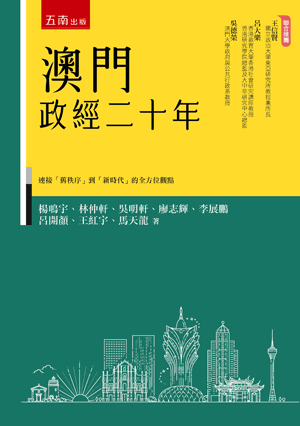
Twenty years of Macao's politics and economy
Twenty years of Macao's politics and economy
Regular price
MOP$117.00
Regular price
Sale price
MOP$117.00
Unit price
/
per
Couldn't load pickup availability
A comprehensive perspective connecting the "old order" to the "new era"!
Four centuries of European culture have been integrated into Chinese life, creating a unique cultural landscape. The urban area of Macao is a World Heritage site, reflecting the interplay with large modern hotels. What stories lie within such a legendary, contradictory, and unique place?
Macao has always been considered by Beijing as a model of "One Country, Two Systems" due to its prosperous gambling industry supported by Beijing and its social stability. What is the actual development of Macao?
This is a collection of essays that deeply explores and investigates the political, economic, and social changes in Macao during the twenty years since its handover. The appeal of this book lies in its "holistic" answer to this question. From a structural perspective, the book can be broadly divided into three levels of relationships: the "state" (central government and SAR government), society (capitalists and the general public), and international factors (mainly Portugal and Portuguese-speaking countries), as well as the interactions between these different levels.
For Chinese readers concerned about Macao's past, present, and future, this is definitely a book worth reading again and again.
View full details
Four centuries of European culture have been integrated into Chinese life, creating a unique cultural landscape. The urban area of Macao is a World Heritage site, reflecting the interplay with large modern hotels. What stories lie within such a legendary, contradictory, and unique place?
Macao has always been considered by Beijing as a model of "One Country, Two Systems" due to its prosperous gambling industry supported by Beijing and its social stability. What is the actual development of Macao?
This is a collection of essays that deeply explores and investigates the political, economic, and social changes in Macao during the twenty years since its handover. The appeal of this book lies in its "holistic" answer to this question. From a structural perspective, the book can be broadly divided into three levels of relationships: the "state" (central government and SAR government), society (capitalists and the general public), and international factors (mainly Portugal and Portuguese-speaking countries), as well as the interactions between these different levels.
For Chinese readers concerned about Macao's past, present, and future, this is definitely a book worth reading again and again.