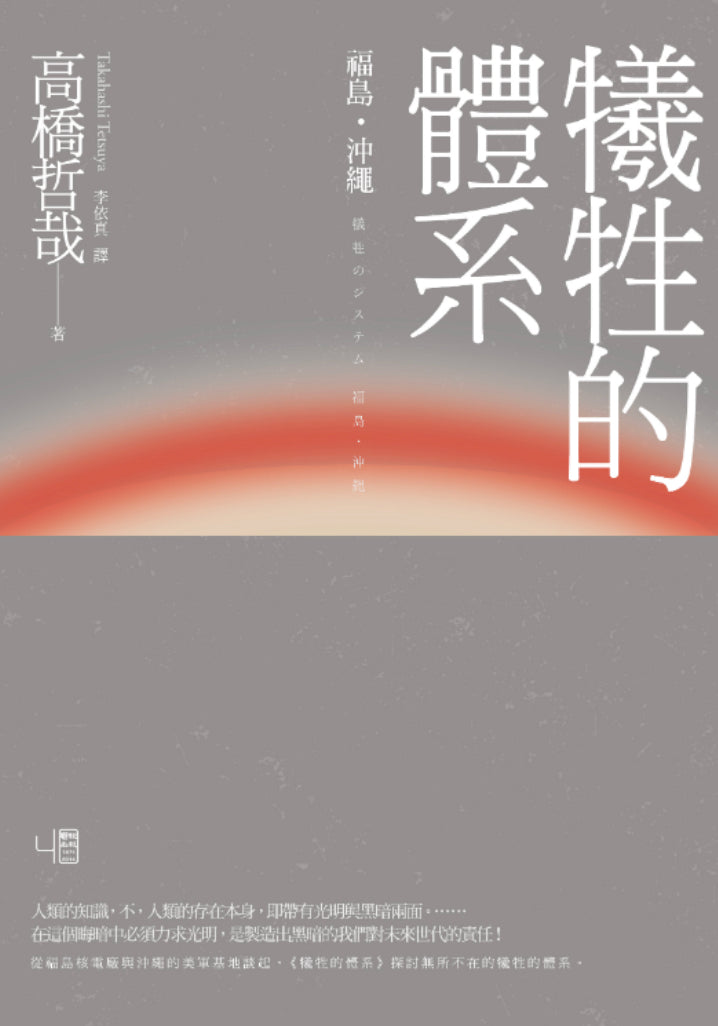

Sacrificial Systems: Fukushima and Okinawa
Sacrificial Systems: Fukushima and Okinawa
Couldn't load pickup availability
Starting with the Fukushima nuclear power plant and the US military bases in Okinawa, this book explores the pervasive system of sacrifice.
From childhood, we learned universal values such as "do not harm others for your own gain," "do not do to others what you would not have them do to you," and "do not build your happiness on the suffering of others." Based on such a consensus, who would dare to openly demand that others sacrifice for their own benefit, or even for their own negligible benefit? From this most basic perspective, it is indeed difficult to imagine why some people are still sacrificed, or why some people even dare to openly demand that others sacrifice for their own benefit. However, the tragedy of the Fukushima nuclear power plant clearly shows us a group of people who were sacrificed. And looking at Fukushima, it's easy to think of Taiwan...
Human knowledge, no, human existence itself, has both light and dark sides. ...
It is our responsibility, as the creators of darkness, to strive for light in this gloom for future generations!
Why Fukushima and Okinawa?
After Japan's defeat in 1945, it has been referred to as "post-war Japan" ever since.
And these two places represent two systems of sacrifice that were incorporated into the national system in post-war Japan.
The nuclear accident in Fukushima exposed the "sacrifice" hidden in the promotion of nuclear energy policy;
And the issue of the US military base in Futenma, Okinawa, highlighted the "sacrifice" in the Japan-US security mechanism.
These issues are well-known throughout Japan. However, can this system be justified by sacrificing certain people for the collective benefit of the entire public community for economic growth and security?
This book was written by Takahashi Tetsuya, who spent his childhood in Tomioka Town—a cautionary zone of the Fukushima Daiichi Nuclear Power Plant accident—and is currently a professor of philosophy at the University of Tokyo, after meticulous reflection as both a victim and a beneficiary.