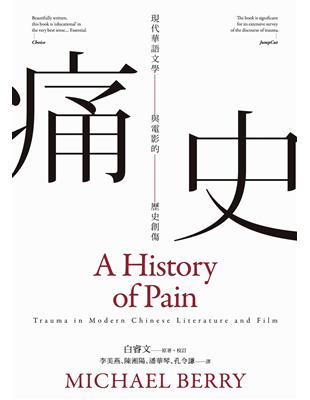

A History of Pain: Historical Trauma in Modern Chinese Literature and Cinema (New Edition)
A History of Pain: Historical Trauma in Modern Chinese Literature and Cinema (New Edition)
Couldn't load pickup availability
How can atrocities experienced by others become one's own experience?
How are brutal moments in colonial history transformed into national trauma?
This book primarily discusses how novels, films, photographic works, and mass media represent historical atrocities.
Inspired by pain and suffering, creators construct violent events from ruins and ashes and present them in artistic forms, collectively writing the stories they know, thereby producing a new form of "historical" narrative. This vivid narrative expresses human experience in a way that traditional historical materials cannot convey.
This book is a study of "historical trauma" resulting from important historical events that occurred in China, Taiwan, and Hong Kong between 1930 and 1997, a period of nearly seventy years in the Chinese world. It is the result of many years of contemplation by Professor Michael Berry, a sinologist at the University of California, USA. These major historical events, in chronological order, are: the Wushe Incident (1930), the Nanjing Massacre (1937–1938), the February 28 Incident (1947), the Cultural Revolution (1966–1976), the Tiananmen Incident (1989), and the Handover of Hong Kong (1997).
Each of these events represents significant implications of Chinese violence and atrocities. The author analyzes and explores how violence is imagined, transformed, and evolved in related literature, films, photographic works, and popular culture. From these selected violent events, the author further studies and reflects on human savagery and brutality and its effects.
The study of historical trauma and the exploration of people's various reactions to trauma have become central themes in modern Chinese literature and cultural studies. This book particularly focuses on – how do cultural depictions of these large-scale violences contribute to people's understanding of national modernization? How do these large-scale population movements, often intertwined with violence, affect people's memories and make them re-imagine acts of violence? What is the relationship between state-level historical atrocities and the suffering experienced by individual victims? What impact do films and literature, as historical witnesses, have? How do various media make these illusions, which are indeed "history," accessible to people in ways that traditional historians cannot?
Through the eyes of contemporary writers, film directors, and other artists, this book observes the journey of trauma, pain, and violence endured over a century of progress. Although most victims (and sometimes perpetrators) are considered Chinese, their experiences, suffering, and imagination are universal and deserve attention and deep thought.