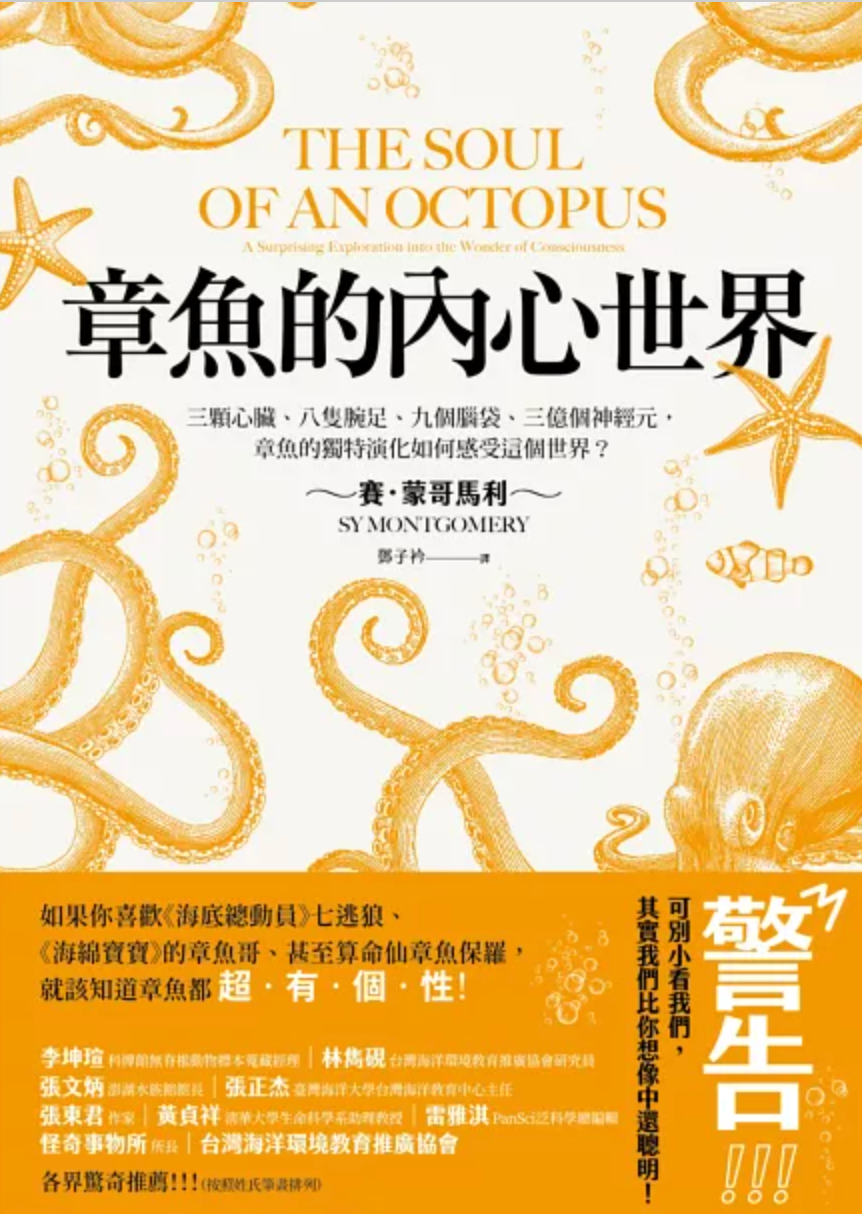

★ Warning ★
Don't underestimate us; we're actually smarter than you think!
If you like the "fish-eating shark" from Finding Nemo, Squidward from SpongeBob SquarePants, or even Paul the psychic octopus,
then you should know that octopuses are SUPER-INDIVIDUAL!
Don't underestimate us; we're actually smarter than you think!
If you like the "fish-eating shark" from Finding Nemo, Squidward from SpongeBob SquarePants, or even Paul the psychic octopus,
then you should know that octopuses are SUPER-INDIVIDUAL!
★ New York Times Bestseller, National Book Award Nonfiction Finalist
★ Highly recommended by various experts! (Listed by stroke order of surname)
★ Highly recommended by various experts! (Listed by stroke order of surname)
Li Kun-Hsuan, Manager of Invertebrate Specimen Collection, National Museum of Natural Science
Lin Chun-Yen, Researcher, Taiwan Association for Marine Environmental Education
Chang Wen-Bing, Director, Penghu Aquarium
Chang Cheng-Chieh, Director, Taiwan Ocean Education Center, National Taiwan Ocean University
Chang Tung-Chun, Writer
Huang Chen-Hsiang, Assistant Professor, Department of Life Sciences, National Tsing Hua University
Lei Ya-Chi, Editor-in-Chief, PanSci
Director, Institute of Peculiar Things
Taiwan Association for Marine Environmental Education
Lin Chun-Yen, Researcher, Taiwan Association for Marine Environmental Education
Chang Wen-Bing, Director, Penghu Aquarium
Chang Cheng-Chieh, Director, Taiwan Ocean Education Center, National Taiwan Ocean University
Chang Tung-Chun, Writer
Huang Chen-Hsiang, Assistant Professor, Department of Life Sciences, National Tsing Hua University
Lei Ya-Chi, Editor-in-Chief, PanSci
Director, Institute of Peculiar Things
Taiwan Association for Marine Environmental Education
First, try to draw what an octopus looks like in your mind.
Take a look. Did you draw an octopus with a round "head," eyes and a beak in the middle, and eight arms at the bottom? Actually, their eyes are at the very top, their arms extend forward from the eyes, and their body (mantle) is attached behind. So, we've misunderstood them greatly from the start. Now, let's re-acquaint ourselves with this wondrous creature!
● Octopuses have three hearts.
● Their vision is wide-angle with no blind spots.
● Their ink contains dopamine, and their venom is both paralyzing and euphoric, but can also poison themselves.
● Humans have only four brain lobes; octopuses have fifty to seventy.
● Each arm has rows of suckers; they have over a thousand suckers in total, with suction power of over a hundred kilograms.
● They are masters of camouflage; they can change over thirty patterns, with each color change taking only 0.7 seconds.
● They mate only once in their lifetime, and die immediately after all the baby octopuses are born.
From shedding their shells, octopuses have become progressively smarter!
Whether they are constantly preparing for a "great escape," hiding in crevices for solitary confinement, or punishing starfish trying to steal their eggs,
you can't help but wonder if octopuses have evolved a rich inner world, using their agile eight arms to outsmart the world?
Unlike the hard shells of their ancestors, such as the nautilus and ammonite, in the evolution of cephalopods, octopuses shed their shells in exchange for greater freedom of movement; at the same time, octopuses also turned themselves into "a large bag of nutritious protein." Octopuses understand their own vulnerability, thus developing an array of dazzling defense mechanisms. From their brains, eyes, arms, to nerves, octopuses are recognized as the most intelligent animals among cephalopods. Many scientists have also begun experimenting with octopuses to understand the development of animal intelligence.
However, are octopuses merely "smart"? Do they possess cognition and self-awareness? Author Sy Montgomery, as a nature enthusiast, used a lyrical style to visit the New England Aquarium in Boston to find out. In just two years, Montgomery interacted with four octopuses that arrived at the aquarium at different times. She discovered that these four octopuses each had distinct personalities and different preferences, sensing their surrounding world through their "multipurpose" eight arms. Montgomery even diligently learned to dive to interact with wild octopuses, traveling to the Caribbean and Tahiti for exploration and research.
Witnessing the life, aging, sickness, and death of the octopuses at the New England Aquarium, Montgomery realized that while we may find it difficult to fully understand what octopuses are thinking, they interact with humans "in their own way," and various miracles occurred in this aquarium. Whether it was listening to the caretakers' instructions when changing habitats or making friends with a visitor with developmental disabilities using their arms, octopuses healed volunteers, caretakers, and of course, Montgomery. Following her, we delve into the inner workings of octopuses, re-acquaint ourselves with animals, and establish a space for equal coexistence with them.