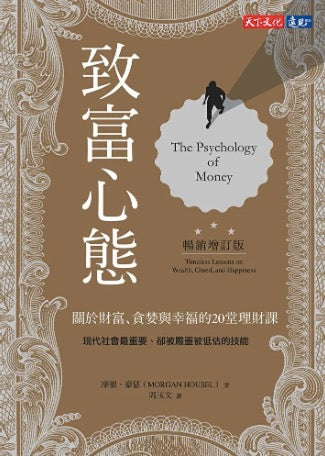

The Psychology of Money: 20 Lessons on Wealth, Greed, and Happiness. Why Your Retirement Savings Are Only Half of What They Should Be
The Psychology of Money: 20 Lessons on Wealth, Greed, and Happiness. Why Your Retirement Savings Are Only Half of What They Should Be
Couldn't load pickup availability
A Wall Street Journal and Amazon bestseller
The most important, yet severely underestimated skill in modern society
There are people who make a lot of money but end up bankrupt, and there are people who make very little but manage to donate large sums to charity. Why is that?
Because financial outcomes are related to luck and risk, and are not influenced by intelligence or personal effort. More importantly, appropriate behavior is more crucial than knowing a lot of financial expertise.
This is the psychology of money, an indispensable soft skill in today's society.
Morgan Housel, a well-known columnist for The Wall Street Journal, realized that we think about and learn about money through knowledge, rather than through understanding mindsets and behavioral patterns in investing and financial management. However, our financial behavior is deeply influenced by various emotions. Everyone views how the world operates differently, so their perspectives on how money works vary greatly, resulting in some becoming wealthy while others struggle.
In "The Psychology of Money," Morgan Housel shares many short financial stories, exploring how people think about money and teaching the skills to get rich. You will learn:
‧ The real reasons why Warren Buffett became a billionaire
‧ Getting rich and staying rich are two different, but equally important, skills.
‧ There are many things that are not worth risking, no matter how huge the potential gains.
‧ Understanding the nature and power of the long tail effect and compounding.
‧ Controlling your time is the highest dividend money can pay you.
‧ The importance of having a margin of safety.
‧ The true essence of financial freedom.
See through the essence of investing and financial management, improve financial flaws, biases, and bad behaviors
Everyone can achieve a life of financial freedom
Recommended by financial experts at home and abroad
Kirkland Capital Chairman, David Yang
Bestselling financial writer, Anakin
Bestselling financial writer, Greenhorn
Value investor/financial writer, Ray H.
Renowned writer, Wu Tan-ru
Oaktree Capital Founder, Howard Marks
Author of "Atomic Habits," James Clear
Author of "Drive," Daniel H. Pink
Author of "Thinking in Bets," Annie Duke
This book can give you a new perspective and inspiration on money. I highly recommend readers to read it multiple times. I suggest everyone cultivate the correct attitude towards money, otherwise, having a lot of money is meaningless. Believe me, as long as your attitude is right, money will naturally come easily. — David Yang, Chairman of Kirkland Capital
"The Psychology of Money" offers a fresh perspective on important financial concepts that investors should know. It's a good book worth reading. — Greenhorn, Bestselling financial writer
Housel's writing style is delightful, his storytelling vivid and fluid, and he effectively cites a wealth of relevant data and conversations with influential figures, making his arguments highly persuasive. Moreover, his sharp yet humorous prose adds much enjoyment to the reading experience! — Anakin, Bestselling financial writer
Housel's observations often have a dual effect: they are both presented to the world for the first time and are incisive. — Howard Marks, Founder of Oaktree Capital
Everyone should have a copy. — James Clear, author of "Atomic Habits"
Few people can write a financial book with such clarity and elegance as Morgan Housel. — Daniel H. Pink, author of "Drive"
This rare author can transform complex concepts into stories that are easy to understand, digest, and absorb. — Annie Duke, author of "Thinking in Bets"