
art, perception and reality
art, perception and reality
Couldn't load pickup availability
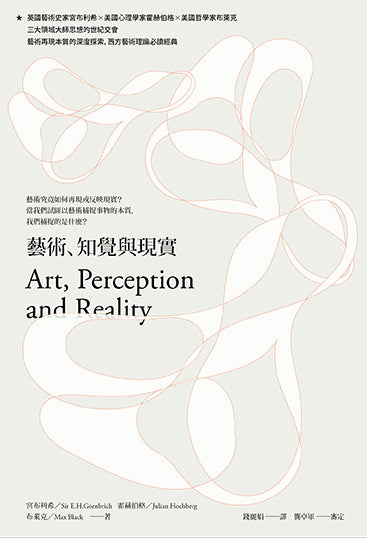
"Art, Perception, and Reality" is an excellent book that helps readers understand 20th-century Western art history. It compiles important perspectives and discussions from renowned art historians, psychologists, and philosophers of the 1960s and 1970s. Although these representative scholars had significant differences in their research objectives and starting points, each contributed to the formation of classic analytical and interpretive paradigms.
This book is based on the lectures delivered by three master speakers—Gombrich, Hochberg, and Black—at the 1972 Thalheimer Lectures at Johns Hopkins University, USA. Carefully compiled by phenomenologist Mandelbaum, it primarily discusses the relationship between art, perception, and reality, specifically the commonalities among various art forms. This involves questions of how art represents or reflects reality, as well as how art and the reality represented by art are perceived.
The research of art historians, psychologists, and philosophers often proceeds independently with little overlap. However, the fundamental question of "artistic representation" provides a common ground for interaction among these three fields, resulting in three lecture manuscripts that are relatively independent yet interconnected, and which ultimately form this book:
◆"Masks and Faces" | Art Historian E. H. Gombrich
Building on a chapter about caricature from his "Art and Illusion," the author developed the lecture "Masks and Faces." The core question is "How do we perceive resemblance in life and art?" Gombrich collected a rich and diverse array of cases and presented numerous examples of literature addressing this or related topics. From there, he expanded into the study of the psychological theory of "resemblance," ultimately affirming the "theory of empathy."
◆"On the Representation of Things and People" | Psychologist Julian Hochberg
As the first psychologist to study "eye movements," Hochberg was a leading figure in visual perception research for half a century. The main question explored in his article is how we perceive people and things in paintings. Hochberg attempts to analyze this problem through four reasons, and his explanatory theory has distinct characteristics in two aspects: first, it emphasizes the subjectivity, intentionality, and selectivity of people in the process of visual perception; second, it affirms the importance of experience and learned behavior.
◆"How Pictures Represent" | Philosopher Max Black
While the first two articles directly view paintings or photographs as representations of reality, Black challenges this fundamental consensus by asking at the outset, "What makes 'naturalistic' paintings or photographs a representation of their subject?" As a philosopher of language, he first distinguishes between two types of paintings: those "with an original scene" and those "without an original scene." He refers to the former as "depicting a subject (or original scene)" and the latter as "presenting a subject (or content)," then focuses on the second case, attempting to find the sufficient and necessary conditions for "a painting presenting a subject."
This book also provides an excellent starting point for learners of other "non-visual" arts to explore the commonalities between non-visual and visual arts, addressing the issue of artistic synesthesia and universal artistic principles from a higher perspective, thereby expanding interdisciplinary horizons and research directions.