
Watching the fire
Watching the fire
Couldn't load pickup availability
"What she handles is actually the memory of pain." — Huang Tsung-Chieh
"The life predicaments laid out in the novel highlight how an overly simplistic revolutionary language fails in everyday life." — Hsieh Hsiao-Hung
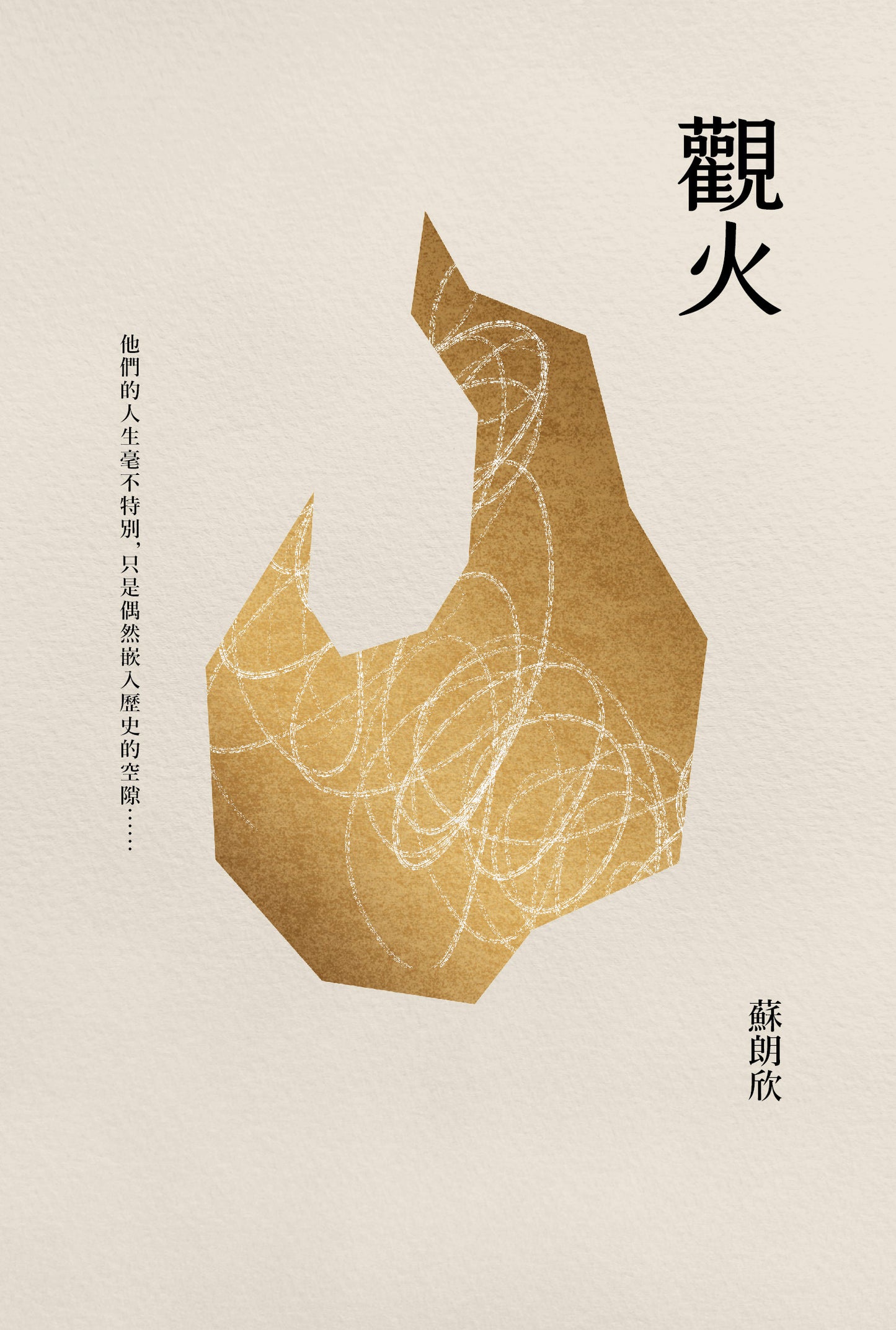
"Watching the Fire" gathers the author Su Long-Yan's widely acclaimed award-winning works and several new creations. Centered around the 2019 Hong Kong social movement, it focuses on ordinary people, just like us, who are still troubled by life's worries. In the most turbulent times, they display deeply complex and subtly moving emotions. After the movement, facing its aftermath — from riot case trials, the pandemic, to the emigration wave — in such a dramatically changing world, the movement may have ended, but life continues. These people and these stories will still be remembered and written.
Amidst differing views, opposing resentments, and passions, the novel captures the most subtle and delicate emotions. Be it sharing cigarettes in a siege, symbolizing life and death together; the confusion and guilt after a satisfying revenge; silently praying for a lost cat; a letter written to a deceased father; or a mother's plate of sliced pork with garlic sauce... These everyday objects subtly encapsulate profound emotions.
"Watching the Fire" not only represents the book's concern for the Hong Kong social movement but also serves as a warning to maintain distance and thoroughly observe and ponder the essence of the movement.
Recommended Preface
Either Ash or Prairie Fire: Reading "Watching the Fire"
Professor, Department of Chinese Language and Literature, National Dong Hwa University Huang Tsung-Chieh
Xiaocheng suddenly felt that everything in the world was gentle and kind, even though this thought was so out of place. She imagined her university, this scenic university in Hualien, catching fire at night, burning the sky to a fiery red. But, in Taiwan, would such a thing happen? She couldn't imagine it.
Rereading Long-Yan's "Fighting the Fire," placed at the beginning of the book, my feelings are complex. The scenic university she depicted has already burned a night sky to charred black due to a fire caused by a strong earthquake in April 2024. As she watched the shocking news images, did Long-Yan recall these words, or did she remember another fire in a campus in the past? What was unimaginable became real, and the "out of place" thought seemed even more out of place? But whether it's the title "Watching the Fire" or this story, "Fighting the Fire," which carries some of her own colors, the subtle uncertainty about her perspective of the world and her relative position to it has always been a hesitant starting point for Long-Yan's creation. This hesitation, however, has led to profound possibilities—behind the "out of place" words lies evidence of the creator's continuous thinking, and only literature can preserve all sorts of improprieties.
For a creator like Long-Yan, who is still very young and continues to advance on this path, it is obviously unfair and inaccurate to reduce her works so far to certain labels and characteristics through any generalized judgment. However, the power of "fire" and "water" undoubtedly holds significant meaning in Long-Yan's novels. Before "Watching the Fire" was "Water Burial." Two important characters in "Water Burial" each had a life experience of "watching the fire"—
"Young Master" Liu Zhi-Hao, who owned large tracts of land due to the village land policy, lived a poor childhood with his mother, dependent on others. His greatest desire was stacks of banknotes, and one day, he actually got them. A man running frantically dropped stacks of banknotes from his pocket, and no one went to snatch them. As he ran against the crowd, desperately picking them up, he looked up and realized, "The fire was already burning before my eyes. The fire was not red or yellow, he later said, the fire was black. Black smoke enveloped your vision, blinding you, and after being blind, your skin became incredibly sensitive, and the scorching air seeped into your internal organs through your pores, and you were dead..."
The young master, who never let go even when he was doomed, later married the "madam," who was originally a swimming champion. After marriage, the madam slowly became a desperate woman. After her husband also died in this desperate marriage, she watched the fire under the steaming fish in the kitchen:
She even specially moved the wooden stool and sat in front of the stove, waiting. No one would wait for a fish in the kitchen... but she chose to stay in the kitchen, waiting for the room to gradually warm up... She just watched, letting the fire burn fiercely. When the air twisted and tilted, she finally lifted the lid, and steam rushed up, clinging to the walls, utensils, and glass windows. Instantly, the surroundings blurred into an old mirror, and the madam's face was equally wet.
The humidity was like the water in a swimming pool, or falling tears. "All in all, that was a life."
What is the meaning of fire? Anthropology has its solutions, and psychoanalysis has its symbols. But when reading Long-Yan's novels, I recall the classic manga "Glass Mask" by Suzue Miuchi from many years ago—in the era I read it, the Taiwanese version was called "The Girl of a Thousand Faces," and the protagonists Kitajima Maya and Himekawa Ayumi were translated as "Tam Pao-Lien" and "Shirley White." In this story, where the main plot follows two young girls competing to be the sole performer of the dream stage "Crimson Goddess," one of their final tests was "wind," "fire," "water," and "earth." Shirley, the "genius girl" from an acting family, expressed the rhythm and movement of fire through dance—burning fire, fire turning to ash; Pao-Lien, with her talent and intuition, performed the impressive story of O-Shichi, a vegetable merchant's daughter from the Edo period. O-Shichi took refuge in a Buddhist temple after a fire, fell in love with the abbot's attendant, Kichisaburo, and to see him again, committed the capital crime of arson. That was the fire of frantic love, a desperate and unquenchable fire of the heart.
Each character in "Watching the Fire" also has their own heart fire; some have turned to ashes, while others are still blazing hot. These are different states of fire, and also due to the different distances of the observer. What Long-Yan subtly reminds us through her words, perhaps, is that beneath those seemingly cold faces, there may have been a fervent past.
For example, Ken and Ling in "Mong Kok Guest House," through the wear and tear of daily life, their expectations and disappointments for each other have become so trivial and subtle that they use "whether one can notice if the brand of hot cocoa at home has changed from Nestlé to Hershey's" as an indicator. But this couple, seemingly indifferent and cold like the northern men and women in Shiono Sakuragi's works, met during the Occupy Central movement. However, Long-Yan does not stop at the flat contrast of "they once had passion and ideals"; instead, when the two reconcile from their equally mundane daily disputes and walk on the streets of Mong Kok at night, the novel describes it thus:
They both knew they were reminiscing, but remained silent—one was thinking about her eyes being sprayed with pepper spray, the other was thinking about seeing others weeping after being sprayed with pepper spray. They wanted to use language to describe that moment, but then realized they had long forgotten how it felt, whether it was anger, fear, powerlessness, or bewilderment.
Memories are indeed unreliable, but even feelings can be forgotten. Just as they couldn't even agree on whether the hotel room that once held their passion and promises for the future had a four-poster bed or was covered in mirrors. How can collective and individual passions be placed back into the ongoing and continuing everyday life? How to view those ideals and emotions that have changed after being put back? If they cannot be put back, how should one face the divergent future? This is not only Ling and Ken's challenge, but also a common challenge for characters of different ages and identities in "Watching the Fire." Mingqian in "Thirteen Years Old" realizes: "He is thirteen, and he already knows very well that nothing can be redone." Ah Qun in "Leaving the Scene" convinces herself: "When one is in their fifties, life is just like this, coming and going." The still-teenage "I" in "Soul Communication" speaks seemingly cynical but actually precocious words: "Isn't history also like this pile of ashes, unclear, compressed over time, just like a landfill has to compress solid waste into a cube before exporting it?" But even if it's just a landfill cube, she still wants to see it. "No reason. Just want to do something. Must do it to feel at ease." Just like Mrs. Chan in "Sliced Pork with Garlic Sauce," who was mocked as a "yellow ribbon mom," insisted on protecting her son's diet before and after the incident, wanting to send him a plate of sliced pork with garlic sauce in his unfree state.
Do these struggles, efforts, and resistances have meaning? Perhaps yes, perhaps no. It depends on our definition of meaning. But even if there is none, "life itself has many meaningless moments." Meaningless, yet still done, must be done. All for the sake of calming a restless heart.
When I read Long-Yan's words, I always feel a desolation beyond her years. The initial draft of "Thirteen Years Old" made me a bit hesitant; the words and thoughts of the characters in it were so unlike a thirteen-year-old. But later, I gradually discovered that it was Long-Yan, seemingly quiet and reticent, who, with her equally turbulent experiences beyond her age, had refined these profound feelings. Although that reticent image might also come from misperceptions caused by language barriers. I remember when we discussed "Soul Communication" near graduation, she struggled to organize her not-yet-fully-formed ideas about how to use this piece to contemplate "how the future will view the movement of this moment." I said, why don't you speak in Cantonese. Instantly, her speech speed quadrupled, and that moment reminded me again that all my impressions were biased by displacement. Therefore, do not jump to conclusions.
Not jumping to conclusions is perhaps also Long-Yan's expectation for her own novel. In the abstract of her graduation project, she wrote: "Writing about Hong Kong while in Taiwan can be an outsider's view, detached, yet it can also be a way to maintain distance and thoroughly rethink, imagine, and observe the nature of the movement." It is precisely by taking a step back that one can see more forms of fire. Whether it turns to ashes or sparks a prairie fire, each has its own circumstances and hardships. Those who seem to be on the same path might simply be coincidental; those who seem like strangers might not have necessarily lacked the same aspirations. She writes with caution, sometimes so cautiously that it borders on detachment, but that is because she deeply knows that "no matter how unnecessary personal despair may be to the world, it is very real, undeniable, it is a thorn embedded in the body, too fine to be extracted, yet subtly painful" ("Water Burial"). Whether "Water Burial" or "Watching the Fire," what she has been dealing with is actually the memory of pain.