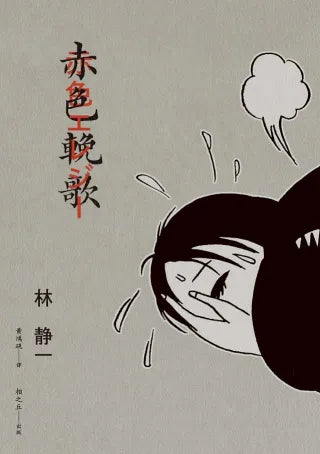

Crimson Elegy
Crimson Elegy
Couldn't load pickup availability
A poignant and beautiful cohabitation love story from the 1970s...
A groundbreaking and audacious masterpiece from GARO, a legendary name in Japanese manga history!
In the animation industry, which often sells innocence, there is a young animator couple, Ichiro and Sachiko—
The boy, like a migratory bird wandering the world, takes on freelance work to pursue his creative dreams;
The girl wishes to cling to a lifeline in their relationship, escaping the constraints of a traditional family.
They return to the same dwelling, intertwined and dependent on each other,
At times, they experience the illusion of peaceful years, but more often, there is a sense of melancholy about the future and a misalignment in their projections onto daily life.
As dreams and reality collide, and a futile love is stifled by societal norms,
Will Ichiro and Sachiko's "cohabiting" home still be their paradise?
In 1970, this manga by Seiichi Hayashi appeared on the pages of the legendary manga magazine GARO, marking a shift in the mindset of young people: the radical left-wing movement in Japan was nearing its end, and the author, at twenty-five, was similar to other youths of the time, transitioning from a collective revolutionary cry to a personal search for self. In this atmosphere, small-scale "cohabiting" became a trend, but workers' rights remained unresolved, and youth drifted, experiencing only a fleeting bloom amidst poverty.
It is against this backdrop that Seiichi Hayashi, influenced by Yoshiharu Tsuge and Jean-Luc Godard, created Red Colored Elegy, arguably the most popular avant-garde manga in Japanese history, using precise silhouettes, hazy narrative collages, unique framing and blank spaces, coupled with a designed visual composition, cinematic appropriations, and an obsession with enka and music.
Today, Ichiro and Sachiko's cohabiting life has become commonplace, and the old values of traditional society are left in the past, but their feelings, and the discord of their era, still resonate on the manga pages, making it difficult for us to look away. We can only try our best to experience and appreciate the tragically beautiful aesthetic limits that the author brings to manga.
﹏﹏﹏﹏﹏﹏﹏﹏﹏﹏﹏﹏﹏﹏﹏﹏﹏﹏
"This manga is a condensed visual poem that, even decades later, still feels avant-garde." — The Believer
"Photo tracing, blank speech bubbles, and almost Cubist sex scenes... beautifully and sadly depict Ichiro and Sachiko's failed romance... The story is heartbreaking, yet universally resonant." — Publishers Weekly
"It is the interplay between animation and manga, the intertwining of artistic practice and lived reality, and the confluence of needs and desires between two young creators that makes this graphic novel a quietly powerful, enduring masterpiece." — The Arkansas International
"Despite being rooted in its time and society, Red Colored Elegy transcends temporal and cultural boundaries through the power of its graphic style." — French comic book store Aaapoum Bapoum
"Red Colored Elegy is a remarkably excellent work, creating fascinating content between tradition and modernity, abstraction and figuration. Even the most minimalist pages contain intense emotional tension in just a few strokes." — Japanese international cultural media PEN
"If comics are a high art, as Red Colored Elegy suggests, then they must also be a synthetic art – whose creators are able to integrate the various visual languages of the moment into an organic and living whole." — Ryan Holmberg
﹏﹏﹏﹏﹏﹏﹏﹏﹏﹏﹏﹏﹏﹏﹏﹏﹏﹏
〆 Awarded third place in Publishers Weekly's Top 10 Comics of 2008 and received a starred review
〆 Nominated for Best American Edition of Foreign Material at the 2009 Harvey Awards
〆 "80P Appendix Booklet" includes "Work Notes" and an explanation by American manga scholar Ryan Holmberg, "Seiichi Hayashi's New Wave"
〆 The Traditional Chinese edition is edited based on the first French black and red dual-color edition, with all images adjusted against the Japanese edition and some original manuscripts
〆 The binding of the entire book and the appendix booklet were designed by GUISTO.