
The Language of the Body: Unraveling the Mysteries of the Body Through Eastern and Western Cultures
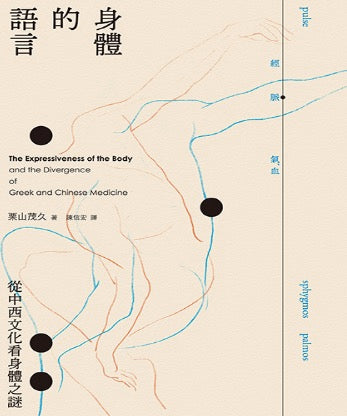
The Language of the Body: Unraveling the Mysteries of the Body Through Eastern and Western Cultures
Couldn't load pickup availability
"People lie, but pulses don't."
The "pulse" on our wrists hides the secrets of the different medical systems that Chinese and Western medicine have developed over thousands of years!
Avicenna, a medieval Western authority on the pulse, said, "The nature of the pulse is musical." Hua Tuo, the legendary physician who pioneered the first general anesthesia surgery in China, said, "The pulse is the harbinger of qi and blood."
Through the same diagnostic act of touching the "pulse" on the wrist, Western and Chinese medicine developed completely different lineages.
In Western medicine, the pulse is a heartbeat, reflecting the movement of the heart and arterial contractions and relaxations, and is data whose frequency can be precisely measured; in the world of Chinese medicine, the pulse is a meridian, connecting different organs and parts, like a flowing river, forming a circulatory system, and is a language of life that can explain physical ailments.
We generally believe that the structure and function of the human body are universally the same, a globally consistent truth.
However, once we look back at history, our views on truth begin to waver...
Why did East and West develop completely different understandings when faced with the same body?
Why has pulse diagnosis remained a key diagnostic tool in Chinese medicine for thousands of years, while being gradually marginalized in Western medicine?
Why are muscles, which are central to Western medicine, almost insignificant in Chinese medicine?
Why did bloodletting therapy thrive in Western medicine until the mid-19th century, yet gradually decline in China after the Eastern Han Dynasty?
In this classic work that spans the fields of medical history, sensory culture, and philosophy, Harvard cultural historian Shigehisa Kuriyama, with delicate brushstrokes, explores two thousand years of medicine and history, tracing the divergence in "bodily sensation" and "conception of the body" between ancient Greek and Chinese medicine. He does not measure past experiences by the standards of modern medicine, but rather returns to the respective cultural contexts of ancient Greece and China to understand how people constructed their own knowledge of the body.
The book is divided into three main sections: "Ways of Touching," "Ways of Seeing," and "States of Being." From the practice of pulse diagnosis and muscle diagrams to the views on blood and qi as life forces, it reveals how Eastern and Western medicine developed two completely different medical paths within different sensory trainings and worldviews, also reflecting the fundamental understanding of the nature of life in different civilizations.
The Expressiveness of the Body is not just a history of medicine, but a profound reflection on sensory experience and the philosophy of the body. Through this book, Shigehisa Kuriyama invites us to rethink what the body is, what existence is, and what life is.