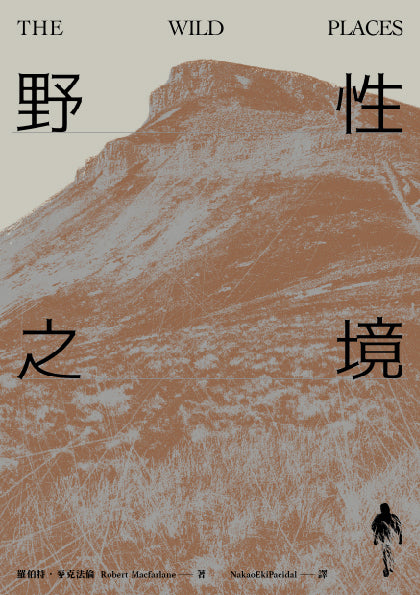


Untamed Domain
Untamed Domain
Couldn't load pickup availability
Weeds push through cracks in the pavement, and tree roots break through asphalt at will.
These, like storms and snowflakes, are signs of wildness.
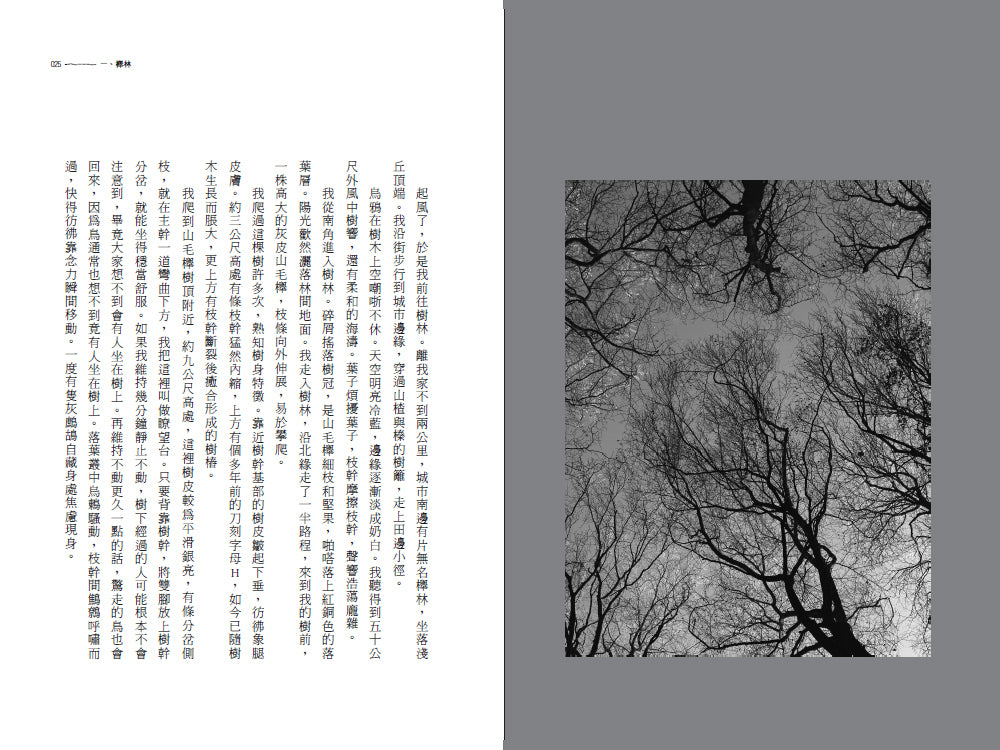
The woodlands on the city's edge, like mountain peaks, can teach us many things.
Most people forget these things as they grow up.
"I've always had this image of wilderness in my mind: somewhere in the far north, cold, vast, remote, pristine, extremely harsh for travelers. For me, going into the wilderness is stepping out of human history."
So the author Macfarlane stepped out of secluded Cambridge to explore the remaining wilderness of the British Isles. He went north, to the treacherous Isle of Eigg, where monks once sought solitude for penance and meditation. There, on the open sea cliffs, they found an external perspective that perfectly matched their inner faith, and while transcribing Latin scriptures, they couldn't help but write in Gaelic: "Today the sun shines on this page's edge, and it makes me glad."
He camped out on the moor, woken at midnight by the rumbling of stones rolling in the water, and saw a herd of deer following an animal trail across the heather moor, wading across the river just a few meters away, their long legs kicking stones in the water. He traveled to a remote limestone valley and found it submerged in water, "dozens of trees and their reflections mirroring each other, like kings on playing cards."
Wilderness appears on remote islands, in highlands, and on cliffs and sea walls. These vertical landforms are just a few narrow contour lines on a flat map, but if we rotate our perspective by 90 degrees, we will find that these places are not only vast but also home to countless creatures. Because they don't appear on maps, we have always overlooked them.
Wilderness appears in narrow grykes; within a few meters of human sight, hundreds of plants thrive under the protection of limestone, as beautiful and complex as all canyons, bays, and peaks, perhaps even more so. They are tiny but wild and untamed.
He gradually realized that "wild" is not just wilderness, a pristine landscape, but also wildness, an enduring attribute of the land. This wildness doesn't need to be sought thousands of miles away; it can be found in the gnarled old tree near home that invites climbing, the silent movement of animals outside the city, the stream flowing freely among rocks, or even just a place reachable by a casual stroll at night—all possess an unbridled wildness.
He decided, "I would make my own maps as I traveled, maps that contradicted the road maps. I would make an essay-map, attempting to re-present some of the last wildness in the British Isles, or to record it before it vanished forever. I hoped this map would not link towns, hotels, and airports, but rather headlands, cliffs, beaches, peaks, torrs, forests, estuaries, and waterfalls."
Step out of the house, whether to distant mountains and capes, or just to the riverside, a park, or even a few streets away to that overgrown, bee-buzzing wasteland, or that old tree with a bird's nest. Centering on your own home, draw your own map of wildness. From this, we can feel that we are living in another world, a world where, if we just stop and look around, we will find wilderness everywhere.