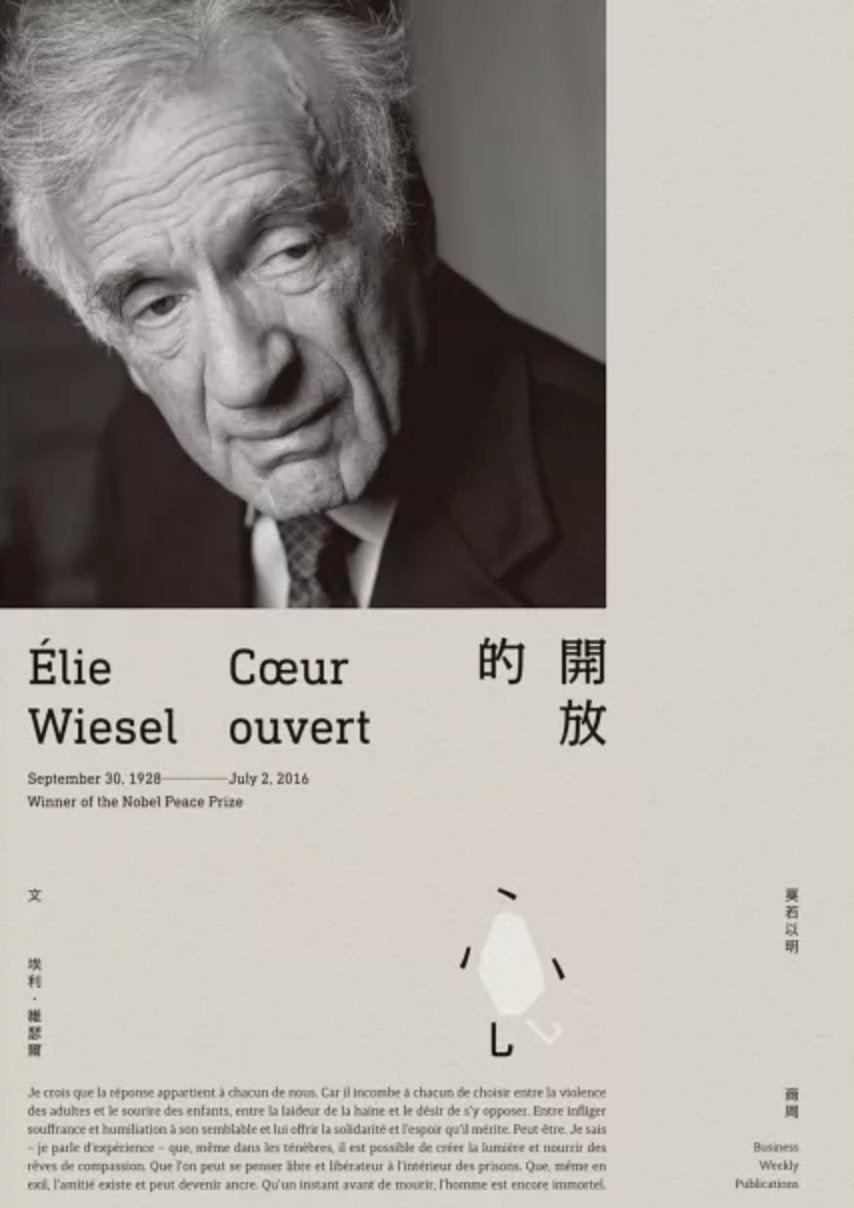

open heart
open heart
Couldn't load pickup availability
◎ Nobel Peace Prize Laureate, Concentration Camp Survivor
Love and Hope Between Life and Death ◎
✽Every day is the last day, every moment is a new beginning✽
A sudden, severe pain in his chest.
It was a matter of life and death, and Elie Wiesel underwent emergency open-heart surgery.
In the operating room, he believed he would fall into ultimate silence.
From life to death, filled with emotions, faces, memories, self-questioning, inquiries to God...
He discovered everything, yet it contained no emptiness.
He gained insights into existence and mission.
A new lease on life.
This Nobel Peace Prize laureate, concentration camp survivor, author of "Night",
a persistent ambassador for universal love and tolerance, a learned Jew,
upon his discharge from the hospital, his sole unwavering belief was in his faith.
He regarded the "open heart" as a metaphor,
and wrote chapters that crossed invisible walls.
In June 2011, Nobel Peace Prize laureate and concentration camp survivor Elie Wiesel was suddenly diagnosed with an acute heart condition, his life hanging by a thread. He hastily bid farewell to his wife and son before being rushed to the operating room for open-heart surgery.
The "open heart" became a metaphor for his beliefs as a human being and a man of faith. He revisited an unspeakable past—his father, who was always by his side in the concentration camp, the image of his sister holding their mother's hand, and the gifts of life brought by his marriage, children, and grandchildren. Had he done enough for writing, teaching, public affairs, for memory and for survivors? He constantly asked God where He would lead him. Was there still hope for humanity?
Through short essays resembling an inner diary, Wiesel wrote about thoughts of hope and despair, explored love, regret, and faith, and conducted a reckoning for himself and his era, completing this profoundly moving work.
Breaking away from the frantic pace of daily life, Wiesel guides our attention to the core of existence. The book is filled with Talmudic wisdom, leading readers to experience what it means to "live each day as if it were the last."
Perhaps the best way to read this book is to read a sentence or two, pause, reflect, and introspect, without too much effort, because every sentence is profoundly impactful.
Elie Wiesel:
● If life is not a celebration, why hold onto it? If life is not a dedication to others, what is there to do in this world?
● Death is not imposed on us to guide us; only life can show the way.
● Am I afraid of death? Haven't I coexisted with death, even lived within it? Why am I now so terrified of death?
● A wise man in the Talmud said, "You must live as if you might die tomorrow." Have I lived according to this advice?
● Whatever the problem, indifference and submission cannot be the answer.
● We cannot accept an Auschwitz with God, nor an Auschwitz without God. How then are we to understand His silence?
● Everyone needs to choose between the violence of adults and the smile of children, between the ugliness of hatred and the desire to oppose hatred.
● We have a responsibility to turn words into instruments of understanding, not vehicles of contempt.
● Every moment is a new beginning, every handshake is a promise, a sign of inner peace.